A stuck-closed thermostat in South Texas heat eliminates the coolant temperature buffer between normal operation and engine head damage. At 104°F ambient, that buffer shrinks to 30°F to 45°F before distortion begins. A $50 part replaced proactively costs 20x to 40x less than the head gasket repair that follows a full overheat event.
How a Thermostat Controls Your Engine’s Heat Window
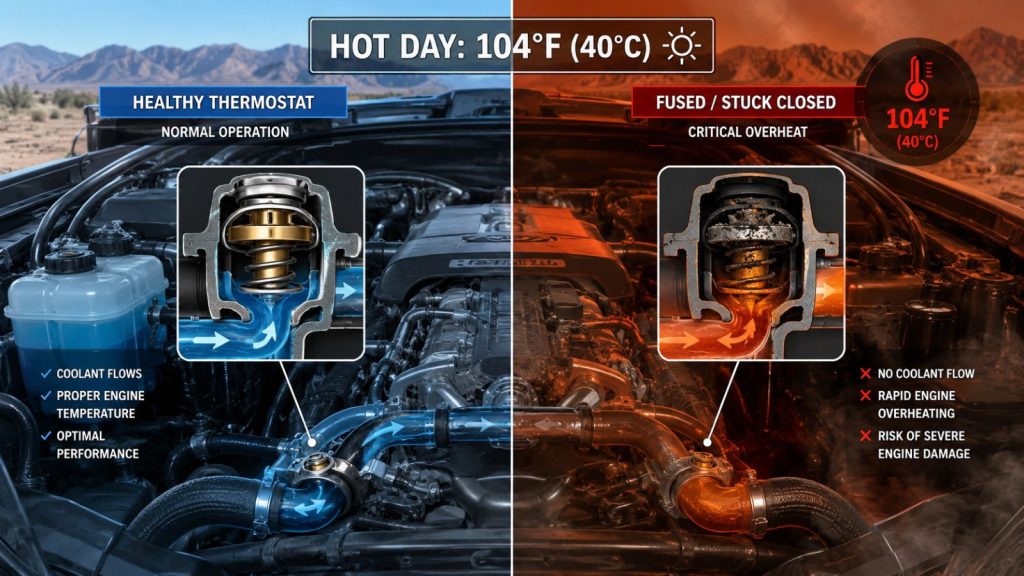
Every engine runs within a defined coolant temperature band. For most late-model vehicles, that band sits between 195°F and 215°F. The thermostat is the gatekeeper that holds coolant in the block until it reaches operating temp, then opens to route it through the radiator.
That opening and closing cycle is mechanical. A wax pellet inside the thermostat expands when it reaches the calibrated threshold, pushing the valve open. When coolant cools below that threshold, the wax contracts and the valve closes again.
The system depends on the wax element responding accurately within a narrow range. An element that opens 10°F late shifts your operating band from 195°F to 215°F up to 205°F to 225°F. In a San Antonio June, that shift matters.
Diagnostic Verdict: On a functioning thermostat, scan tool coolant temp PIDs show a clear stabilization plateau within 5 to 8 minutes of startup at idle, holding between 195°F and 215°F without continuous climb.
What a Stuck-Closed Thermostat Does to Coolant Temperature
A stuck-closed thermostat blocks coolant flow to the radiator entirely. Heat builds inside the block with no path out. Coolant temp climbs without a stabilization point.
On the scan tool, a stuck-closed thermostat produces a continuous upward line. There is no plateau. Coolant that should stabilize at 205°F passes 220°F, then 230°F, then 240°F inside 3 to 5 minutes under normal load.
Aluminum cylinder heads on common San Antonio fleet vehicles, including late-model Toyotas, Hondas, and Ford EcoBoost engines, begin to distort at sustained temps of 250°F to 260°F. Cast iron heads tolerate slightly more, approximately 270°F to 280°F, but neither material recovers dimensionally once the threshold is crossed.
Scan Tool Readings That Confirm a Stuck Thermostat
The diagnostic process starts with a live coolant temp PID pull at startup. A normal thermostat shows a rise to operating temp, a plateau, and minor oscillation as the valve cycles. A stuck-closed thermostat shows a rise with no plateau and no oscillation.
A second confirmation comes from comparing coolant temp at the upper radiator hose to the scan tool reading. On a stuck-closed thermostat, the upper hose stays cold while the block temp climbs. Coolant is not moving through the radiator circuit.
Diagnostic Verdict: A stuck-closed thermostat confirmed by scan tool PID shows continuous coolant temp climb past 230°F with zero upper radiator hose temperature rise, confirming blocked flow before visible gauge movement alerts the driver.
Why South Texas Heat Shrinks the Safety Margin to Near Zero
Most service manuals do not specify a thermostat replacement interval. The part is treated as replace-on-failure. In temperate climates, that guidance is adequate.
In San Antonio, it is not. OEM thermostat specs are written for average operating environments. At 102°F to 108°F ambient, the wax element inside the thermostat cycles through its operating range more aggressively every time the engine runs.
We measure coolant temp plateaus at 218°F to 222°F on thermostats with two or more Bexar County summers behind them. That reading is already 13°F to 17°F above the OEM design midpoint. The thermostat has not failed any binary test, but the buffer between its actual operating point and the distortion threshold has already narrowed by one-third. The OEM replace-on-failure model does not account for South Texas heat cycling degradation on that timeline.
At 104°F ambient, the delta between normal operating temp and the head distortion threshold is 30°F to 45°F on a healthy thermostat. A two-summer thermostat running at 220°F reduces that delta to 30°F to 40°F before the day’s first errand is done.
Diagnostic Verdict: Thermostats showing plateau temps of 218°F to 222°F on scan tool PIDs after two South Texas summers should be treated as proactive replacement candidates, not pass/fail results.
The Real Cost Gap Between a $50 Part and an Engine Head Repair
The thermostat itself costs $45 to $85 in parts on most vehicles. Labor for replacement runs $90 to $150 at Ruben’s current rate. Total proactive replacement: $135 to $235.
A head gasket failure with machine shop resurfacing runs $1,400 to $3,200 depending on the vehicle. That figure does not include coolant flush, radiator inspection, or any secondary damage to sensors or hoses exposed to sustained high temps.
In vehicles we service from the Alamo Farmsteads and surrounding 78238 neighborhoods, we consistently find thermostats that test within spec on a cold bench pull but fail under actual South Texas load conditions. Short-trip driving patterns here mean the thermostat cycles through its opening range 8 to 12 times during a single morning of errands. That repetition accelerates wax element fatigue on a timeline a single bench test does not reveal.
The math is direct. A proactive thermostat replacement costs 20x to 40x less than the repair that follows a confirmed overheat event. The part that prevented the damage is never the part the driver remembers paying for.
Diagnostic Verdict: On vehicles with two or more summers of Bexar County service history and a documented plateau shift to 218°F to 222°F, proactive thermostat replacement at $135 to $235 is confirmed as the lower-cost intervention against a $1,400 to $3,200 head gasket repair outcome.
What Ruben’s Checks When a Customer Reports a Rising Temp Gauge
A rising temp gauge complaint starts with a live scan tool pull, not a visual inspection. Coolant level, hose condition, and radiator cap pressure all matter, but none of them confirm thermostat function. Only a real-time PID trace does.
The pattern we see most often in June and July diagnostic pulls is a thermostat that appears functional at initial idle but shows a continuous temp climb once load increases. After two or more San Antonio summers, the wax element stiffens. It opens late and recovers slowly. The first time a driver sits in post-event exit traffic on Hwy 151 near SeaWorld with the AC running at full load, the margin runs out.
The AC compressor adds 15% to 22% additional thermal load on the engine cooling circuit. A vehicle idling on Hwy 151 in June with AC active and a marginal thermostat is carrying simultaneous HVAC thermal load and combustion thermal load with no airflow assist from forward motion. Coolant temps that hold at 215°F on a moving vehicle climb to 228°F to 235°F at a dead stop under that combined load.
When the Thermostat Passes the Initial Check
Some thermostats pass the initial idle PID check and still fail under load. The second diagnostic step is a test drive with live scan tool monitoring under the actual load conditions the driver described.
If the PID trace shows a plateau that holds at idle but climbs continuously once the vehicle enters stop-and-go on Loop 410 or Hwy 151, the thermostat is the primary suspect. A secondary check of the water pump drive and coolant flow rate rules out pump cavitation as a contributing factor.
Full cooling system evaluation details are covered in Ruben’s heating and cooling services, including thermostat diagnostics, coolant flush, and pressure testing.
Diagnostic Verdict: A thermostat that holds a 205°F to 210°F plateau at idle but climbs continuously past 228°F under stop-and-go load on a live scan tool trace is confirmed as a functional failure under South Texas real-world conditions, even if it passes a static bench test.
Drivers can have their cooling system and thermostat function validated at Ruben’s Auto Repair, 7210 Polar Bear, San Antonio, TX 78238, before June heat turns a diagnostic appointment into an engine repair, or they can submit an online contact form.
Frequently Asked Questions
Can a bad thermostat warp an engine head in under 5 minutes?
Yes, aluminum heads distort at 250°F to 260°F, a temperature a stuck-closed thermostat reaches within 3 to 5 minutes under normal load in San Antonio summer heat.
What does a normal thermostat look like on a scan tool?
Yes, a functioning thermostat shows a coolant temp plateau between 195°F and 215°F within 5 to 8 minutes of startup with no continuous climb.
Is a thermostat replacement worth doing before it fails completely?
Yes, proactive replacement at $135 to $235 prevents head gasket repair costs of $1,400 to $3,200 when a marginal thermostat fails under South Texas heat load.
Does San Antonio heat affect how long a thermostat lasts?
Yes, Bexar County heat cycling degrades the wax element faster, shifting plateau temps to 218°F to 222°F after two summers and narrowing the safety margin significantly.
Should I be worried if my temp gauge rises and then drops back down?
Yes, intermittent temp spikes followed by recovery often indicate a thermostat opening late, a pattern confirmed by live scan tool PID traces showing delayed plateau formation.