
Annual coolant flush service in the San Antonio market typically costs between 120 and 220 dollars, while radiator replacement runs 650 to 1,400 dollars and head gasket repair climbs to 3,500. Texas summer ambient temperatures above 102°F accelerate coolant pH degradation, making shorter flush intervals than the owner’s manual recommends a documented financial decision for Helotes drivers.
The financial math on cooling system maintenance is rarely close. A coolant flush completed before the corrosion inhibitor package depletes costs a fraction of the radiator, water pump, heater core, or head gasket replacement that follows when the chemistry fails. For Helotes commuters running daily routes on Hwy 1604, I-10, and through Northwest Side traffic, the question is not whether the flush is worth it — it is whether the owner’s manual interval is short enough for Texas conditions. We have measured coolant pH on intake vehicles across the service area and found that the answer is consistently no.
What a Coolant Flush Removes from the System
A coolant flush is not a coolant change. The flush procedure circulates a cleaning solution through the radiator, engine block, heater core, water pump, and connecting hoses to remove scale, suspended particulate, and degraded inhibitor byproducts before fresh coolant is installed. A simple drain-and-fill leaves between 30 and 50 percent of the old contaminated coolant in the engine block and heater core where the radiator drain cannot reach.
The contamination that builds up in a neglected cooling system is not just discolored fluid. It is mineral scale from years of top-offs, suspended aluminum oxide from acidic corrosion of radiator end tanks, and silicate dropout that settles at the bottom of the radiator core where it restricts flow. A correctly executed flush removes these deposits and resets the system to a clean baseline ready to accept fresh coolant at full inhibitor strength.
Diagnostic Verdict: Visual inspection of drained coolant from a Helotes intake vehicle at 67,000 miles showed a brown-black fluid with visible particulate suspension, confirming that the residual contamination would have remained in the engine block under a simple drain-and-fill service.
The True Cost of a Radiator Replacement in San Antonio
Radiator replacement on common passenger vehicles in the San Antonio market typically runs between 650 and 1,400 dollars combined parts and labor, depending on whether the vehicle uses a plastic-tank aluminum core or a full aluminum performance core. Hybrid and turbocharged vehicles frequently exceed 1,800 dollars because they carry dual radiator configurations and require specific manufacturer coolant.
The repair scope is rarely limited to the radiator alone. A radiator that fails from acidic corrosion has typically been operating against the same chemistry that attacked the water pump impeller, the heater core fins, and the head gasket sealing surface. Replacing the radiator without diagnosing the upstream coolant condition often produces a second failure within 12 to 18 months because the new component is exposed to the same degraded fluid.
Diagnostic Verdict: Teardown inspection of a radiator pulled from a vehicle at 84,000 miles revealed pinhole perforation at the plastic-to-aluminum end tank seam consistent with prolonged exposure to coolant measuring at a pH of 7.8.
The True Cost of an Annual Coolant Flush
A complete cooling system flush with new manufacturer-spec coolant typically runs between 120 and 220 dollars at independent shops in the San Antonio market, depending on system capacity (typically 8 to 14 quarts) and coolant type. OAT and HOAT formulations command higher coolant material costs than conventional green coolant, but they extend service life and protect modern aluminum components better.
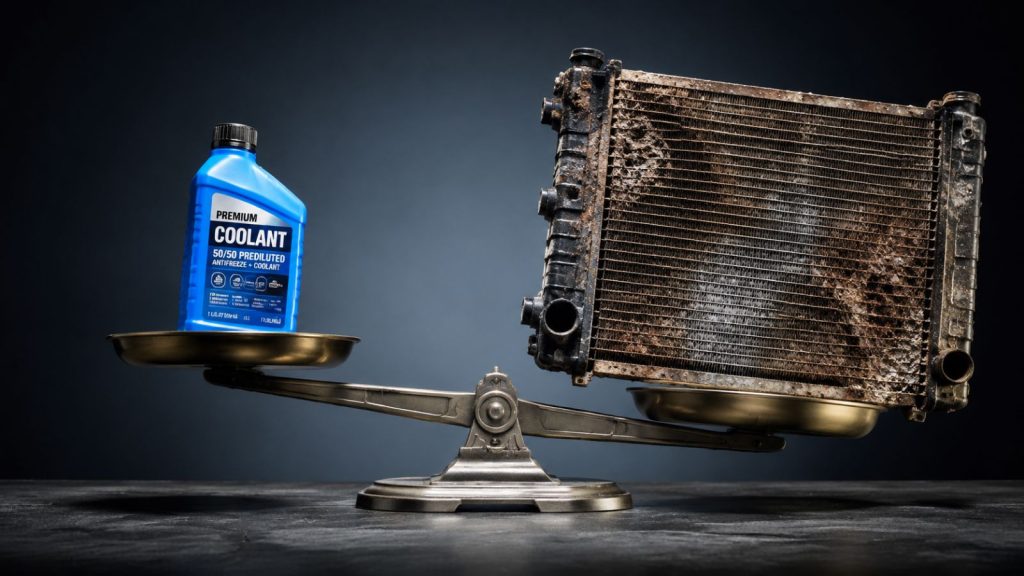
The labor side of the service is straightforward — drain, flush, refill, bleed, pressure test. The math on annual flush service versus reactive radiator replacement is clear at a glance: roughly 150 dollars in preventive service per year against 1,000-plus dollars in reactive repair when the system fails. Across a ten-year ownership horizon, the prevention path costs approximately 1,500 dollars; the failure path costs approximately the same just for one event, before counting the cascade of related failures.
Diagnostic Verdict: Post-flush coolant testing on a recently serviced vehicle confirmed a fresh coolant pH reading of 10.2 with full glycol concentration verified by refractometer, restoring the system to factory chemistry baseline.
How Texas Heat Accelerates Coolant Degradation in Helotes Vehicles
Manufacturer recommended flush intervals — typically 60,000 to 100,000 miles for OAT coolants — are based on average North American thermal cycling. Sustained operation in 102°F to 108°F summer ambients accelerates the chemical depletion of the corrosion inhibitor package because reaction rates roughly double for every 18°F increase in operating temperature.
A Helotes commuter driving the I-10 grade between Boerne and Comfort exposes the cooling system to coolant temperatures between 215°F and 230°F for 20 to 40 minutes at a time during summer months. The Hwy 1604 northwest stop-and-go in summer afternoon traffic, combined with sustained AC compressor load, pushes the radiator into worst-case heat soak with no ram-air cooling. Across the service area, we have observed Helotes and Northwest Side vehicles reach coolant pH degradation into the 7.5 to 8.5 range at approximately 40,000 to 70,000 miles — well ahead of the owner’s manual interval.
Diagnostic Verdict: pH strip testing on a Hwy 1604 commuter vehicle at 52,000 miles showed a coolant reading of 7.9, confirming significant inhibitor package depletion well before the manufacturer’s stated 80,000-mile flush interval.
When Flush Intervals Should Be Shorter Than the Owner’s Manual Recommends
For Helotes and Northwest Side commuter vehicles, the practical recommendation based on observed pH degradation is to test coolant condition annually starting around 30,000 miles and to flush whenever pH drops below 9.0 or visible discoloration appears. For drivers who regularly cover the I-10 Hill Country grade or carry heavy AC compressor load through summer commutes, annual flush service starting at 40,000 miles is reasonable insurance against the cost cascade documented above.
The interval shortening is not about selling more service. It is about matching the manufacturer’s chemistry assumptions to the actual thermal cycling the vehicle experiences. A coolant specification developed against North American averages does not account for Texas Hill Country grades, sustained 105°F+ ambient, or Edwards Aquifer mineral content that arrives in any top-off performed with tap water.
Diagnostic Verdict: Comparative pH testing across a sample of Helotes intake vehicles showed that those with documented annual flush service maintained pH above 9.5 through 90,000 miles, while those following only the owner’s manual interval averaged 7.8 by the same mileage.
Why a Blown Head Gasket Multiplies the Repair Bill
When coolant pH drops into the acidic range, the chemistry begins attacking the head gasket sealing surfaces — both the gasket itself and the aluminum or cast iron deck surface it seals against. The failure mode is progressive: small breaches allow coolant to seep into combustion chambers or oil passages, the engine runs progressively hotter as coolant volume drops, and eventually a full gasket failure occurs.
Head gasket replacement in the San Antonio market typically runs between 1,800 and 3,500 dollars and frequently requires cylinder head removal, machine shop inspection of the deck surface for warpage, and reassembly with new fasteners and gaskets. Engines that ran hot enough to blow a head gasket usually also require radiator replacement at the same time, pushing the combined bill past 4,000 dollars. The same condition is preventable through annual professional coolant flush service at roughly five percent of the failure-event cost.
Diagnostic Verdict: Cylinder head removal from a vehicle presenting with white exhaust smoke revealed coolant tracking across the gasket sealing surface consistent with prolonged acidic attack, confirming pH degradation as the root cause of the failure.
What Professional Cooling Service Includes That DIY Top-Off Misses
DIY coolant top-off addresses a low-level symptom without diagnosing the underlying chemistry. Adding tap water — common in San Antonio because the Edwards Aquifer mineral content makes the water available and convenient — introduces calcium and magnesium ions that accelerate scale formation inside the radiator core and heater core. Adding off-spec coolant (mixing OAT with