Hybrid battery liquid cooling loop failures occur when specialized glycol degrades or pump flow rates drop below 15 L/min during San Antonio heat cycles. When internal battery temperatures reach 125°F to 130°F, the system triggers safety faults that can disable the high-voltage (HV) system. Validating thermal management integrity is essential for preventing permanent cell damage in South Texas.
Lackland AFB Heat and P0A93 Overheating Fault Pathways
The high-traffic corridors of Hwy 90 and the entrance gates at Lackland AFB present a significant thermal challenge for hybrid vehicles. During prolonged idling in 102°F radiant heat, the lack of ram-air cooling puts the entire burden of thermal rejection on the dedicated liquid cooling loop. If the inverter or battery cooling pump is weakened, the system cannot dissipate the heat generated by the DC-to-DC conversion process. This often results in the P0A93 Diagnostic Trouble Code (DTC), which signals an inverter cooling system malfunction and can force the vehicle into a “limp mode” or total HV shutdown to protect the electronics.
Diagnostic Verdict: Scan tool analysis during a Hwy 90 test drive confirmed the inverter temperature spiked to 142°F while the pump flow was restricted, triggering a P0A93 fault.
Glycol Conductivity and Specialized Hybrid Cooling Services
Unlike standard engine coolant, the fluid used in hybrid battery liquid cooling loops must maintain low electrical conductivity to prevent high-voltage isolation faults. Over time, San Antonio’s extreme temperature swings cause the glycol to break down, increasing its ion content and conductivity. Specialized Heating and Cooling Services are required to flush and replace this fluid with the correct OEM-spec non-conductive coolant. Failure to maintain the chemical integrity of the loop can lead to “check hybrid system” warnings even if the mechanical hardware appears functional.
Diagnostic Verdict: A conductivity test of the battery coolant revealed a reading above 100 μS/cm, indicating the fluid had lost its dielectric properties and required a full system exchange.
Measuring HV Battery Module Temperature Deltas for Performance Loss
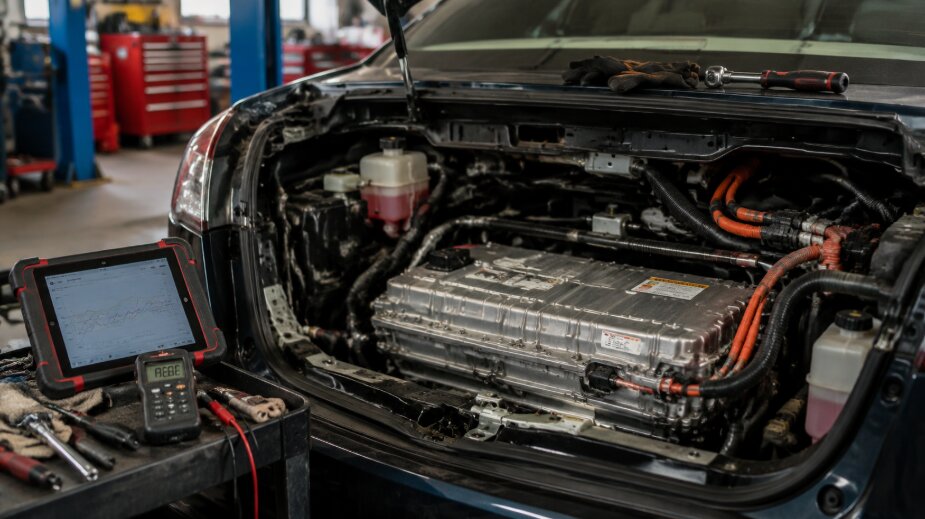
We monitor the health of the HV battery by measuring the temperature delta between the internal modules. In a high-functioning system, the modules should remain within 3°F to 5°F of each other. In hybrids experiencing cooling loop degradation, we frequently observe deltas of 10°F to 15°F. These “hot spots” cause uneven internal resistance across the battery pack, which leads to reduced fuel economy and a significant drop in acceleration as the battery management system (BMS) limits power output to prevent a thermal runaway event.
Diagnostic Verdict: Live data logging showed Module 1 at 108°F and Module 14 at 122°F, confirming a 14°F delta caused by a blockage in the battery’s internal cooling plates.
Pinpointing Depressed PWM Signals and Reduced Pump Flow Rates
The cooling fans and pumps in a hybrid system are controlled by Pulse-Width Modulation (PWM) signals from the BMS. As battery temperatures rise, the fan duty cycle should ramp linearly from 20% to 100%. We often find that debris—ranging from road grit to accumulated pet hair in the intake vents—forces the fans to work harder, yet we observe PWM signals stuck at lower percentages due to control circuit resistance. Furthermore, the hybrid cooling pump must maintain a flow rate of 15 to 20 L/min; any drop below this threshold allows the coolant to “heat soak” before it reaches the radiator.
Diagnostic Verdict: Oscilloscope testing revealed a depressed PWM signal of only 25% despite module temperatures exceeding 115°F, identifying a failing fan control module.
Preventing Permanent Cell Damage with Thermal Management Diagnostics
Sustained exposure to high temperatures is the primary cause of premature hybrid battery failure in San Antonio. Once the battery modules are subjected to repeated 130°F+ cycles, the internal chemistry begins to break down, leading to a permanent loss of capacity. Professional thermal management diagnostics ensure that the liquid cooling loop, the electric pumps, and the airflow ducting are all operating within factory specifications. This proactive approach prevents the $3,000 to $5,000 cost of a full battery pack replacement by keeping the cells within their optimal operating window.
Diagnostic Verdict: Teardown and physical inspection of the battery cooling ducting revealed a 40% restriction from dust and debris, which had been driving the internal cell temperatures toward the failure threshold.
Drivers can have their HV battery cooling loops validated at Ruben’s Auto Repair, 7210 Polar Bear, San Antonio, TX 78238, before the peak summer heat sets in.
Frequently Asked Questions
Does San Antonio heat cause hybrid batteries to fail faster?
Yes, ambient temperatures over 100°F combined with stop-and-go traffic can drive internal battery temperatures above the 130°F safety limit.
What does a P0A93 code mean on my hybrid?
Yes, the P0A93 code specifically indicates that the inverter cooling system is not operating correctly, often due to a failed water pump.
How often should hybrid battery coolant be changed?
Yes, specialized non-conductive glycol should typically be tested every 30,000 miles to ensure it hasn’t become electrically conductive or chemically degraded.
Can a dirty cooling fan cause my hybrid system to shut down?
Yes, restricted airflow to the battery pack can cause module temperature deltas to exceed 10°F, triggering a protective system shutdown.
Will my gas mileage drop if my battery cooling system is weak?
Yes, as battery temperatures rise, the car relies less on electric power and more on the gas engine, significantly reducing overall MPG.