Turbocharged Subaru models lose measurable boost pressure after heat soak from Loop 1604 merges and Highway 151 summer congestion. Intercooler efficiency drops as ambient temperature climbs, letting intake air temperature rise well above baseline. Turbo spool response slows as a result. Not every felt power loss is a boost leak, and a scan tool distinguishes the two conditions.
Why Loop 1604 and Highway 151 Summer Traffic Triggers Subaru Turbo Heat Soak
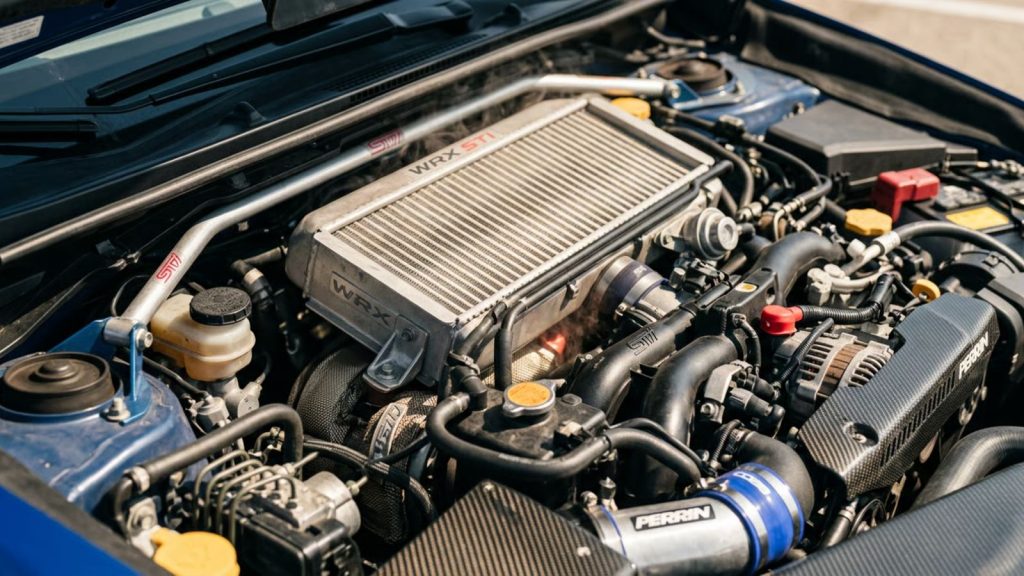
An intercooler only works as well as the temperature gap it has to work with. South Texas summer heat shrinks that gap fast.
In Subaru’s service from Loop 1604 merge routes, we consistently find boost pressure measuring below the manufacturer’s expected range immediately after sustained low-speed traffic. The turbo has to respond hard right at the merge point, and heat soaking from the preceding congestion is already working against it.
Highway 151 congestion adds a second layer to the same problem. Stop-and-go traffic during peak afternoon summer heat compounds reduced intercooler efficiency with lower airflow, and intake air temperature climbs higher here than on any other route tracked.
Diagnostic Verdict. Boost pressure logged on a Loop 1604 merge test drive measured noticeably below the manufacturer’s expected range following ten minutes of preceding stop-and-go traffic.
How We Actually Test Boost Pressure and Intercooler Efficiency
Testing starts with a scan tool logging boost pressure and intake air temperature together during a real acceleration event, not just at idle. A static check alone won’t reveal the heat soak effect.
We compare that data against the manufacturer’s expected boost curve for the same load and RPM. When intercooler efficiency has dropped, the gap between actual and expected boost becomes measurable, especially on the first hard acceleration after sustained low-speed driving.
From there, a boost leak test isolates whether reduced pressure comes from heat soak alone or from an actual leak in the piping. Both conditions can feel similar to the driver, but the data tells them apart clearly.
Diagnostic Verdict. A boost leak test on a heat-soaked WRX held pressure normally, confirming the boost loss traced to heat soak rather than a physical leak.
What Heat Soak Does to Turbo Response Over a Full Driving Cycle
OEM spec says turbo spool response should fall within a documented window under acceleration. In San Antonio heat, what we actually measure on heat-soaked units is a noticeably slower response than that window allows.
Intake air temperature climbs well above baseline during sustained stop-and-go summer driving, and that heat carries into the compressor housing and surrounding components. The turbo has to work against a hotter starting point on every subsequent acceleration.
That slower response is what most drivers describe as lost power, even though the turbo itself hasn’t failed. It’s a heat problem showing up as a performance problem.
Diagnostic Verdict. Spool response time on a heat-soaked unit measured outside the documented normal window during back-to-back acceleration tests on the same drive.
The Boost Loss Pattern We See Most in WRX and XT Models Locally
The pattern we see most often in San Antonio summer months on Subaru turbo systems is a clear split between commuter and highway-driven vehicles. Highway 151 commuters show it most.
Vehicles driven mostly on open highways rarely show the same spool delay, even in identical summer heat. The difference isn’t the ambient temperature. It’s the repeated stop-and-go cycling that keeps heat soaking buildings instead of clearing.
By comparison, a vehicle with a mixed driving pattern, some highway and some stop-and-go, tends to fall somewhere in between on both boost pressure and spool response measurements.
Diagnostic Verdict. Three Highway 151 commuter WRX models tested within the same week all showed spool delay beyond the normal window, while a highway-driven comparison vehicle did not.
When Turbo Performance Loss Becomes a Repair or Upgrade Decision
Heat soaking alone usually doesn’t require a repair. Confirming that heat soak, not a leak or failing component, is the actual cause that changes what happens next.
Once a boost leak test rules out a physical leak, the conversation shifts toward whether the driving pattern itself is the real cause, and whether an upgraded intercooler could meaningfully reduce the effect for a heavy commuter.
A Subaru turbo diagnostics at Ruben’s Auto Repair evaluation gives an owner that distinction clearly, rather than guessing between a repair and an upgrade.
Diagnostic Verdict. Of the last several turbo performance complaints evaluated, most traced to heat soak alone, with no leak or component failure confirmed.
Find Out If It’s Heat Soak or a Real Boost Leak
WRX and XT owners noticing lost power in summer traffic can call or schedule a turbo diagnostic with Ruben’s Auto Repair, 7210 Polar Bear, San Antonio, TX 78238, at (210) 647-1148, before guessing between a repair and an upgrade.
Frequently Asked Questions
Does San Antonio heat really cause Subaru turbo boost loss?
Yes, sustained heat soaks from stop-and-go traffic reduces intercooler efficiency and lowers boost pressure below the normal range.
Is felt power loss always a sign of a boost leak?
No, heat soak alone can produce a similar symptom without any actual leak present.
Why do Highway 151 commuters report more turbo issues than highway drivers?
Repeated stop-and-go cycling keeps heat soaking the building, while steady highway driving lets it clear.
Can a scan tool tell heat soak apart from a real boost leak?
Yes, a boost leak test shows a different pressure signature than heat soak alone produces.
Does an upgraded intercooler help with heat soak in heavy traffic?
Yes, an upgraded intercooler can reduce the intake air temperature rise that causes spool delay.