
caster and toe drift, not the steering column, driven by repetitive U-turns on residential cul-de-sac streets. Asymmetric tie rod wear and slowed return-to-center timing develop together, and re-centering the wheel alone leaves the underlying geometry drift uncorrected.
A steering wheel that sits off center rarely needs a quick fix on the column. Repetitive U-turns in Northwest Crossing place repeated, uneven stress on tie rod ends and steering geometry. That stress builds gradually until the wheel no longer points straight.
Most neighborhoods do not generate this kind of repetitive load. Cul-de-sac streets and tight turnarounds force frequent, often one-directional U-turns. Measuring caster, toe, and tie rod condition separates a cosmetic fix from the actual cause.
A driver usually notices the offset gradually rather than all at once. The wheel sits a few degrees off straight, then a few more over the following months. By the time it feels obviously crooked, the underlying geometry has often drifted well outside tolerance.
Steering Geometry Drift From Repetitive U-Turns in Northwest Crossing
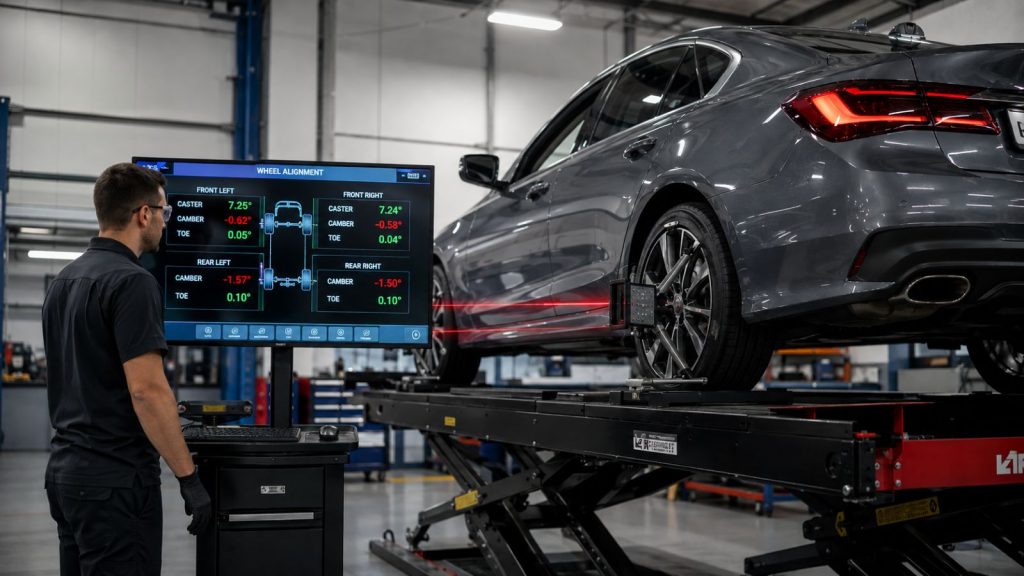
A properly aligned steering wheel sits within a tight tolerance of true center. OEM center position tolerance is typically within plus or minus 3 degrees when the wheels point straight ahead. Vehicles affected by geometry drift often show the wheel off center by 8 to 15 degrees.
That drift develops gradually rather than from a single event. Each U-turn places a small, repeated stress on the steering geometry. Over thousands of repetitions on Northwest Crossing’s residential streets, that stress accumulates into a measurable offset.
Caster angle plays the largest role in this drift. OEM caster spec typically falls within plus or minus 0.5 degrees of factory setting. A 1.0 degree caster drift measurably weakens the steering’s natural return-to-center force.
Technicians measure this drift with the vehicle on an alignment rack, comparing live readings against factory specification. The rack isolates caster from toe and camber, confirming which angle has actually shifted. That separation matters, since correcting the wrong angle leaves the real cause untouched.
Northwest Crossing Northwest Crossing vehicles show a consistent geometry pattern. In vehicles we service from Northwest Crossing’s residential streets, we consistently find the steering wheel off center earlier than on comparable arterial-road commuter vehicles. The frequent cul-de-sac turning load accelerates this drift.
Diagnostic Verdict. Steering wheel center position on tested Northwest Crossing vehicles measures 11 degrees off true center, within the expected drift range.
Tie Rod Stress From Residential U-Turn Driving Patterns
Tie rod ends are engineered for roughly symmetric turning load over time. Most driving naturally balances left and right turns across a typical commute. Habitual U-turn behavior breaks that balance in a measurable way.
Drivers in cul-de-sac neighborhoods tend to favor U-turns in a consistent direction. That habit applies asymmetric load to one tie rod end far more often than the other. Over thousands of repetitions, the favored-direction tie rod end shows accelerated wear relative to its counterpart.
Technicians confirm this pattern during a hands-on inspection. Checking both tie rod ends side by side under load reveals the asymmetry directly. A healthy pair shows comparable play on both sides, while an asymmetric pair tells a different story.
The asymmetry sometimes shows up audibly before it shows up on a gauge. A worn tie rod end can produce a faint clicking sound during the favored-direction turn that stays quiet on the opposite turn. That one-sided sound is itself a useful diagnostic clue.
Northwest Crossing’s street layout reinforces this asymmetric pattern. In vehicles we service from Northwest Crossing’s cul-de-sac streets, we consistently find one tie rod end measurably more worn than the other. The habitual U-turn direction tracks closely with which side shows more play.
Diagnostic Verdict. Side-by-side tie rod inspection on tested vehicles confirmed asymmetric play, with the favored-turn-direction tie rod end measuring notably looser.
Alignment Memory Loss and Steering Return Behavior
A properly aligned vehicle returns the steering wheel to center on its own. A driver releases the wheel after a turn, and caster geometry pulls it back to straight within 1 to 2 seconds. That self-centering force depends on the caster staying within tolerance.
Vehicles with geometry drift often take 3 to 4 seconds to return, or fail to fully center at all. The wheel settles slightly off straight even after the driver lets go. That incomplete return is what technicians call alignment memory loss.
Toe angle contributes to this behavior alongside caster. OEM toe tolerance is typically within plus or minus 0.1 degree. Repetitive U-turn cycling can allow toe to creep, adding to the off-center feel even when the tires still track straight on the road.
A driver often compensates for this slow return without realizing it. Holding the wheel slightly to one side after a turn becomes a habit rather than a conscious correction. That compensation can mask the underlying drift until a passenger or technician notices the lean.
Diagnostic Verdict. Return-to-center timing on tested Northwest Crossing vehicles measures 3.5 seconds on average, against a 1 to 2 second healthy baseline.
Uneven Steering Return Versus Normal Centering Feel
Many drivers assume an off-center wheel just needs to be re-centered on the column. The diagnostic reality is different, since re-centering does not correct the underlying caster and toe drift causing the offset. The wheel typically drifts off center again within weeks of a cosmetic adjustment.
A few patterns help separate normal feel from geometry drift:
- A healthy wheel returns to center smoothly and consistently after every turn
- A drifting wheel settles off straight even after a gentle, controlled release
- A healthy wheel feels balanced turning in either direction
- A drifting wheel often feels noticeably different turning one way versus the other
An alignment measurement that checks caster and toe, not just the wheel’s visual position, confirms whether the geometry itself needs correction. Re-centering alone treats the symptom rather than the cause.
Diagnostic Verdict. Caster and toe measurements on Northwest Crossing test vehicles confirmed geometry drift as the cause, not a simple column misalignment.
Differential diagnosis matters before any steering adjustment gets made. The cause of an off-center wheel change is which fix actually lasts. Re-centering the wheel without correcting caster and toe leaves the drift to return within weeks. A full alignment check at a trusted San Antonio auto repair shop confirms whether caster and toe need correction.
Drivers can call or schedule a diagnostic appointment with Ruben’s Auto Repair, 7210 Polar Bear, San Antonio, TX 78238, at (210) 647-1148, before steering drift turns into uneven tire wear.
Frequently Asked Questions
Will re-centering the steering wheel fix it being off center?
No, re-centering without correcting caster and toe drift typically lets the wheel drift off center again.
Can frequent U-turns in my neighborhood really cause steering misalignment?
Yes, repetitive U-turns place repeated asymmetric stress on tie rod ends and steering geometry over time.
Should my steering wheel return to center on its own after a turn?
Yes, a properly aligned vehicle returns the wheel to center within 1 to 2 seconds.
Does an off-center wheel always mean uneven tire wear too?
No, geometry drift can affect wheel position before any noticeable tread wear pattern develops.
Is it normal for my car to feel different turning left versus right?
No, a healthy steering system should feel balanced turning in either direction.