
Uneven tire wear on Leon Valley roads commonly traces back to suspension bushing failure, not alignment alone, with stop-and-go cycling and pothole impacts compressing bushing material past its elastic recovery range. Camber and toe drift gradually as bushings degrade, producing tread patterns that return even after a fresh alignment.
Uneven tire wear in Leon Valley rarely starts with the tires themselves. Suspension bushing failure quietly shifts camber and toe long before a driver notices the tread pattern. Catching it early prevents a repeat trip back for the same alignment problem.
A fresh alignment fixes the angles for the moment. It does not fix bushings that have already lost their elastic recovery. Measuring bushing play first confirms which repair actually lasts.
Leon Valley’s mix of residential streets, feeder roads, and aging pavement creates a specific wear environment. Stop-and-go cycling, pothole impacts, and gradual surface settling all load suspension bushings differently than a smooth highway commute. Separating these causes takes measured data, not a quick glance at the tread.
Suspension Bushing Degradation From Leon Valley Stop and Go Driving
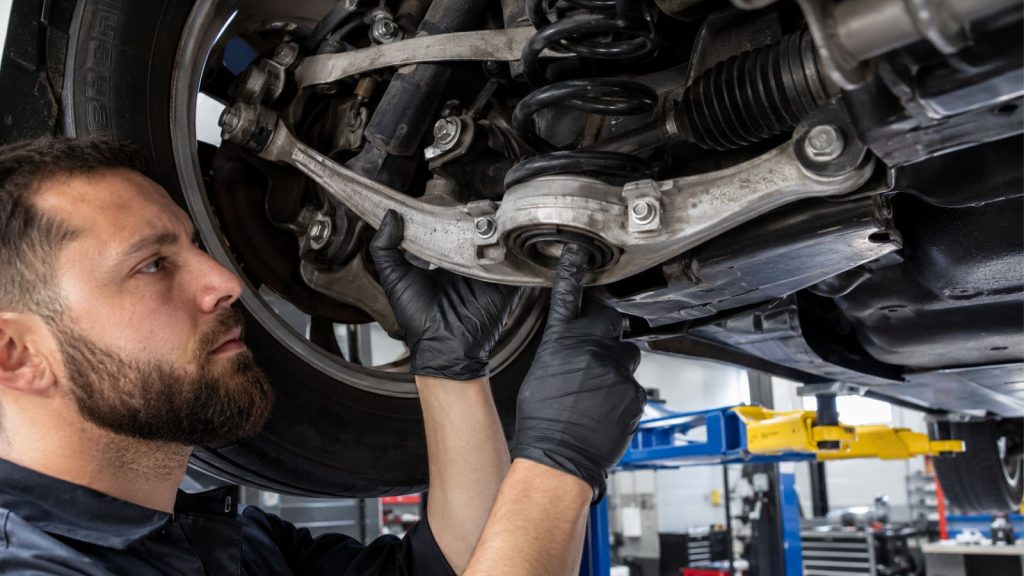
Control arm bushings absorb load every time a vehicle starts or stops. New bushings show 0 to 0.5 mm of play under load. Bushings past 1.5 mm of play are considered functionally failed.
Leon Valley’s residential streets create constant stop-and-go cycling. Each acceleration and brake event flexes the bushing rubber in a new direction. Over thousands of cycles, that flexing breaks down the material’s ability to spring back.
Technicians check this play with the vehicle on a lift, applying load by hand while watching the bushing for movement. A healthy bushing barely shifts under that test. A failed bushing shows visible play, sometimes with a faint creak as the rubber separates from the metal sleeve.
Leon Valley vehicles show a consistent drift pattern. In vehicles we service from Leon Valley’s residential streets, we consistently find camber and toe drift tied to bushing play. The alignment numbers move again within months of a fresh alignment.
Diagnostic Verdict. Bushing play measurements on Leon Valley commuter vehicles average 1.6 to 2.0 mm, well past the 1.5 mm failure threshold.
Pothole Impact Loading and Accelerated Bushing Wear
Potholes deliver a sudden, concentrated load to one corner of the vehicle. A pothole impact at 30 to 35 mph can generate momentary loads several times the vehicle’s static weight. That spike compresses the bushing material far beyond normal driving load.
Rubber bushings have a limited elastic recovery range. Repeated pothole impacts push that material past its recovery point over time. Once that happens, the bushing stays slightly deformed even under normal load.
The damage rarely announces itself with a single dramatic event. Each pothole hit compresses the rubber a little further than the last. By the time a driver notices vibration or pulling, dozens of smaller impacts have already done the underlying damage.
Pothole exposure varies by specific Leon Valley route. In vehicles we service from Leon Valley’s pothole-prone feeder roads, we consistently find faster bushing compression than average. The deformation shows up as play well before typical mileage intervals.
Diagnostic Verdict. Bushings from Leon Valley’s pothole-heavy routes show measurable play 15,000 to 20,000 miles earlier than bushings from smoother routes.
Alignment Shift From Suburban Road Surface Inconsistencies
Camber and toe both depend on the bushing position holding steady. OEM camber spec typically falls within plus or minus 0.5 degrees. Degraded bushings can let camber drift 1.0 to 1.5 degrees out of spec.
Toe angle reacts the same way under load. OEM toe tolerance is typically within plus or minus 0.1 degree. Repeated stop-and-go cycling on worn bushings allows the toe to creep well past that tolerance.
Technicians feel the drift before a gauge confirms it. A vehicle with toe creep tends to wander slightly on a straight stretch. That subtle wander often shows up first on Leon Valley’s longer feeder road stretches.
The drift develops gradually rather than all at once. A driver compensates without realizing it, making small steering corrections that become second nature. By the time the wander feels obvious, the tread wear has often already set in.
Diagnostic Verdict. Alignment readings on affected vehicles show camber drifting 1.1 to 1.4 degrees and toe creeping past 0.1 degree tolerance.
Uneven Tread Wear Patterns Linked to Bushing Failure
Bushing-driven misalignment produces a specific tread signature. A healthy tire wears within 1/32 inch variance across its width. Tires affected by bushing wear often show 3/32 inch or more variance between edges.
Drivers can spot the pattern without a gauge:
- A feathered edge on one side of the tread
- Faster wear on the inner edge than the outer edge
- A new alignment that seems to wear off again within weeks
Many drivers assume uneven tread wear means they simply need an alignment. The diagnostic reality is different, since worn bushings let the alignment drift again within weeks of a fresh adjustment. A bushing play check before alignment confirms which repair actually lasts.
Diagnostic Verdict. Tread depth variance measurements of 3/32 inch or more correlate directly with bushing play above the 1.5 mm failure threshold.
Bushing Wear Versus Alignment-Only Tire Wear
Not every uneven wear pattern points to bushings. Tire pressure imbalance and rotation neglect also produce uneven tread wear. Separating the causes requires more than a visual tread inspection.
Two patterns help separate the causes:
- Pressure or rotation wear typically shows even wear across both front tires
- Bushing-driven wear typically shows a one-sided pattern that returns after alignment
A pressure gauge and rotation history rule out the simpler causes first. If tread wear persists after correcting pressure and rotation, the inspection moves to bushing play. That sequence avoids replacing parts that were never the actual problem.
Tire age factors into the comparison as well. Older tires naturally show more wear variance even on a properly aligned vehicle. A side-by-side comparison against a known wear baseline keeps the diagnosis accurate rather than guesswork.
Diagnostic Verdict. Bushing play measurement, not tread inspection alone, confirmed the root cause on Leon Valley vehicles retested after a prior alignment.
Differential diagnosis matters before any alignment gets scheduled. The cause of uneven tread wear changes which repair actually lasts. Replacing worn bushings before realignment keeps the new settings from drifting again within weeks. A full bushing inspection at a trusted San Antonio auto repair shop confirms which component needs attention.
Drivers can call or schedule a diagnostic appointment with Ruben’s Auto Repair, 7210 Polar Bear, San Antonio, TX 78238, at (210) 647-1148, before a worn bushing turns a fresh alignment into a repeat visit.
Frequently Asked Questions
Will an alignment fix uneven tire wear if the bushings are worn?
No, an alignment on worn bushings typically drifts again within weeks of the appointment.
How much bushing play is considered a failure?
Yes, play measuring 1.5 mm or more under load is considered functionally failed.
Can potholes really damage suspension bushings without an immediate symptom?
Yes, repeated pothole impacts compress bushing material gradually before any vibration becomes noticeable.
Does uneven tread wear always mean an alignment problem?
No, tire pressure imbalance and rotation neglect can also cause uneven tread wear.
How is bushing-related wear different from rotation-related wear?
Yes, bushing wear typically shows a one-sided tread pattern that returns after a fresh alignment.