
Center support bearing radial play above 0.005 inches and isolator compression set above 50% produce a speed-locked driveshaft vibration between 58 and 72 mph on I-10 West sustained cruise. At 65 mph, a worn center bearing generates a 1st order vibration at 37 to 43 Hz felt as a steady seat buzz. That speed window separates center bearing resonance from tire imbalance before any component is removed.
What Center Support Bearing Wear Does to Driveshaft Balance at Highway Speed
Center support bearing failure is a precision measurement problem. A healthy bearing maintains radial play of 0 to 0.003 inches (0 to 0.076 mm) at the bearing race. Play above 0.005 inches (0.127 mm) allows the driveshaft midpoint to orbit off-center under sustained rotation.
That off-center orbit introduces a rotational imbalance at the driveshaft center section. At or above 0.010 inches (0.254 mm) of radial play, the orbiting midpoint produces a measurable 1st order vibration at highway cruise RPM. The driver feels it as a steady hum or buzz through the seat base and floorboard that holds constant rather than pulsing.
The rubber isolator ring inside the center support bearing bracket is the second failure point. New isolator rubber maintains a free height of 12 to 18 mm and a Shore A durometer of 50 to 65. Compression set above 35% of original free height reduces the isolator’s vibration absorption capacity. At compression set above 50%, the bearing bracket contacts the body mount under sustained cruise load, transmitting 1st order driveshaft vibration directly into the cabin floor without rubber attenuation.
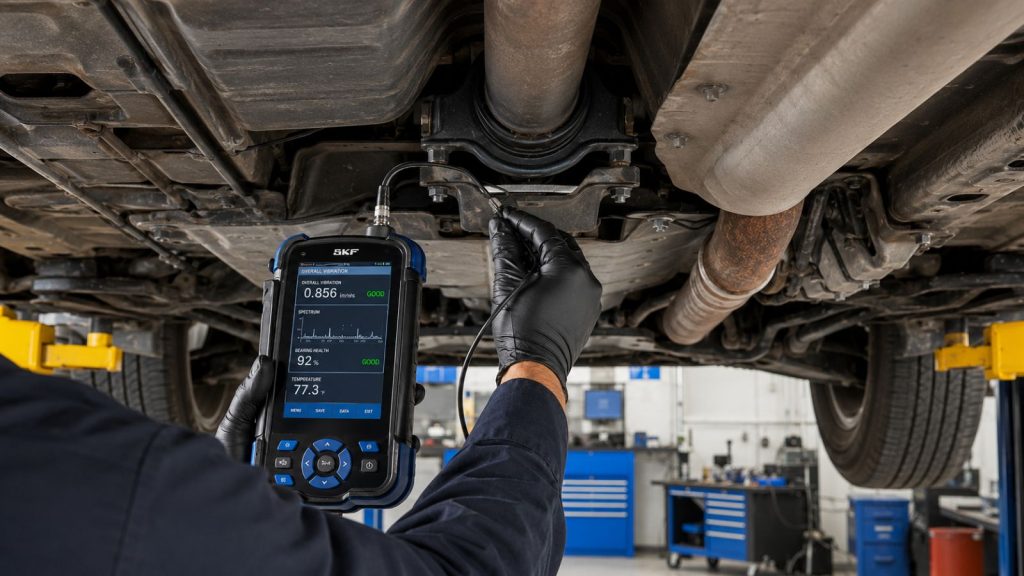
A properly balanced two-piece driveshaft produces vibration amplitude below 0.1 in/sec at the driveshaft tunnel at 65 mph. Center support bearing play above 0.005 inches introduces rotational imbalance that drives vibration amplitude above 0.2 in/sec at cruise speed. That reading exceeds the diagnostic threshold for confirmed drivetrain imbalance on a vibration analyzer road test.
Diagnostic Verdict. On two-piece driveshaft platforms presenting with I-10 West cruise vibration complaints, shop-floor dial indicator measurement confirms center support bearing radial play above 0.007 inches in the majority of confirmed cases, with isolator free height compression set above 40% measured simultaneously on teardown inspection.
How I-10 West Cruising Conditions Create Sustained Driveshaft Resonance Load
I-10 West is a sustained-speed route. The flat freeway stretch between Leon Valley and the Loop 1604 interchange runs 8 to 12 miles without significant grade change. At 65 mph, that segment holds the driveshaft at a constant 2,200 to 2,600 RPM for 7 to 10 continuous minutes on a typical morning commute.
Stop-and-go driving never loads the center support bearing this way. A vehicle driven primarily on city streets with frequent speed changes never sustains the driveshaft in its resonant frequency window long enough for the driver to notice the vibration. The I-10 West commute from Leon Valley does. It holds the driveshaft at the same RPM through the entire flat approach to Loop 1604, and the steady seat buzz arrives and holds for the full segment.
June heat compounds the load. Underbody temperatures on vehicles sitting in stop-and-go I-10 West on-ramp traffic reach 130°F to 150°F before the vehicle reaches highway cruise speed. At those temperatures, isolator rubber with existing compression set above 35% loses additional stiffness. A bearing that resonated only between 62 and 68 mph in cooler conditions may resonate across a wider speed range after a June stop-and-go approach to I-10.
In vehicles we service from the Leon Valley and Helotes corridors with daily I-10 West commutes, center support bearing isolator compression set above 40% is a consistent finding on vehicles with 70,000 to 100,000 miles driven primarily on sustained highway routes. The sustained cruise mileage on I-10 West compresses the isolator wear timeline compared to vehicles of the same odometer reading driven on mixed stop-and-go and highway routes.
Diagnostic Verdict. On Leon Valley commuter vehicles with I-10 West cruise vibration and 70,000 to 100,000 miles of primary highway use, isolator compression set above 45% is confirmed on inspection, with bearing bracket-to-body mount contact marks visible on the bracket face at the most advanced compression set position.
The Harmonic Vibration Frequency Pattern From Bearing Wear to Speed-Locked Resonance
The vibration has a speed address. At 65 mph on I-10 West, a rear-wheel-drive platform with a typical axle ratio of 3.31 to 3.73 and a tire diameter of 28 to 30 inches spins the driveshaft at approximately 2,200 to 2,600 RPM. That produces a 1st order center bearing vibration at approximately 37 to 43 Hz. That frequency sits in the tactile vibration band felt through the seat and floor, above the audible hum threshold and below the steering wheel shimmy frequency range.
The result is a smooth, steady buzz rather than a pulsing or rhythmic vibration. It does not change character with minor throttle variation. It holds as long as the vehicle holds cruise speed on the flat I-10 West segment. Above Loop 1604, the Hill Country grade west toward Helotes requires the driver to add throttle to maintain 65 mph. That additional torque load amplifies the center bearing imbalance force, and the vibration amplitude increases on the uphill segment beyond what flat-road cruise produced.
The speed-locked window is the most diagnostically useful behavior. Center bearing resonance produces maximum vibration amplitude within a narrow cruise speed range, typically 58 to 72 mph on most light-duty platforms. Below 55 mph and above 75 mph, the vibration reduces as the driveshaft RPM moves outside the resonant frequency of the degraded isolator system. The driver experiences it as a buzz that appears at freeway entry speed and fades in heavy traffic or at higher merge speeds.
The pattern we see most often on I-10 West corridor vehicles with cruise vibration complaints is exactly this speed-locked description. The driver notices the buzz between 62 and 68 mph and reports that it fades above 72 mph or below 58 mph. That speed ceiling, where the vibration fades rather than continuing to build, is the precise diagnostic indicator of center support bearing resonance. Tire imbalance complaints never include a fade speed above the onset speed.
Diagnostic Verdict. On vehicles where the driver describes a vibration onset above 58 mph and a fade above 72 mph, vibration analyzer road test confirms peak vibration amplitude of 0.2 to 0.4 in/sec at 37 to 43 Hz within the 62 to 68 mph window, dropping below 0.1 in/sec at 75 mph on the same road surface.
What the Diagnostic Process Confirms Before Center Support Bearing Replacement
Tire imbalance is the most common misdiagnosis for center support bearing resonance. Both produce a highway vibration felt through the seat. Neither produces identical behavior under a road test that varies speed systematically.
Tire imbalance vibration increases progressively with road speed. It does not have a ceiling where it fades. A vehicle with an imbalanced tire vibrates more at 70 mph than at 65 mph, and more at 75 mph than at 70 mph. The amplitude increases continuously as speed increases. Center bearing resonance does the opposite. It peaks in a narrow speed window and diminishes above that window as the driveshaft RPM moves past the isolator’s degraded resonant frequency.
Many I-10 West commuters have completed a tire balance service and returned with the vibration unchanged, because the vibration source was the center support bearing isolator, not the tire. The tire balance service addressed speed-correlated imbalance while the speed-locked resonance source remained in the driveshaft center section. The speed-variation road test resolves this before any service is performed.
The speed-variation road test is the first diagnostic step after the driver describes the vibration. Accelerating smoothly from 55 to 75 mph on I-10 West while noting exactly where the vibration begins and where it fades identifies the speed window precisely. If the vibration has a clear onset speed and a clear fade speed above 70 mph, the center support bearing is the confirmed diagnostic direction. If the vibration increases steadily with speed and does not fade, tire imbalance remains the primary suspect and a vibration analyzer road test separates the two sources by frequency.
Drivers who need a San Antonio mechanic experienced with driveshaft and drivetrain vibration diagnosis on the I-10 West corridor benefit from that speed-variation test before scheduling a tire balance or driveshaft replacement. Dial indicator measurement at the center bearing bracket and isolator compression set measurement confirm the finding after the road test establishes the speed window.
Diagnostic Verdict. On vehicles where the speed-variation road test confirms vibration onset above 58 mph and fade above 72 mph,