Subaru AWD differentials in Alamo Ranch and Great Northwest short-trip driving show fluid degradation closer to 25,000 miles instead of the standard 30,000-mile interval. Repeated cold starts and stop-and-go cycling prevent fluid from reaching full operating temperature. Old fluid messes with your torque precision. You will likely hear a high-pitched whine long before a light pops up on your dash.
Why Alamo Ranch and Great Northwest Short Trips Wear the AWD Differential
A Subaru differential needs sustained driving to reach full operating temperature. You will likely wrap up your Alamo Ranch visit before that even starts.
In Subarus we service from Alamo Ranch commuter routes, we consistently find differential fluid degradation appearing closer to 25,000 miles rather than the standard 30,000-mile interval. Driving in a cycle of cold starts and brief warmups ruins oil viscosity. It is actually harder on your car than cruising for hours at highway speeds. Without reaching a steady heat, the internal fluids simply give up early.
Gridlock across the Great Northwest makes a bad situation worse. Your differential suffers when you constantly hit the gas and brakes in traffic. These shifts in load create mechanical wear. It builds on the thermal damage common in quick city drives.
Your confirmed screening report. Fluid samples pulled from three Alamo Ranch commuter Subarus at 24,000 to 26,000 miles all showed reduced viscosity consistent with early degradation.
How We Actually Check Differential Fluid and Torque Balance
The check starts with a scan tool pull for live torque split data during a controlled drive cycle. Checking things once gives a weak perspective. Trends matter.
We test if your drivetrain sends power correctly by measuring it against the stock ratios defined by the manufacturer. Bad fluid drifts away from its original specs. This shows up most when you floor it or whip around a bend.
A quick draw follows. We test the liquid to see what’s happening inside. Looking at the parts helps. When you find metal debris or heat damage, it backs up the data you saw in the torque split report.
The Doctor’s Decision. Torque split readings on a 2019 Forester showed a deviation of several percentage points from the expected front-to-rear ratio during a hard-turn test.
What Fluid Degradation Does to Torque Distribution Over Time
This piece helps your Subaru balance power across the axles when you are driving in normal traffic. Short commutes and the brutal South Texas sun drain your battery life faster than you might expect.
Old oil thins out and fails to protect metal parts when the engine works hard. Frequent heating ruins the precision of your differential. This causes the torque to wander outside of its normal operating limits after every hard run.
That drift rarely announces itself right away. Most owners don’t notice anything different until the mechanical symptoms, not the torque data, become impossible to ignore.
The Clinical Decision. A differential showing confirmed fluid degradation at 26,000 miles measured torque distribution outside the normal design range on a follow-up test six weeks later.
The Lift Inspection Findings We See Most in Suburban Commuter Subarus
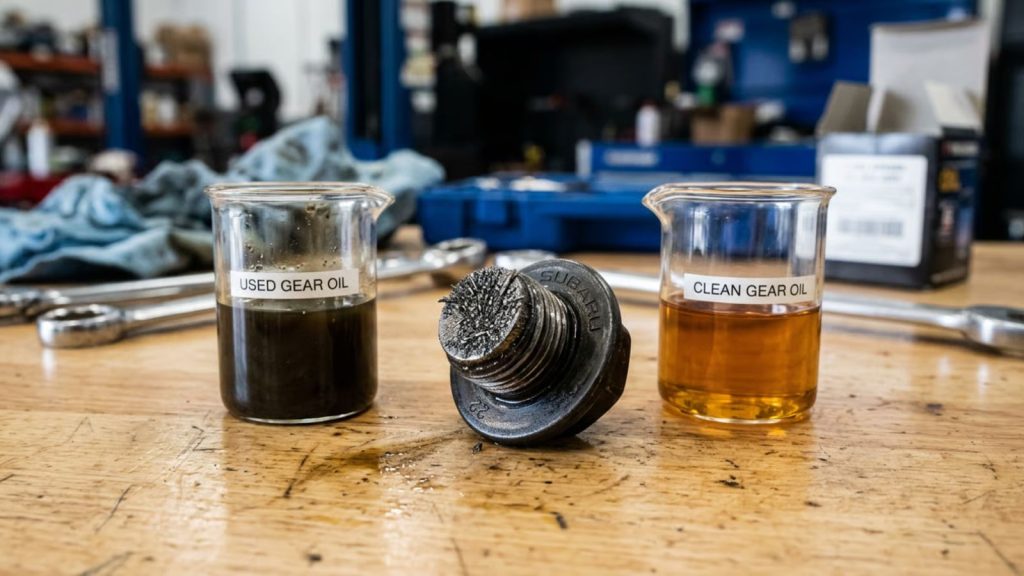
The pattern we see most often in San Antonio suburban commuter Subarus on the differential system is a specific sequence of findings on lift inspection. Look for odd colors in the liquid. This typically happens at the start.
Shavings on the plug magnet serve as a red flag. These physical signs almost always appear before the car begins to whine or rattle. Tracking these particles shows us the true age of your engine. It catches internal damage before the car actually starts acting up on the road.
You usually hear that sharp differential whine during tight turns only after the other two problems have already started. Those tracks are permanent. You are looking at years of friction rather than a few recent scratches.
Final health assessment. Lift inspection on a high-mileage Outback showed moderate drain plug particulate and fluid discoloration weeks before the owner first reported a turning whine.
When Differential Wear Becomes a Fluid Service or Rebuild Decision
Spotting early damage in the oil samples completely flips the script for your machinery. Routine maintenance handles lubrication needs. It succeeds provided the torque output still matches the mechanical goals of the machine.
Hold off too long and everything flips. Once torque imbalance and audible whine are both present, wear has typically progressed to the point where fluid service alone won’t resolve the underlying mechanical issue.
Get your Subaru AWD tested at Ruben’s Auto Repair. Catching dark fluid early lets you fix the problem before your engine takes a real hit.
The Official Assessment. Catching dirty fluid before the transmission starts whining saves you money. At this stage, we just swap the liquid and get you back on the road.
Catch AWD Differential Wear Before It Reaches the Rebuild Stage
Subaru owners commuting through Alamo Ranch or Great Northwest can call or schedule a differential inspection with Ruben’s Auto Repair, 7210 Polar Bear, San Antonio, TX 78238, at (210) 647-1148, before fluid degradation turns into a torque imbalance repair.
Frequently Asked Questions
Does short-trip driving really wear a Subaru AWD differential faster?
Short trips keep the differential from getting hot enough to work right, which ruins the oil much faster.
Can a Subaru differential wear out without any warning light?
You will likely notice dark oil or tiny metal shavings well before a check engine light actually pops up.
What does a failing AWD differential sound like?
Does your car cry out when you turn? That annoying sound happens because the steering fluid is dirty. It shows that the liquid is already failing to do its job.
Should differential fluid be checked before the standard 30,000-mile interval?
Short commutes are surprisingly hard on engines. Many vehicles driven this way begin to break down after just 25,000 miles on the road.
Does catching differential wear early avoid a full rebuild?
Fresh fluid fixes early wear. Catching it at the discoloration stage prevents serious torque issues later.