High mileage vehicles have less remaining margin before a marginal AC issue becomes an actual failure compared to newer vehicles. Machine learning models trained on historical failure data can recognize early warning patterns in compressor cycling and refrigerant efficiency that preceded failure in similar high mileage vehicles. A pattern match above 70 to 75 percent similarity is treated as a meaningful early warning.
A newer vehicle with a marginal AC issue usually has months of runway before that issue becomes an actual failure. A high mileage vehicle carrying the same marginal issue often doesn’t have anywhere near that much room, since years of wear have already spent down most of the margin that would otherwise absorb it. That difference is exactly why predictive alerting matters more the higher a vehicle’s mileage climbs.
Why Mileage Changes the Math on Wear
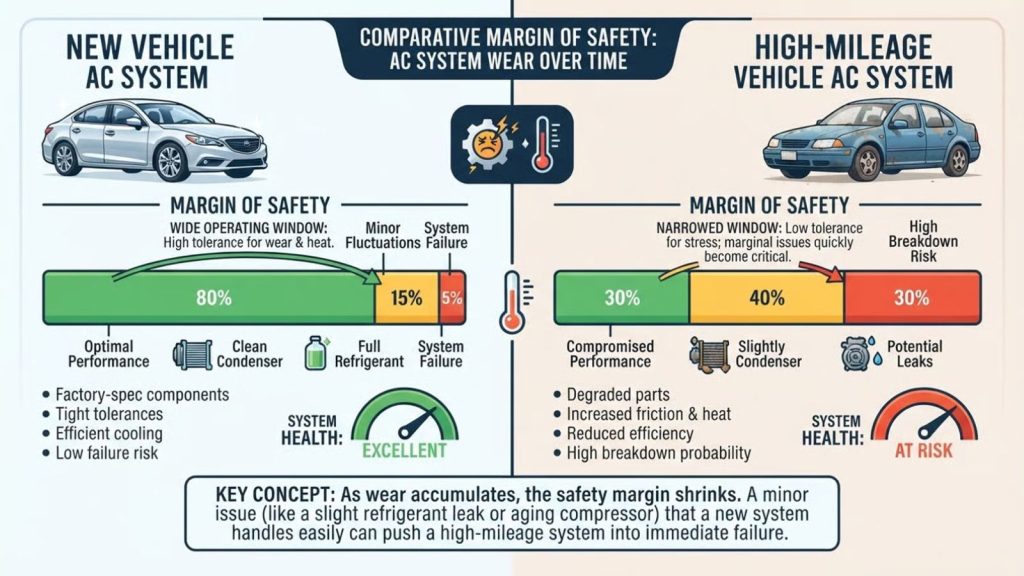
Every AC component has some amount of margin built into it, distance between normal operation and actual failure. A newer vehicle typically has plenty of that margin left, which is why a marginal issue can sit undetected for a while without much consequence, standard periodic inspection usually catches it with time to spare.
High mileage changes that equation directly. San Antonio’s heat cycles have been part of that vehicle’s wear story for years at that point, chipping away at the same margin a newer vehicle still has in abundance. The result is that the same rate of degradation a newer vehicle could tolerate for months might only give a high mileage vehicle a matter of weeks before an actual failure shows up.
How Predictive Models Actually Catch This Earlier
A model trained on historical failure data from vehicles at comparable mileage recognizes specific patterns, a certain shift in compressor cycling paired with a certain change in refrigerant efficiency, that have shown up before failure in similar vehicles again and again. That recognition doesn’t require waiting for this specific vehicle’s own symptoms to become obvious, it works off what similar vehicles have already shown historically.
That distinction matters most on high mileage vehicles precisely because they have the least room to wait. A newer vehicle can afford some lag between an early sign and an actual response. A high mileage vehicle, with its margin already thin, benefits far more from catching a pattern early rather than waiting for a driver to confirm what the data already suggested.
How We Weight These Indicators By Mileage
We don’t treat every wear indicator the same regardless of a vehicle’s mileage. A 10 percent increase in compressor cycling frequency reads very differently on a vehicle with 40,000 miles compared to one closer to 150,000, where that same shift has historically preceded failure within a much tighter window based on comparable vehicle data.
We also track how closely a specific vehicle’s current indicators match historical patterns that preceded failure in similar high mileage vehicles. A pattern match above roughly 70 to 75 percent similarity gets treated as a meaningful early warning worth acting on, rather than something to keep monitoring passively.
Finally, we compare predicted remaining margin against how failure actually played out across the high mileage vehicles we’ve tracked over time. That comparison helps refine how much genuine lead time a given alert pattern provides, so an alert translates into an actionable window rather than firing too early to matter or too late to help.
Why We’d Rather Flag This Early on High Mileage Vehicles Specifically
On a high mileage vehicle, the gap between catching a predictive pattern and waiting for an obvious symptom can be the entire difference between a manageable scheduled repair and an unplanned roadside breakdown. That gap matters more here than it does on a newer vehicle simply because there’s so much less margin left to work with once a marginal issue starts moving.
Get Your High Mileage Vehicle Checked Against Known Failure Patterns
If your vehicle has real mileage on it and you want to know whether current wear indicators match patterns that have preceded failure in similar vehicles, we can check that against what we’ve tracked. Ruben’s Auto Repair certified AC repair service, 7210 Polar Bear, San Antonio, TX 78238, (210) 647-1148, works with high mileage commuter vehicles regularly.
Frequently Asked Questions
Why do high mileage vehicles need predictive alerting more than newer ones?
Newer vehicles have more remaining margin before a marginal issue becomes an actual failure. High mileage vehicles have already spent down much of that margin through years of wear, leaving a narrower window before a developing issue turns into a breakdown.
How does a predictive model actually know what to look for?
It’s trained on historical failure data from vehicles at comparable mileage and wear levels, recognizing specific combinations of compressor cycling changes and refrigerant efficiency shifts that have preceded failure in similar vehicles before.
Does this mean my high mileage vehicle is more likely to fail than a newer one?
Not necessarily more likely overall, but if a marginal issue is present, it typically has less time to progress before becoming an actual failure compared to the same issue on a newer vehicle.
What counts as a meaningful early warning versus normal variation?
We look for a pattern match above roughly 70 to 75 percent similarity to historical failure patterns in comparable vehicles before treating something as a meaningful warning rather than normal fluctuation.
Is this only relevant for very old or high mileage vehicles?
The underlying principle scales with mileage. It becomes increasingly relevant as accumulated wear narrows a vehicle’s remaining margin, which is most pronounced in high mileage commuter vehicles specifically.