Fleet AC maintenance traditionally runs on a calendar, servicing every vehicle at the same interval regardless of actual condition. Telematics data tracking compressor load, cycling frequency, and temperature differential per vehicle is starting to replace that with condition based scheduling. A 10 to 15 percent shift in a vehicle’s own baseline over several weeks is a more reliable signal than fleet wide averages.
Every so many months, every vehicle gets looked at, whether it needs it or not. That’s how Fleet AC maintenance has worked for a long time, and honestly it’s not a bad system, it’s just a blunt one. We’re starting to see something more precise take its place, and it comes down to actually using the data these vehicles are already generating.
Why a Calendar Schedule Treats Every Vehicle the Same When They’re Not
A calendar based interval assumes every vehicle on a route sees roughly the same wear. In practice, that assumption doesn’t hold up well. Two delivery vehicles running what looks like the same route on paper can rack up very different amounts of actual AC strain depending on stop frequency, how long each stop runs, and how much idle time gets built into the day.
That mismatch is where a fixed schedule starts costing money on both ends. Some vehicles get inspected before they need it, which isn’t harmful exactly, just a bit of wasted shop time. Others go the full interval without a look and end up developing something a data driven schedule would have caught weeks earlier, sometimes turning into an actual breakdown before the next scheduled check ever arrives.
How We Actually Read the Data Per Vehicle
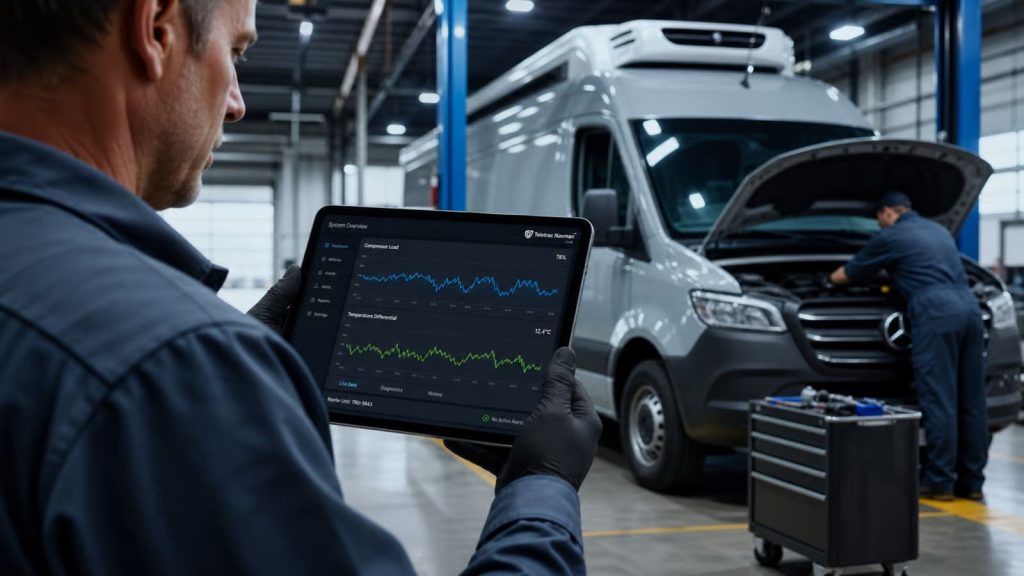
We don’t look at fleet averages first. We start with each vehicle’s own numbers.
Compressor load and cycling frequency get pulled individually, because vehicles running what look like identical routes can show a real gap in daily cycling, sometimes 15 to 20 percent different from one another, purely from how their specific stop pattern and idle time played out that day.
Cabin to ambient temperature differential is the next thing we watch, tracked in real time across the fleet. When that differential drops outside the expected range for more than 2 or 3 consecutive delivery days on a specific vehicle, that’s usually developing inefficiency showing up in the data before anyone driving it has said a word.
The comparison that actually matters most, though, is a vehicle against its own history, not against the rest of the fleet. A gradual 10 to 15 percent shift in one vehicle’s compressor load pattern over several weeks tells us more than comparing that vehicle to others running a different route entirely. Every vehicle is really its own baseline.
Why We’d Rather Fleets Move Toward This Instead of the Calendar
The math here is pretty simple once you see it laid out. A fixed schedule wastes some inspections and misses some real problems, every single cycle, because it can’t tell the difference between a vehicle that’s fine and one that’s quietly wearing out faster. Data driven scheduling narrows that gap on both sides. Fewer wasted visits, fewer surprise breakdowns mid route, and for a fleet running several vehicles daily through San Antonio heat, that adds up to real time and money saved across a full year rather than a handful of good guesses.
Talk to Us About Setting Up a Baseline for Your Fleet
If your fleet is still running AC maintenance on a fixed calendar, we can help you set up a per vehicle baseline and start reading that data in a way that actually informs your schedule. Ruben’s Auto Repair AC diagnostic team, 7210 Polar Bear, San Antonio, TX 78238, (210) 647-1148, works with fleet operators on this regularly.
Frequently Asked Questions
How is telematics based scheduling different from a normal maintenance calendar?
A calendar schedules every vehicle the same regardless of actual wear. Telematics tracks each vehicle’s own compressor load, cycling, and temperature data, which can flag developing issues specific to that vehicle well before a fixed interval would catch it.
Do vehicles running the same route really show different wear patterns?
Yes. Even similar routes vary in stop frequency and idle time, and that variation alone can create a meaningful difference in daily cycling frequency between two vehicles that look identical on paper.
What kind of data actually matters most for catching issues early?
Comparing a vehicle against its own historical baseline tends to be more useful than comparing it to fleet averages, since a gradual shift in that specific vehicle’s own pattern is a stronger signal than a one time comparison across different vehicles.
Does this replace scheduled maintenance entirely?
Not entirely. It shifts scheduling from a fixed calendar toward one informed by actual condition data, which usually means fewer unnecessary early inspections and fewer missed issues compared to a purely fixed interval.
Is this only useful for larger fleets?
It scales down reasonably well. Even a small number of vehicles benefit from tracking individual baselines instead of applying one calendar to all of them, though the data becomes more useful for spotting patterns as fleet size grows.