Variable displacement compressor failure in San Antonio often stems from a stuck PWM solenoid rather than mechanical seizure. At red lights, a failing solenoid prevents the swash plate from tilting, causing lukewarm air at idle despite functional cooling at highway speeds. Diagnosis requires duty cycle signal testing and pressure differential analysis.
In April, my shop floor is flooded with VDCs that survived the winter but can’t stroke up for the first 90°F afternoon. The issue isn’t a lack of refrigerant; it is a lack of logic. In modern SUVs and vans, the old-school “clank” of an AC clutch engaging has been replaced by the silent operation of the Variable Displacement Compressor (VDC). While this technology is 30% more efficient for fuel economy, it introduces a complex failure point: the Pulse Width Modulation (PWM) solenoid. When this electronic valve fails, it leaves you sweating at a red light on Bandera Road while your car’s computer desperately tries to command a cooling cycle that never happens.
Variable Displacement Swash Plate AC Compressor Transition
Traditional compressors were “all or nothing”—they were either spinning at 100% or they were off. Your 2026 model vehicle likely uses a swash plate design that never stops spinning. Instead of a clutch, a PWM solenoid (also called an Electronic Control Valve) regulates the pressure inside the compressor crankcase to tilt an internal swash plate. The angle of this plate determines how much refrigerant is moved.
At a dead stop in San Antonio humidity, your computer should tilt that plate to its maximum angle to compensate for the lack of airflow. If the solenoid is sluggish, the plate stays flat, and your vents immediately turn humid.
Bandera Road Low Velocity Airflow AC Performance Loss
We call this the “Stoplight Sweat.” You’ll notice the air is ice-cold while you are cruising down I-10 at 60 mph, but the moment you stop at the light near Alamo Ranch Marketplace, the air turns lukewarm. This happens because, at highway speeds, “ram-air” is naturally forced through your condenser, aiding the cooling process even if the compressor is only at 10% capacity. However, once you drop to idle RPMs at a red light, the system depends entirely on the PWM solenoid to “lift” the swash plate. If that valve is mechanically stuck, the system cannot maintain the 250PSI head pressure required for R-1234yf to shed heat in a San Antonio April.
PWM Control Solenoid Failure and Compressor Displacement Faults
The most frustrating part for many drivers is that the compressor itself is often mechanically sound. The failure is almost always the solenoid—a part that costs roughly 150. Many general repair shops will tell you that the “compressor is dead” and quote you $1,200 for a total system replacement. At Ruben’s Auto Repair, we prioritize logic-based service. If the compressor isn’t making noise and hasn’t distributed metal “Black Death” debris through the lines, we can often replace just the Electronic Control Valve, saving you over $1,000 while restoring factory-level cooling.
In Leon Valley, we specifically see failures where abrasive limestone dust from construction on Grissom Road fouls the external solenoid electrical connectors. If the protective boot is torn, this dust triggers high-resistance connections that paralyze the valve before it even has a chance to move.
Why DIY Can Cause “Slugging” and Total Seizure
When the air turns warm at a red light, many parents in the John Marshall High School pickup line reach for a DIY “refrigerant in a can.” This is the most dangerous thing you can do to a VDC system.
Because the solenoid—which typically operates at a PWM frequency of 250 Hz to 500 Hz—is paralyzed, your manifold gauges might show “low pressure,” but the system is actually full. By adding more gas, you risk “liquid slugging.”
This occurs when liquid refrigerant enters the compressor cylinders because the swash plate couldn’t move to accommodate the extra volume. The result is a catastrophic internal snap, turning a $150 valve repair into a $1,200 total system failure.
Oscilloscope Signal Validation for AC Compressor Diagnostic Verification
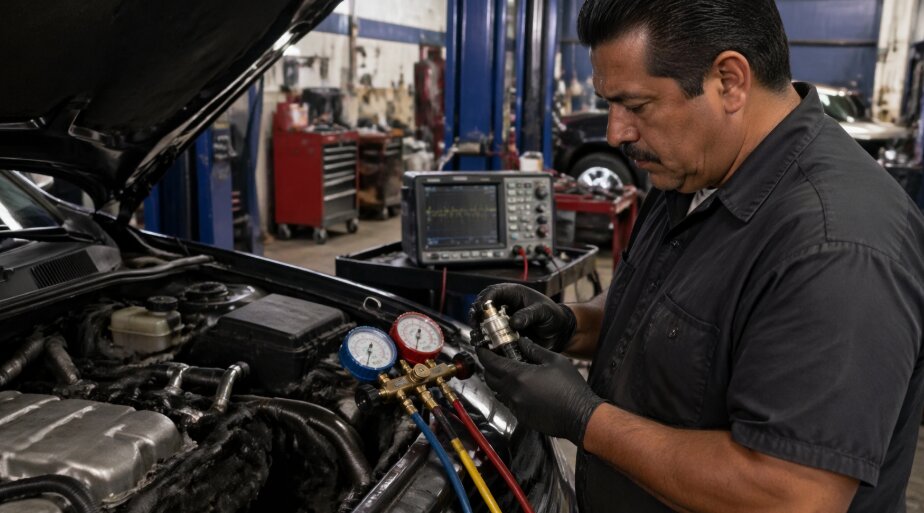
I don’t believe in guessing with your money. To diagnose a VDC failure, we use an oscilloscope to back-probe the signal going to the compressor. The “Moment of Clarity” occurs when the scope confirms a 90% duty cycle—meaning the car is screaming for maximum cold air—but our digital manifold gauges show the high-side pressure is stagnant at 150PSI. This proves the solenoid is electrically receiving the command but is mechanically paralyzed. We verify the “brain” is working before we ever recommend replacing the “heart.”
For a logic-based AC checkup before the San Antonio summer hits, visit Ruben’s Auto Repair at 7210 Polar Bear, San Antonio, TX 78238. We’ve spent 15 years saving Leon Valley drivers from unnecessary compressor replacements.
Frequently Asked Questions
Can I just rev my engine to get the AC to work?
No. While increasing RPMs might move a tiny bit more refrigerant, it’s a “Manual Override” myth. If the solenoid is stuck, you are just putting excessive heat and friction on a compressor that isn’t lubricated properly.
Why does the AC smell humid the second I stop moving?
That is the smell of the evaporator core warming up. When the VDC fails to stroke up at idle, the refrigerant stops boiling off in the evaporator, and the moisture on the fins immediately evaporates into the cabin.
Does R-1234yf fail faster than the old stuff?
The gas doesn’t fail, but the systems are more sensitive. Modern R-1234yf systems are designed with such tight tolerances that a minor solenoid hang-up that might have gone unnoticed in 2010 will completely kill your cooling in 2026.
Is the solenoid replacement a permanent fix?
Yes, provided the system is flushed and the oil balancing is corrected. We ensure the new valve isn’t immediately fouled by the same degraded oil that stuck the first one.