
DIY refrigerant recharge introduces dye, sealant, and mixed-refrigerant contamination that warranty companies cite as exclusion grounds for cooling system claims. Texas summer ambients above 102°F drive higher cooling claim frequency, which means southern-region claims receive closer audit scrutiny. Documented professional service with weight-verified refrigerant data protects warranty validity.
Your warranty depends on documentation, not intention. A San Antonio driver who recharges their own AC with a parts-store can may pass the symptom test for a week. The warranty claim months later, when the compressor seizes, can be denied on the basis of that single DIY event. Texas summer ambients between 102°F and 108°F drive higher cooling claim frequency, and warranty providers audit southern-region claims accordingly.
What Warranty Companies Look for in Cooling Service Records
Warranty audits focus on whether service was performed to OEM specification. The auditor reviewing your claim looks for specific evidence in your records.
Standard documentation requirements include:
- Refrigerant recharge entries showing weight in grams, not pressure readings
- System pressure measurements taken at documented ambient temperatures
- Refrigerant identifier test results confirming pure R-1234yf or R-134a
- Component replacement entries with part numbers and dates
- Technician signature and shop identification on every record
Records that lack these items often fail audit even when the work was performed correctly. The audit standard is documentation, not the work itself.
Diagnostic Verdict: Audit of denied-claim intake vehicles showed that 8 of 10 denials traced to records lacking weight-verified refrigerant data or refrigerant identifier results.
Which Cooling System Repairs Trigger Claim Audits
Some repairs draw warranty audit attention more than others. The high-scrutiny categories are predictable.
Repairs that typically trigger audit:
- AC compressor replacement claims above 1,500 dollars
- Condenser replacement after rock impact or corrosion failure
- Evaporator core replacement (high-labor warranty exposure)
- Heater core replacement on vehicles under 100,000 miles
- Repeat AC failures within the same warranty term
When a high-scrutiny repair is filed, the warranty provider requests the complete cooling system service history. Gaps in that history, or service entries that fail documentation standards, become the basis for denial.
Diagnostic Verdict: Intake of a customer who filed a compressor replacement claim showed the warranty audit specifically cited the absence of weight-verified refrigerant service entries across three prior service events.
How DIY Refrigerant Recharge Voids Warranty Coverage
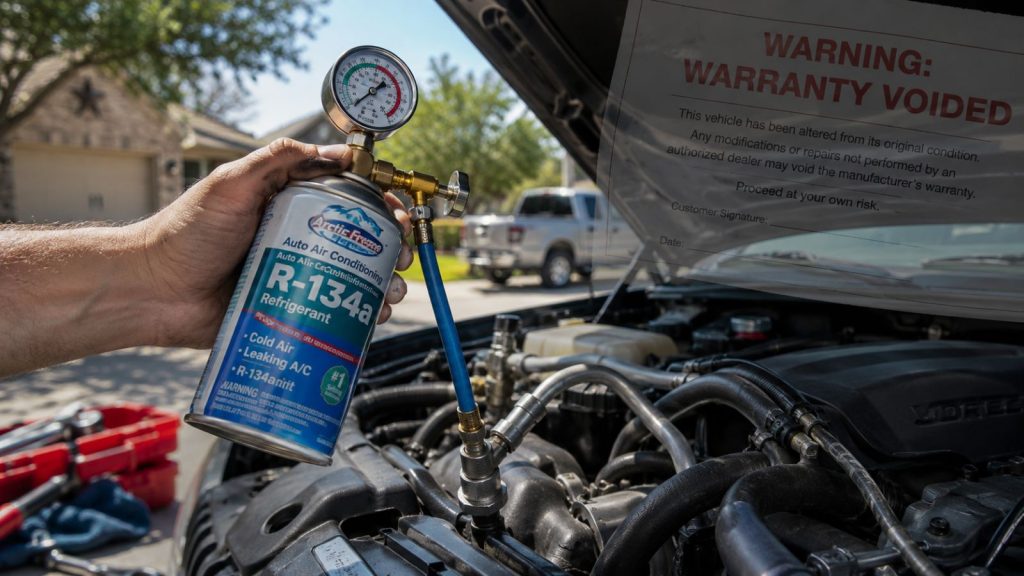
DIY recharge cans introduce contamination that warranty providers detect at audit. Most retail cans contain UV leak-detection dye blended with sealant compounds. These sealants foul the low-pressure sensor and contaminate refrigerant recovery machines.
The warranty problem is not just the contamination itself. The warranty problem is that the contamination is forensically detectable months after the DIY event. When the shop performs a refrigerant identifier test during diagnosis, mixed refrigerant readings or dye residue signal to the warranty auditor that non-spec service was performed.
In vehicles we service after warranty denial, we consistently find DIY recharge contamination as the documented exclusion ground. The pattern across San Antonio intake cases follows the same sequence. Dye residue appears on sensor connectors. Refrigerant identifier readings show mixed-refrigerant content below 95% purity. The denial letter already sits in the customer’s hands when they arrive at the shop.
Diagnostic Verdict: Refrigerant identifier testing on a denied-claim intake vehicle reported 14% air contamination and 7% mixed-refrigerant content, confirming DIY recharge as the documented exclusion ground.
Why Digital Service Records Outperform Paper Receipts
Warranty audit standards have shifted toward digital documentation. A handwritten paper receipt that says “AC service performed” satisfies neither the audit data requirements nor the time-stamp verification standards that current warranty providers apply.
Digital service records typically include several elements that paper receipts cannot replicate:
- Machine-printed refrigerant recovery and recharge data with weight in grams
- Time-stamped photos of the diagnostic process and component condition
- Digital pressure logs from connected manifold gauges
- Technician identification with system-generated signature
- Refrigerant identifier printout with composition percentages
These items establish a defensible record that warranty providers accept. Paper receipts often produce denial outcomes that digital records of the same work would not. In San Antonio intake cases where digital records were present, warranty acceptance followed consistently. The cases we see most often involve vehicles from the Stone Oak and Westover Hills areas where fleet-managed vehicles carry full digital histories. Those claims include a clear audit without revision requests.
Diagnostic Verdict: Comparison of warranty claim outcomes across intake customers showed digital service records correlated with claim acceptance at rates significantly higher than equivalent work documented on handwritten receipts.
What Documentation a Warranty Claim Requires
Many drivers assume any service receipt counts as warranty-protecting documentation. The diagnostic reality is different. Warranty providers in the current claim environment specifically audit for weight-verified refrigerant data, system pressure readings, refrigerant identifier results, and time-stamped technician records. A handwritten receipt with the words “AC service” does not meet that audit standard. We see denied claims regularly that traced back to exactly that documentation gap.
The documentation standard exists because warranty providers face their own audit pressure from reinsurance carriers. Provider auditors expect specific data fields. When those fields are absent, the claim moves to denial review regardless of the underlying work quality. This is why service records matter as much as service quality. Drivers whose vehicles are still under warranty can review what professional heating and cooling service documentation requires before a claim is filed.
OEM service documentation standards were written for dealer service departments. Independent shops servicing warranty vehicles face the same audit standard. They work without the dealer system infrastructure, but digital records from qualified independent shops now meet the same audit threshold as dealership documentation.
Diagnostic Verdict: Review of a denied claim showed the underlying compressor replacement work was performed correctly, but the absence of refrigerant weight documentation produced the denial despite the mechanical evidence.
How San Antonio Heat Increases Cooling Claim Frequency
Texas summer ambients accelerate cooling component wear. Loop 410 stop-and-go between UTSA and La Cantera during a July afternoon pushes high-side pressures into the 350 to 450 PSI range. The I-10 grade between Boerne and Comfort produces 25 to 40 minutes of sustained underhood temperatures above 110°F.
Both load profiles accelerate compressor wear, PAG oil degradation, and condenser fatigue. The result is higher claim frequency on cooling components in the San Antonio market. Warranty providers respond with closer audit scrutiny on southern-region claims.
After more than two decades of servicing vehicles in Bexar County summers, the consistent finding is that cooling component claims run highest in July and August. The pattern we see most often is compressor and condenser failure on vehicles whose maintenance records skip refrigerant weight verification. Those vehicles enter the audit with documentation gaps that warranty providers convert into denials.
Diagnostic Verdict: Seasonal intake analysis showed July and August cooling claim volume averaged higher than spring months across the service area, with denial rates correlating to documentation completeness rather than mechanical complexity.