Turn signal failure on downtown San Antonio delivery routes traces to relay contact fatigue from 400 to 640 switching cycles per shift, multifunction switch stalk contact wear from the same activation frequency, and flasher module thermal cycling from repeated short-duration activations at loading zone entries. A second-tap requirement on the stalk before the signal activates is the early warning. Complete signal absence is the endpoint.
What Relay and Switch Cycling Fatigue Does to Turn Signal Reliability
Turn signal components have a measurable life. Automotive turn signal relays are rated for a contact cycle life of 100,000 to 300,000 switching operations at the rated current load. The multifunction switch stalk uses a spring-loaded contact mechanism rated for approximately 200,000 to 500,000 activation cycles. Both ratings are set for normal suburban use, where turn signals activate 10 to 20 times per hour.
A downtown San Antonio delivery vehicle activating the turn signal 50 to 80 times per hour accumulates 400 to 640 relay switching cycles per 8-hour shift. At that rate, a relay with a 100,000-cycle rating reaches its fatigue threshold in approximately 156 to 250 operating days. A switch with a 200,000-cycle rating reaches its threshold in 312 to 500 operating days. Neither timeline registers as a short service life in a suburban context, but both arrive well within the expected operating life of an active delivery vehicle.
Relay contact fatigue above the rated cycle threshold produces intermittent contact resistance increase. The turn signal activates inconsistently, flashing erratically on some turns and failing to activate on others. The switch stalk produces the same progression from a different failure mode. Worn spring-loaded contacts in the stalk produce an intermittent loss on the first activation attempt, requiring a second tap to initiate the flash sequence.
The flasher module adds a third component in the failure chain. Electronic flasher modules under repeated short-duration activations, where the turn signal is activated and cancelled within 3 to 5 seconds at a loading zone entry, undergo thermal cycling at a higher frequency than on a suburban route. That thermal cycling accelerates solder joint fatigue on the module’s circuit board, producing intermittent flash rate variation or a no-flash condition on individual activations.
Diagnostic Verdict. On downtown delivery vehicles presenting with intermittent turn signal complaints, relay contact resistance measurement confirms resistance above the acceptable threshold in the majority of confirmed relay fatigue cases, with multifunction switch stalk resistance testing confirming intermittent open circuit at the contact point on vehicles where the second-tap symptom is reported.
How Downtown San Antonio Delivery Route Patterns Accelerate Component Wear
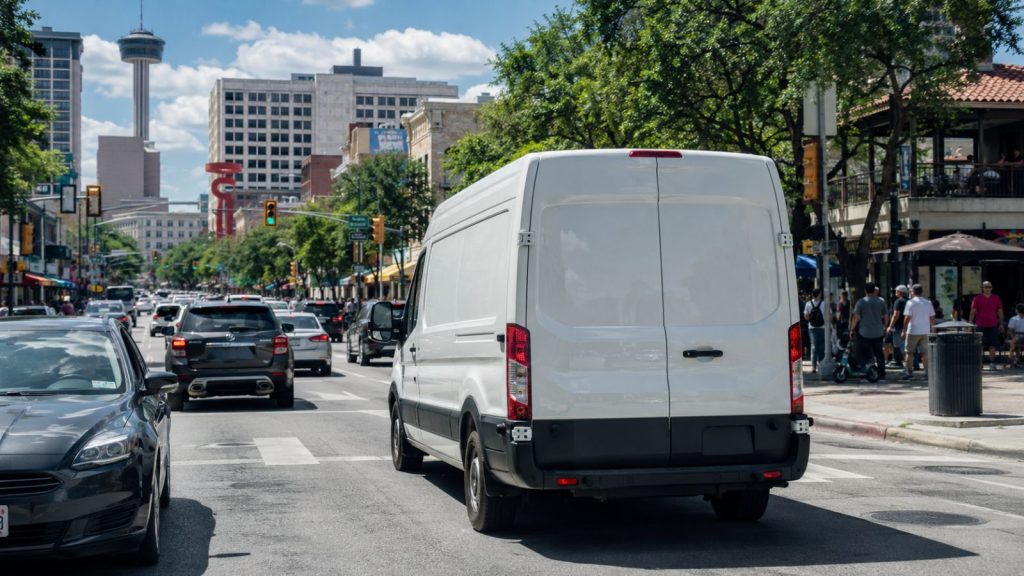
The activation count is the diagnostic driver. The downtown San Antonio delivery corridor through the River Walk district, Southtown, and the Convention Center area requires signaling for turns, lane changes, and loading zone entries on virtually every block. A delivery vehicle covering a typical 15 to 20 block downtown route activates the turn signal 50 to 80 times per hour, three to four times the rate of a suburban delivery route covering the same distance.
That compression of the activation timeline is what separates a downtown delivery vehicle from a same-age suburban commuter vehicle at a shop inspection. Two vehicles of identical make, model, and mileage can show dramatically different relay and switch wear profiles if one has spent its service life on downtown delivery routes and the other on suburban errands.
Loading zone and parking structure entries produce an additional failure mechanism distinct from the raw activation count. Downtown delivery vehicles frequently activate the turn signal for a maneuver that completes in 3 to 5 seconds before the signal is cancelled. That short-activation pattern subjects the flasher module and relay to more switching events per mile than a suburban route where each activation stays on for a full lane change or intersection approach.
July ambient temperatures of 102°F to 108°F raise underdash temperatures during downtown stop-and-go idling, accelerating contact oxidation on relays with existing cycle wear and softening the spring preload on multifunction switch contact mechanisms. A relay or switch already near its fatigue threshold operates less reliably under elevated July underdash temperatures.
In delivery vehicles we service from downtown San Antonio and Southtown routes, turn signal relay inspection consistently shows contact oxidation and arc pitting consistent with high-cycle fatigue on vehicles with fewer than 60,000 miles. The failure pattern correlates to downtown route frequency rather than total vehicle age.
Diagnostic Verdict. On downtown and Southtown delivery vehicles with fewer than 60,000 miles, relay contact inspection confirms arc pitting and oxidation consistent with high-cycle fatigue in the majority of intermittent turn signal cases, with the failure pattern absent on comparable mileage vehicles used exclusively on suburban routes.
The Failure Pattern From Intermittent Signal to Complete Turn Signal Loss
The failure does not arrive suddenly. It follows a predictable progression that gives a fleet operator a diagnostic window before the vehicle becomes a safety liability on a downtown delivery route.
The first stage is a second-tap requirement on the stalk. The driver activates the left turn signal and nothing happens. A second tap initiates the flash sequence. The driver adapts without reporting the fault. This stage can persist for two to four weeks of daily downtown route use before advancing.
The second stage extends the intermittent failure to both sides. The right turn signal, which had been functioning normally, begins showing the same second-tap requirement. At this stage the relay contact or switch stalk is failing, not just degraded, and the failure is no longer limited to high-frequency use periods.
The third stage is complete signal absence on one or both sides without hyper-flash on the remaining functional side. That absence without hyper-flash distinguishes a relay or switch fault from a bulb failure, where hyper-flash would appear on the intact side because the circuit resistance has changed.
The pattern we see most often on downtown delivery vehicle turn signal complaints is the second-tap stalk requirement appearing first on left turns at busy Southtown intersections before progressing to complete signal absence on both sides within two to four additional weeks of daily downtown route use.
Diagnostic Verdict. On vehicles at stage two or three of this progression, BCM scan tool history confirms stored turn signal circuit codes including B1481 or B2588 in the majority of cases on BCM-managed platforms, with the code set date correlating to the driver’s reported onset of the second-tap symptom.
What the Diagnostic Process Confirms Before Relay or Switch Replacement
Bulb replacement gets approved for turn signal failure more often than the evidence supports. A blown bulb produces a hyper-flash condition on the remaining functional side, where the flash rate doubles because the circuit resistance has changed with the open filament. Intermittent relay or switch fatigue produces no hyper-flash because the bulb is intact. The circuit fault is upstream at the relay contact or switch stalk.
Many fleet managers have replaced a turn signal bulb on a vehicle that returned the next week with the same intermittent failure, because the relay and switch were the confirmed sources. The bulb was functioning correctly. The fault was in the switching circuit, which a bulb replacement did not address.
The hyper-flash versus no-hyper-flash distinction is the first diagnostic checkpoint before any part is ordered. If the opposite side hyper-flashes when one side fails, the bulb is the confirmed source for that side. If no hyper-flash occurs and the signal simply fails to activate or activates inconsistently, the relay, switch, or flasher module is the confirmed source requiring further isolation.
After the hyper-flash test establishes the fault location, relay resistance testing, stalk contact resistance measurement, and BCM code retrieval narrow the specific component. On vehicles with BCM-managed turn signal circuits, stored codes including B1481 and B2588 direct the repair to the relay or switch circuit without requiring component swap testing. Drivers and fleet operators who need a San Antonio mechanic for turn signal and electrical diagnosis serving downtown delivery fleets benefit from that hyper-flash checkpoint and BCM code review before any component is replaced.
Diagnostic Verdict. On vehicles where the hyper-flash test confirms no hyper-flash and BCM code retrieval confirms a stored relay or switch circuit fault, relay replacement and stalk contact cleaning resolve the intermittent turn signal in the confirmed majority of downtown San Antonio delivery vehicle cases, without bulb replacement or flasher module replacement on vehicles at stage one or two of the failure progression.
Fleet operators and delivery drivers noticing a second-tap stalk requirement or intermittent turn signal failure on downtown San Antonio routes can schedule a relay and switch diagnostic with Ruben’s Auto Repair, 7210 Polar Bear, San Antonio, TX 78238, at (210) 647-1148, before high-cycle relay and switch fatigue advances to complete signal loss on a Southtown or River Walk delivery run.
Frequently Asked Questions
Why do turn signals fail on downtown San Antonio delivery routes faster than on other vehicles?
Yes, downtown delivery vehicles activate turn signals 50 to 80 times per hour, accumulating 400 to 640 relay switching cycles per shift and reaching relay fatigue thresholds in 156 to 250 operating days.
Is a second-tap requirement on the turn signal stalk a warning of complete failure?
Yes, a second-tap requirement indicates multifunction switch contact wear from high-cycle fatigue and typically progresses to complete signal absence on both sides within two to four additional weeks of downtown route use.
Does a turn signal that fails without hyper-flash mean the bulb needs replacement?
No, hyper-flash on the opposite side confirms a blown bulb, while signal failure without hyper-flash confirms the fault is upstream at the relay contact or switch stalk rather than at the bulb.
What BCM codes confirm a turn signal relay or switch fault in San Antonio delivery vehicles?
Yes, B1481 and B2588 are commonly stored on BCM-managed platforms when relay or switch circuit faults develop from high-cycle fatigue on downtown delivery routes.
Does July heat in San Antonio make turn signal relay and switch wear worse on delivery routes?
Yes, July underdash temperatures accelerate contact oxidation on relays with existing cycle wear and reduce spring preload on multifunction switch contacts already near their fatigue threshold.
Can a flasher module cause intermittent turn signals on short loading zone entries in San Antonio?
Yes, repeated 3 to 5 second short-duration activations at downtown loading zones accelerate flasher module solder joint fatigue beyond what longer-duration suburban route activations produce.