
Most drivers know what warm air feels like when the AC stops cooling, but few understand why the cold disappears.
A Freon leak is one of the most common AC failures—and one of the easiest to miss. It doesn’t shout, it whispers. It starts with small drops in cooling, faint hissing, or longer cool-down times. And by the time the AC blows warm in Texas heat, the leak has already spread damage across the system.
This guide breaks down the real signs of a Freon leak, how drivers in San Antonio can detect it early, and what repairs make sense before it becomes a four-figure job. You’ll also see a case study of a local driver who caught the leak just in time, avoiding a major compressor failure.
The goal is simple: clear, direct knowledge that helps you protect your car before the AC fails completely.
What Is a Freon Leak in a Car AC System?
A car’s AC system is a sealed loop. Freon (R-134a/R-1234yf) circulates through components, absorbs heat, and releases it outside the vehicle. It’s not normal for refrigerants to “run low.” If levels drop, refrigerant is escaping somewhere—often slowly, invisibly, and silently.
A Freon leak is not only a cooling problem. It affects the entire AC system:
- Pressure drops
- The compressor overworks
- Lubrication decreases
- Temperatures rise
- The system becomes unstable
If the leak is ignored, bigger failures follow.
What Are the Most Common Signs of a Car AC Freon Leak?
Freon leaks expose themselves long before the cooling stops. Drivers just don’t always recognize the early warnings.
Here are the clearest signs:
AC takes longer to cool the cabin
Low refrigerant means less heat absorption. The AC struggles, especially in the afternoon heat.
Warm air during idle or slow traffic
When refrigerant is low, the system cannot maintain pressure at low speeds.
Hissing or bubbling sound from the dashboard or engine bay
This is one of the strongest leak indicators. Refrigerants are escaping or boiling in the lines.
Visible oil or stains around AC components
Freon leaks often mix with compressor oil, creating greasy residue around:
- hose connections
- Schrader valves
- the condenser
- the compressor
Ice buildup on the evaporator or AC lines
Less refrigerant means temperatures drop too low inside the evaporator, causing rapid icing.
Frequent compressor cycling
The compressor switches on and off to compensate for unstable pressure.
A faint chemical smell
Some refrigerants create a sweet or chloroform-like odor when leaking.
Reduced airflow even when the blower is strong
This may mean the evaporator is freezing due to low refrigerant.
Drivers often assume they “just need a recharge,” but a recharge without finding the leak only hides the real problem.
What Causes Car AC Freon Leaks in 2025?
Refrigerant leaks don’t happen randomly. They come from specific sources:
Worn O-rings and seals
Heat dries them out. They shrink over time, creating small leak points.
Cracked aluminum AC lines
Texas roads, vibration, and age create hairline fractures.
Punctured or corroded condenser
Located in front of the radiator, the condenser is exposed to:
- rocks
- insects
- road debris
- corrosion
It’s the single most common source of visible leaks.
Leaky Schrader valves
The small valve core that controls refrigerant access can wear out or crack.
Faulty compressor shaft seal
This leak is subtle but common in high-mileage vehicles.
Evaporator core leak
This leak is hidden inside the dashboard. It’s hard to detect without dye or electronic sniffers.
Previous AC repairs done without replacing seals
Many leaks come from old O-rings reused after repairs.
Once a leak begins, refrigerant escapes, taking lubrication with it. This accelerates wear within the compressor and triggers a chain of failures.
How Can You Tell If Your Car’s AC Freon Leak Is Minor or Major?
Signs of a minor leak:
- AC slowly loses cooling over time
- Cabin cools but takes longer
- Works in the morning but fails midday
- Dye test reveals small trace amounts
Signs of a major leak:
- The AC blows warm suddenly
- Refrigerant escapes within hours or days
- Oil stains or wet marks around the condenser
- High-side pressure rises dangerously
Most leaks start small and worsen with vibrations, heat, and pressure cycles.
How Do You Confirm a Freon Leak in the Safest Way?
Mechanics diagnose Freon leaks using several reliable methods:
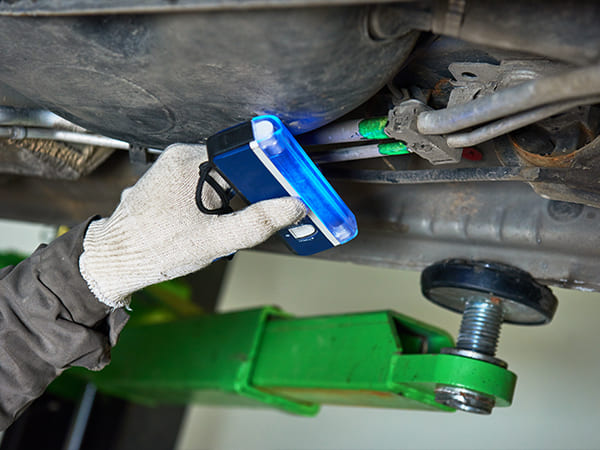
UV dye injection
The dye mixes with the refrigerant and leaks out visibly under UV light.
Electronic leak detector (“sniffer”)
This tool senses refrigerant concentration in the air.
Pressure testing
If pressure drops after the system is charged, a leak exists.
Visual inspection
Oil residue, cracked hoses, or corrosion often reveal the source.
Soap bubble test
Used for Schrader valves and accessible connections.
Guessing is unreliable. A real diagnosis prevents unnecessary repairs and protects the compressor.
What Happens If You Ignore a Freon Leak?
Refrigerant leaks cause more than warm air. They damage critical components:
Compressor overheating
Low refrigerant = poor lubrication. The compressor wears rapidly.
System contamination
Air and moisture enter, creating acid and corrosion.
High repair costs
A small leak grows into a $1,000+ AC overhaul.
Frozen evaporator coil
Low refrigerant creates ice buildup.
Electrical strain
Sensors and switches operate outside normal limits.
A Freon leak is not harmless. It is a warning signal.
Case Study: How One Local Driver Avoided a $900 Failure
Ashley, a San Antonio real estate agent, noticed her AC cooling more slowly each week. She assumed it needed a recharge and planned to buy a DIY kit.
Before doing it, she came in for a quick check.
Technicians found:
- A slow leak at the condenser seam
- Low refrigerant, but not empty
- Oil residue on the lower grille
- Early signs of compressor strain
If she added a DIY can, pressure would spike and force the compressor to fail.
Instead, the team replaced the condenser, installed new O-rings, vacuum-tested the system, and recharged it properly.
Cost: $380
Compressor replacement later: $900–$1,300
Ashley drove away with ice-cold air—and avoided a costly failure.
How Do You Fix a Car AC Freon Leak?
Repairs depend on the leak location:
Replace damaged O-rings
Often the cheapest fix.
Replace leaking Schrader valves
Fast and inexpensive.
Replace or repair cracked AC lines
Aluminum lines can sometimes be welded or replaced.
Replace the condenser
Most common leak repair in Texas.
Repair evaporator leaks
Time-consuming but necessary.
Flush and recharge
Once the leak is fixed, the system must be vacuumed and filled with the correct amount of refrigerant.
Sealers should never be used. They clog expensive components.
Need Fast, Accurate Freon Leak Repair?
If your AC is losing cooling, hissing, cycling, or showing signs of a Freon leak, now is the time to fix it before the compressor is damaged. For fast diagnosis and reliable repair, call or book online with Ruben’s Auto Repair today.
Frequently Asked Questions
How do you know if your car AC is leaking Freon?
You’ll notice weak cooling, hissing, oily residue, ice on AC lines, or longer cool-down times. A pressure or dye test confirms the leak.
Can a car lose Freon without a leak?
No. Refrigerant loss always means a leak is present, even if it’s small or hard to detect.
Is it safe to drive with a Freon leak?
It’s safe to drive, but not safe for the AC system. Low refrigerant damages the compressor.
How much does it cost to fix a Freon leak?
Repairs range from $150–$900 depending on whether the