
Hub bearing play above 0.005 inches causes directional drift that worsens at highway speed. Shavano Park’s winding residential streets, clay-soil road base, and stop-sign grid create a mechanical load pattern that accelerates hub bearing wear faster than highway mileage alone. Dial indicator measurement confirms the failure before alignment is blamed.
What Hub Bearing Play Actually Measures
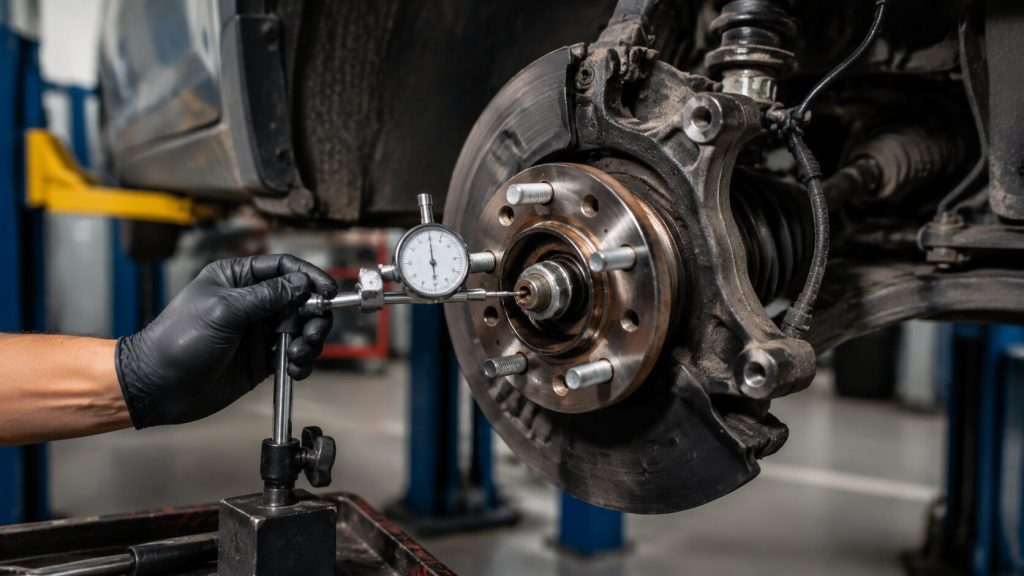
Drift starts with movement that is invisible without the right tool. A dial indicator placed at the wheel rim gives the only reliable measurement of hub bearing condition. Acceptable lateral play on most passenger vehicles falls between 0.001 and 0.005 inches (0.025 to 0.127 mm).
Play readings above 0.005 inches indicate structural looseness in the hub bearing. At or above 0.010 inches (0.254 mm), lateral drift under steady cruising reproduces reliably on flat pavement, even when tire pressure is equal side to side and the alignment was recently adjusted.
Two distinct measurements matter here. Lateral play is side-to-side movement at the rim. Axial play is in-and-out movement. Lateral play is the primary driver of drift. Axial play above 0.003 to 0.005 inches (0.076 to 0.127 mm) signals bearing race wear and typically appears alongside lateral play on assemblies that have reached failure.
Before the dial indicator goes on the wheel, tire pressure gets equalized to OEM placard specification. On most passenger sedans and light SUVs, that is 32 to 35 PSI. A cross-side pressure difference of 5 PSI or more mimics hub looseness in a drift test and contaminates the measurement.
Hub assembly mounting bolts are torqued next. Most front-wheel-drive and all-wheel-drive platforms specify 85 to 125 ft-lb at the hub flange, depending on make and model. An under-torqued hub flange introduces micro-movement at the knuckle interface. That micro-movement compounds bearing play into measurable drift before the bearing itself has reached end-of-life.
Diagnostic Verdict. On vehicles presenting with drift complaints from the Shavano Park area, we measure lateral play above 0.007 inches in the majority of confirmed hub failure cases, with axial play above 0.004 inches present simultaneously on assemblies showing visible bearing race pitting on teardown.
How Shavano Park Streets Load the Hub Assembly
Shavano Park’s residential grid is not a straight-line commuter route. The neighborhood’s winding cul-de-sac loops and curved streets in the 78231 area generate repeated lateral cornering loads at 15 to 25 mph. Every low-radius turn cycles the hub bearing race through compression and release.
On a hub bearing already showing 0.005 to 0.008 inches of lateral play, this cycling widens the measurement over time. A driver who notices nothing unusual in January may have a confirmed drift complaint by July, after a full spring and summer of neighborhood driving on Bexar County’s expansive clay-soil road base.
Bexar County’s clay soil moves vertically during the July heat cycle. Unshaded asphalt surface temperatures reach 140°F to 160°F. That thermal expansion causes minor but repeated road surface elevation changes that translate into bump loads on hub assemblies during normal neighborhood driving. Bearings with existing micro-pitting absorb these loads with accelerating wear progression through the summer months.
In vehicles we service from the Shavano Park and Castle Hills corridor, we consistently find front hub lateral play above 0.007 inches at the time of the first drift complaint. The play had been developing well before the symptom registered at neighborhood speed. The winding street pattern and the stop-sign grid, with intersections approximately every 300 to 500 feet in residential blocks, create a rocking load cycle on the hub flange that freeway mileage alone does not replicate.
Diagnostic Verdict. On Shavano Park-area vehicles with drift complaints, we find lateral play measurements taken after a summer of suburban residential driving consistently exceed play readings on the same make and model driven primarily on Loop 1604 or I-10 at steady highway load.
The Drift Symptom Progression from Neighborhood to Loop 1604
The symptom does not announce itself on a quiet residential street. Hub bearing lateral play below 0.010 inches does not generate enough force differential at 20 mph to register as a noticeable pull. The driver negotiates the turns on Shavano Park’s residential streets without sensing anything wrong.
The drift becomes undeniable above 55 mph. On the Loop 1604 entry or Bandera Road at 40 to 45 mph, sustained speed loads a hub assembly with 0.008 inches or more of lateral play in a way that neighborhood driving does not. The steering wheel pulls. On a straight freeway lane, the vehicle requires constant correction to hold its line.
The pattern we see most often on northwest side vehicles from Shavano Park, Leon Valley, and Castle Hills is a drift complaint that originates on Loop 1604 or Bandera Road at highway speed. The driver has not connected the symptom to their neighborhood streets. They report that the vehicle “drives fine around the neighborhood” but pulls on the freeway. That description is a diagnostic flag for hub bearing play, not alignment drift.
Diagnostic Verdict. On vehicles with this symptom profile, dial indicator measurements taken after a Loop 1604 highway run reproduce lateral play readings 0.001 to 0.002 inches higher than cold static measurements, consistent with thermal expansion of a worn bearing race under sustained load.
What the Diagnostic Process Confirms Before Condemning the Hub
Alignment gets blamed for drift more often than it deserves. Alignment is a legitimate suspect, but it is not the first diagnostic step when hub play is present.
OEM alignment specification for total toe variance on most passenger platforms falls between 0.10 and 0.20 degrees. A fresh alignment brings the vehicle within that window. A hub assembly with lateral play above 0.010 inches will move the effective wheel angle outside that tolerance under load. The alignment adjustment cannot hold against bearing play. The drift returns within days of the alignment service.
Most service advisors and many drivers assume alignment is the answer to a pull or drift complaint. The diagnostic reality is different. A hub assembly with measurable lateral play introduces a dynamic steering input that changes with speed and load. An alignment corrects a static angular measurement. These are not the same problem. Performing alignment on a vehicle with hub play above 0.010 inches wastes the alignment and delays the correct repair.
The correct sequence is: equalize tire pressure, torque hub flanges to OEM spec, perform dial indicator measurement at both front wheels, and record lateral and axial play values. If lateral play exceeds 0.005 inches on either side, the hub assembly is evaluated before alignment is scheduled. If play reads below threshold and torque is confirmed, the alignment measurement becomes the next diagnostic step.
For drivers who rely on the northwest side mechanic near me for this kind of sequential diagnostic work, the distinction between hub play and alignment drift determines whether the repair solves the problem or circles back to the same complaint.
Diagnostic Verdict. On vehicles where alignment was performed at another facility prior to the drift complaint visit, we find hub lateral play above 0.008 inches in the majority of cases, confirming that the alignment service preceded hub diagnosis rather than following it.
Drivers noticing a pull on Loop 1604 or Bandera Road that disappears on neighborhood streets can schedule a hub bearing diagnostic with Ruben’s Auto Repair, 7210 Polar Bear, San Antonio, TX 78238, at (210) 647-1148, before the play measurement climbs past the point where alignment alone cannot correct the drift.
Frequently Asked Questions
What causes directional drift on suburban roads in San Antonio?
Yes, hub bearing lateral play above 0.005 inches is the primary mechanical cause of directional drift that worsens at highway speed and persists after alignment.
Will a wheel alignment fix drift caused by hub bearing looseness?
No, alignment corrects static angular measurements and cannot compensate for hub lateral play above 0.010 inches under dynamic load.
How is hub bearing play measured?
Yes, a dial indicator placed at the wheel rim measures lateral and axial play, with acceptable lateral play falling between 0.001 and 0.005 inches on most passenger vehicles.
Does Shavano Park’s road surface contribute to hub bearing wear?
Yes, winding low-radius streets, clay-soil pavement movement, and stop-sign deceleration cycles load hub bearings differently than sustained highway driving and accelerate bearing race wear.