
Engine misfire on humid San Antonio mornings traces to condensation tracking inside cracked spark plug boots or ignition coil towers, diverting spark energy away from the gap. The misfire registers as P0300 or cylinder-specific codes at coolant temperatures below 100°F and resolves once the engine reaches normal operating temperature. The self-resolving timeline does not mean the problem is gone.
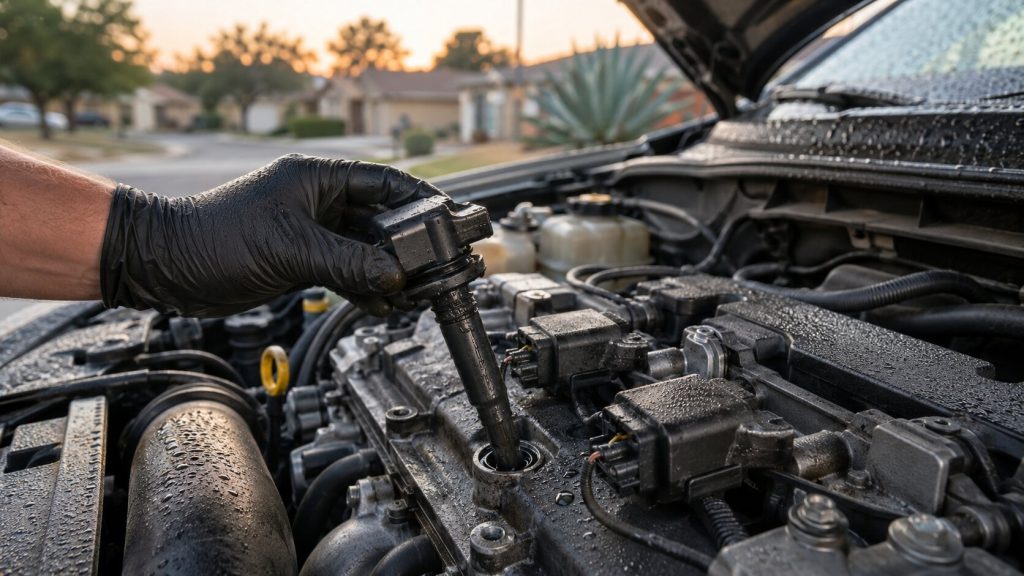
=What High Humidity Does to Spark Plug Gap and Ignition Coil Performance at Cold Start
Spark energy needs a clean path. OEM spark plug gap specification for most modern passenger vehicles falls between 0.028 and 0.060 inches depending on platform. A properly gapped plug requires 8,000 to 15,000 V to fire across that gap under normal compression.
Spark plug boots and coil-on-plug ignition systems are engineered to maintain dielectric isolation against moisture at the spark plug well. Condensation forming on an intact boot does not cause a problem. Condensation forming inside a boot with a hairline crack or aged seal gives the spark an easier path to ground than the plug gap itself. Spark energy follows the path of least resistance, and that path is the moisture film, not the gap.
Ignition coil secondary winding resistance on most platforms falls between 4,000 and 15,000 ohms depending on coil design. A coil with secondary winding insulation breakdown, often accelerated by repeated moisture exposure and thermal cycling, can test within specification when dry. The same coil fails to deliver adequate secondary voltage when humidity infiltrates a hairline crack in the boot or tower, producing a misfire that disappears once the engine warms and the moisture evaporates.
On older distributor-equipped platforms still serviced in the San Antonio fleet, the cap and rotor present a separate moisture susceptibility. A cap with hairline cracking or a degraded seal allows condensation to form on the interior cap surface and rotor tip under high humidity, creating a carbon tracking path between terminals.
Diagnostic Verdict. On vehicles presenting with humid-morning cold-start misfire, spark plug boot inspection confirms visible moisture film or cracking on at least one cylinder in the majority of cases, with ignition coil secondary resistance testing outside the 4,000 to 15,000 ohm range on the affected cylinder when the coil is tested while still wet from overnight condensation.
How Shavano Park Spring Mornings Create Peak Moisture Exposure on Ignition Components
Shavano Park’s overnight parking pattern drives the exposure. The neighborhood’s mature residential tree canopy reduces some radiative heat loss, but the surrounding open lawn and driveway areas common to the area still allow significant overnight radiative cooling. Combined with San Antonio’s documented spring morning humidity of 65% or higher, vehicles parked outdoors in Shavano Park accumulate visible dew on exterior surfaces and, on aging ignition components with compromised seals, condensation intrusion at the spark plug well before the first cold start of the day.
Shavano Park sits within the broader Edwards Aquifer recharge zone region, an area whose limestone geology and surface water features contribute to elevated regional humidity compared to drier inland areas. That regional baseline compounds the spring morning condensation pattern, extending the window during which moisture-sensitive ignition components face condensation risk beyond the peak spring months into early summer mornings.
Castle Hills and Stone Oak residents who park vehicles outdoors overnight experience the same humid-morning misfire risk as Shavano Park drivers. Vehicles parked in covered or enclosed garages overnight in these same neighborhoods show a measurably lower incidence of humid-morning misfire complaints at the shop, supporting condensation exposure as the primary variable rather than vehicle age or mileage alone.
In vehicles we service from the Shavano Park and Castle Hills area parked outdoors overnight, spring morning misfire complaints consistently arrive on the first cold day following a clear, dewy night rather than during sustained rain. Inspection of spark plug boots on these vehicles regularly shows visible moisture film or cracking on at least one cylinder, even on vehicles with otherwise normal engine performance throughout the rest of the day.
Diagnostic Verdict. On Shavano Park and Castle Hills vehicles parked outdoors overnight following a clear humid night, spark plug boot moisture or cracking is confirmed on at least one cylinder in the majority of misfire complaints, while comparable garage-parked vehicles of similar age and mileage show no equivalent condensation finding.
The Misfire Pattern From Moisture Tracking to Cylinder Combustion Irregularity
The misfire has a recognizable timeline. It appears within the first 1 to 2 minutes of engine operation and smooths out completely once the engine warms. That self-resolving window is the diagnostic signature, not a sign the problem corrected itself.
A humidity-related misfire typically registers as P0300, a random cylinder misfire code, or cylinder-specific codes such as P0301 through P0308, depending on which cylinder’s ignition components are most affected by moisture intrusion. Freeze frame data on these codes commonly shows the fault occurring at engine coolant temperatures below 100°F, consistent with a cold start event. The code clears or does not recur once the engine reaches normal operating temperature of 195°F to 220°F.
That temperature correlation is the key. As the engine warms, underhood and engine compartment heat evaporates the condensation that was tracking the spark to ground. The spark plug gap regains its position as the path of least resistance, and the misfire stops. The driver experiences a rough idle or stumble that clears up on its own, and reasonably assumes the issue is resolved.
The pattern we see most often on San Antonio spring humidity misfire complaints is a rough idle or stumble in the first 1 to 2 minutes of engine operation that smooths out completely once the engine reaches normal operating temperature. That self-resolving timeline, distinct from a misfire that persists through the whole drive, is the diagnostic signature associated with moisture intrusion at the ignition components rather than a worn spark plug or fuel delivery issue.
Diagnostic Verdict. On vehicles with this self-resolving cold-start misfire pattern, scan tool freeze frame data confirms the misfire code set at coolant temperature below 100°F with no recurrence above 195°F, and visual inspection of the affected cylinder’s boot or coil confirms a cracked seal or contaminated terminal as the moisture entry point.
What the Diagnostic Process Confirms Before Spark Plug or Ignition Coil Service
A self-resolving misfire gets dismissed as a non-issue more often than the evidence supports. Many drivers and some service advisors assume an intermittent cold-start misfire that clears up on its own means nothing is wrong, since the engine runs fine for the rest of the day. The diagnostic reality is that condensation tracking inside an aging spark plug boot or ignition coil is a progressive failure, not a one-time event.
A boot or coil that tracks moisture once will track it again on the next humid morning. The underlying crack or seal degradation that allows moisture intrusion does not heal itself between humid mornings. Left unaddressed, repeated misfire events on the same cylinder can foul that cylinder’s spark plug faster than normal wear, and sustained unburned fuel passing into the exhaust during repeated cold-start misfires raises catalytic converter temperature beyond its normal operating range over time.
The cold-start versus warm-engine misfire comparison test confirms the source before any part is replaced. A misfire confirmed by scan tool freeze frame data at coolant temperatures below 100°F that does not recur once the engine reaches 195°F to 220°F operating temperature confirms moisture intrusion as the source. Visual inspection of the affected cylinder’s boot or coil for cracking or contamination then confirms the specific component requiring replacement.
Drivers who need a San Antonio mechanic for ignition system and misfire diagnosis serving Shavano Park and Castle Hills benefit from that two-step confirmation before scheduling a spark plug or coil replacement. The test isolates the specific cylinder and component rather than replacing an entire set of plugs or coils when only one boot or coil tower has a moisture entry point.
Diagnostic Verdict. On vehicles where the cold-start versus warm-engine comparison confirms moisture intrusion as the source, replacement of the affected spark plug boot or ignition coil resolves the humid-morning misfire in the confirmed majority of Shavano Park and Castle Hills cases, without full ignition system replacement.
Shavano Park and Castle Hills drivers noticing a rough idle on humid mornings that smooths out after a few minutes can schedule an ignition system diagnostic with Ruben’s Auto Repair, 7210 Polar Bear, San Antonio, TX 78238, at (210) 647-1148, before condensation tracking advances to repeated misfire events.