
Chassis flex noise on Medical Center district road surfaces traces to torsional stress at frame crossmember weld points, cab and bed mount bolt torque loss below OEM specification, or stress crack propagation at frame rail weld zones. Acceptable frame rail torsional flex measures 0.5 to 1.5 degrees under diagonal load. Flex above 2.0 degrees produces audible creaking on every torsional load cycle.
What Torsional Stress Does to a Vehicle Frame on Uneven Road Surfaces
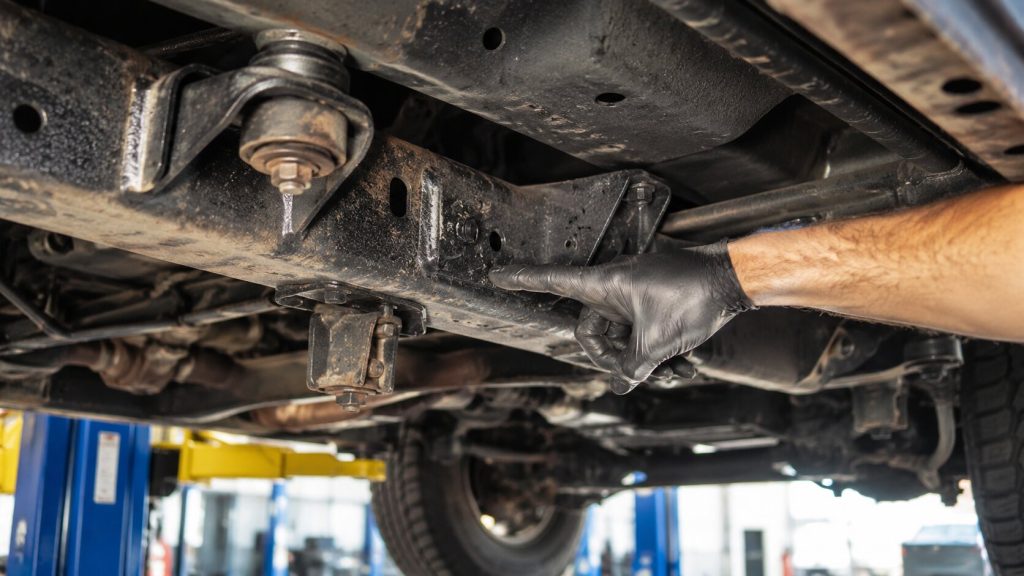
Frame creak starts with diagonal wheel load. When one wheel drops into a utility cut repair or pothole while the opposing wheel remains on flat pavement, the frame absorbs a torsional flex cycle across its full length. On body-on-frame light-duty trucks, acceptable torsional flex under that load measures 0.5 to 1.5 degrees of twist along the frame centerline at the crossmember weld points.
Flex above 2.0 degrees indicates crossmember weld fatigue or frame rail deformation. At that threshold, the weld zone moves under load in a way it was not designed to move. The movement produces an audible creak on every torsional cycle. A 2 to 3 inch pothole drop at 20 mph generates an estimated vertical impact load of 2.5 to 3.5 times the static axle weight at the frame rail suspension attachment point.
Repeated impact loads above 2.5 times static axle weight concentrate stress at the crossmember weld heat-affected zones. That is where frame fatigue crack initiation begins. Medical Center district utility cut repairs and patched road surfaces deliver this load category to vehicle frames at low speed under stop-and-go traffic conditions. The repetition of that load on the same weld points, day after day, advances crack width faster than highway mileage at steady load.
Cab and bed mount bolt torque adds a second failure mode. Ford F-150 cab mount bolts specify 59 ft-lb. GM Silverado cab mount bolts specify 63 ft-lb. Cab bed mount bolt torque on both platforms specifies 35 to 55 ft-lb at the bed interface. Torque below 80% of OEM specification at any mount position allows micro-movement at the frame interface under torsional load.
Diagnostic Verdict. On body-on-frame trucks presenting with Medical Center corridor creak complaints, shop-floor torque checks confirm cab mount bolt torque below 80% of OEM specification on at least one mount position in the majority of cases, with torsional flex above 1.8 degrees measured at the crossmember weld zone on the same vehicles.
How Medical Center District Road Conditions Load the Chassis Under Traffic
Medical Center road surfaces are not uniform. Wurzbach Pkwy through the Medical Center corridor carries hospital transport, delivery vehicles, and daily commuter traffic over utility cut repairs with road surface elevation differentials of 1 to 3 inches at the cut edge. Vehicles navigating these cuts at 15 to 25 mph under stop-and-go conditions absorb repeated diagonal wheel loads at the frame rails on every crossing.
Hospital shift change traffic concentrates this exposure into a predictable daily cycle. A Medical Center worker or patient commuter crossing Wurzbach Pkwy utility cuts twice daily accumulates approximately 500 torsional flex cycles per year from those crossings alone. Each cycle stresses the same crossmember weld points. June ambient temperatures of 98°F to 104°F raise frame rail surface temperatures on sun-exposed vehicles to 140°F to 160°F in stop-and-go Medical Center traffic. Elevated steel temperature increases the propagation rate of existing micro-cracks at weld heat-affected zones under the same torsional load.
The Hwy 90 and Hwy 151 connector approach to the Medical Center adds a speed-transition load. Vehicles decelerating from 45 to 55 mph on the connector to Medical Center surface street speed encounter patched road surfaces and lane transition edges within a short distance. That transition shifts frame load from steady highway compression to repeated torsional impact in the same drive cycle.
In vehicles we service from the Leon Valley and Westover Hills corridors with daily Medical Center commutes via Wurzbach Pkwy, frame creak complaints correlate to commute frequency rather than total mileage. Vehicles with fewer than 70,000 miles present with audible frame creak when the owner logs five or more Medical Center district crossings per week. That onset timeline runs well ahead of where frame fatigue typically appears on highway-primary vehicles of the same age.
Diagnostic Verdict. On Leon Valley and Westover Hills commuter vehicles with Medical Center corridor creak complaints, frame rail inspection confirms torsional flex above 1.5 degrees and cab mount bolt torque below OEM specification on vehicles with fewer than 70,000 miles, consistent with accelerated fatigue from repeated utility cut crossing loads rather than age or highway mileage.
The Acoustic Indicators That Separate Frame Fatigue From Other Chassis Noise
The creak location matters. Frame fatigue creak produces a single low-frequency pop or groan in the 80 to 200 Hz range that correlates to torsional load direction. It repeats consistently on the same road surface geometry. A driver crossing the same Wurzbach Pkwy utility cut repair hears the same pop in the same location every time.
Suspension bushing creak behaves differently. Worn suspension bushings produce a higher-frequency squeak in the 300 to 800 Hz range that correlates to vertical suspension travel. It repeats on every bump and corner, not on a specific surface geometry. Exhaust hanger creak appears under acceleration and deceleration load. It does not appear under steady torsional chassis flex on a diagonal surface.
A mechanic’s stethoscope placed at the frame rail versus the suspension mount during a diagonal ramp load test separates the two sources by frequency and location. Frame fatigue creak is audible at the frame rail. Suspension creak is audible at the bushing or ball joint. The driver who hears a single pop on a specific road transition and nothing on smooth pavement is describing frame fatigue, not suspension wear.
The pattern we see most often on Medical Center corridor vehicles with chassis creak complaints is exactly that single-pop pattern on a repeatable surface transition. It is absent on smooth pavement at any speed. Suspension bushing creak presents on every bump and corner. That behavioral difference between the two noise sources is the first diagnostic signal before the vehicle goes on a lift.
Diagnostic Verdict. On vehicles where the creak reproduces consistently on the same Wurzbach Pkwy utility cut crossing and does not appear on smooth pavement, stethoscope testing confirms the acoustic signal originates at the frame rail crossmember weld zone, not at the suspension mount or exhaust hanger, in the majority of confirmed frame fatigue cases.
What the Diagnostic Process Confirms Before Frame or Mount Repair
Suspension bushings and exhaust hangers are the two most common misdiagnoses for frame creak. Both produce chassis noise. Neither produces the geometry-correlated, surface-specific pop that frame fatigue generates on Medical Center district road surfaces.
Many drivers and some service advisors replace suspension bushings on a vehicle with frame fatigue and return with the creak unchanged. Suspension bushing wear produces noise on vertical suspension travel, not on torsional chassis flex. Replacing bushings on a vehicle whose creak source is a loose cab mount bolt or a crossmember weld crack does not resolve the symptom. The re-torque test is the correct first diagnostic step, not the parts replacement.
Re-torquing all cab and bed mount bolts to OEM specification is the first action before any frame inspection begins. If the creak resolves after re-torque, the mount interface was the source. If the creak persists after all mounts are confirmed at OEM torque, dye penetrant testing at crossmember weld points confirms frame fatigue as the creak source. Dye penetrant reveals surface cracks at weld heat-affected zones that are invisible to visual inspection alone.
Drivers who need a San Antonio mechanic experienced with chassis and frame diagnosis near the Medical Center benefit from that two-step sequence. Re-torque first. Dye penetrant second. Parts are replaced only after the source is confirmed. That sequence prevents replacing suspension components on a frame fatigue problem and returning with the same creak after the first Wurzbach Pkwy crossing.
Diagnostic Verdict. On vehicles where re-torquing cab and bed mounts to OEM specification does not resolve the creak, dye penetrant testing at crossmember weld points confirms visible surface crack width at the heat-affected zone in the majority of confirmed frame fatigue cases presenting from the Medical Center corridor.
Drivers noticing a frame creak on