
Throttle hesitation at the Loop 1604 UTSA Blvd exit ramp re-acceleration point traces to accelerator pedal position sensor voltage plateau during the deceleration-to-acceleration transition, throttle body carbon deposit mechanical resistance above 1.0 mm increasing ETC plate opening time, and PCM fuel re-engagement delay after deceleration fuel cut. The hesitation is transition-specific. It does not appear at steady highway speed or in parking lot maneuvering.
What Electronic Throttle Control Delay Does to Acceleration After Exit Ramp Deceleration
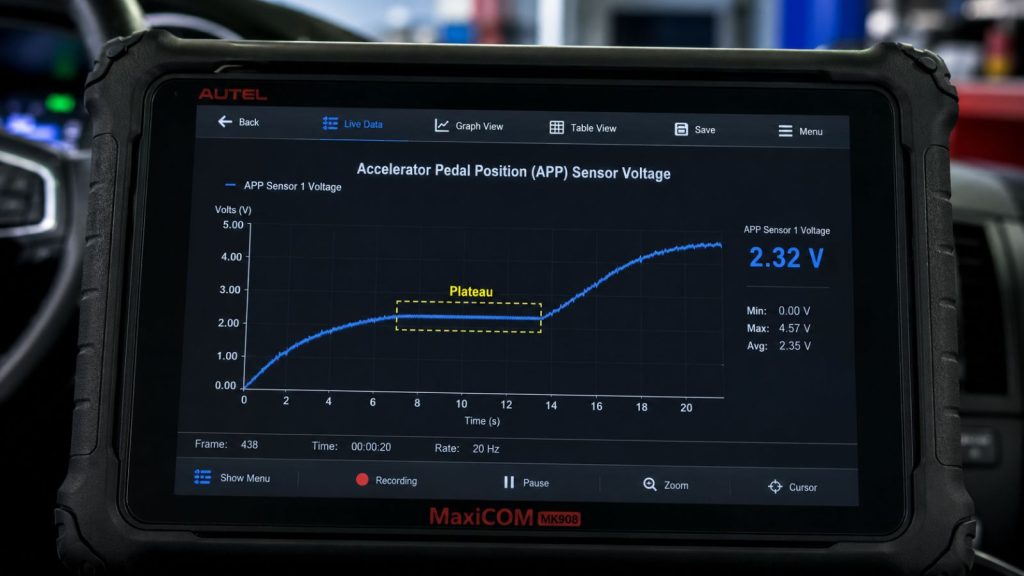
Electronic throttle control lag is a measured failure. A functional ETC system responds to accelerator pedal input within 100 to 200 milliseconds from pedal depression to throttle plate opening. A system with a degraded accelerator pedal position sensor, throttle body carbon restriction, or PCM fuel re-engagement delay responds in 400 to 700 milliseconds or longer.
At the Loop 1604 UTSA Blvd exit, the driver decelerates from 65 to 70 mph to a full stop at the signal at the bottom of the ramp within approximately 800 to 1,000 feet. That deceleration takes 6 to 8 seconds of closed-throttle operation. The PCM cuts fuel injection during that deceleration above approximately 1,200 to 1,500 RPM. When the driver re-applies the throttle at the green light, the PCM must simultaneously re-engage fuel injection, command the ETC motor to open the throttle plate, and recalculate injector pulse width.
A 400 to 700 millisecond ETC response lag during that re-engagement sequence produces the dead pedal feeling drivers describe at the UTSA Blvd exit. The car does not respond immediately to throttle input. It hesitates for a fraction of a second, then accelerates normally. That transition-specific hesitation does not occur at steady highway speed because the PCM never drops into deceleration fuel cut mode during cruise.
The throttle position sensor compounds the issue on vehicles with throttle body carbon deposits above 1.5 mm on the bore wall. Carbon prevents the throttle plate from returning to the fully closed position after deceleration, leaving the plate 2 to 4 degrees open at rest. The TPS reports that 2 to 4 degree open position as a non-idle signal, causing the PCM to miscalculate the re-acceleration fuel demand at the ramp bottom and delaying the injector pulse width increase by an additional 100 to 300 milliseconds.
Diagnostic Verdict. On vehicles presenting with UTSA Blvd exit ramp throttle hesitation complaints, scan tool ETC data confirms APP sensor voltage plateau at 1.5 to 2.0 V for 300 to 500 milliseconds during the ramp re-acceleration event before climbing to commanded throttle demand voltage, with throttle body carbon deposit thickness above 1.0 mm confirmed on inspection of the same vehicle.
How Loop 1604 Exit Ramp Geometry Near UTSA Blvd Creates Peak Throttle Transition Demand
Exit ramp geometry drives the diagnostic. The Loop 1604 exit ramp at UTSA Blvd descends from freeway speed to a signalized intersection within a short distance. The driver decelerates hard, stops, then immediately re-accelerates onto UTSA Blvd toward campus or into the Northwest Crossing residential grid. That sequence of full highway deceleration to full stop to immediate re-acceleration within 300 to 500 feet is the highest-demand throttle transition in the UTSA area commute.
UTSA student, faculty, and staff commuters using this exit daily accumulate approximately 500 full deceleration-to-acceleration ramp transitions per year on this single exit point. Each transition cycles the ETC system through its maximum rate-of-change demand. APP sensor potentiometer tracks wear under that cycle frequency faster than on a vehicle driven primarily at steady highway speed or in city stop-and-go traffic without the highway-to-zero deceleration component.
June heat adds a mechanical dimension. A vehicle parked in a UTSA surface lot during a June afternoon in ambient temperatures of 98°F to 104°F carries underhood temperatures well above ambient at engine start. That heat soak raises throttle body surface temperature before the first drive cycle of the afternoon commute. Carbon deposits at elevated throttle body temperature are harder and less compliant, increasing throttle plate mechanical resistance at the exact moment the driver needs clean ETC response exiting Loop 1604 at UTSA Blvd.
In vehicles we service from the UTSA and Northwest Crossing area with daily Loop 1604 commutes via the UTSA Blvd exit, APP sensor voltage output at the re-acceleration transition consistently shows non-linear voltage rise on scan tool data. The signal plateaus at 1.5 to 2.0 V for 300 to 500 milliseconds before climbing to the commanded throttle demand voltage. That plateau is the sensor track wear pattern on vehicles with more than 40,000 to 50,000 miles of daily UTSA Blvd exit cycling.
Diagnostic Verdict. On UTSA and Northwest Crossing commuter vehicles with daily Loop 1604 exit use above 40,000 miles, APP sensor voltage trace during a live scan tool ramp re-acceleration test confirms the plateau pattern in the majority of confirmed ETC hesitation cases, with TPS idle voltage reading above 0.7 V confirming throttle plate not returning to fully closed position on the same vehicles.
The Throttle Response Delay Progression From APP Sensor Wear to Drive-By-Wire Lag
The hesitation builds gradually. The first stage is a barely perceptible pause at the UTSA Blvd ramp bottom that the driver dismisses as normal. APP sensor voltage rise at this stage plateaus for 100 to 200 milliseconds. Throttle body carbon deposits measure 0.8 to 1.0 mm. The combined delay is at the low end of the perceptible range.
The second stage is a noticeable half-second dead pedal before the vehicle begins to accelerate. The driver has to mentally account for the lag and push the pedal slightly further to command the response they expect. APP sensor plateau extends to 300 to 400 milliseconds. Throttle body carbon is above 1.0 mm and the throttle plate no longer returns to the fully closed TPS position after deceleration.
The third stage is a hesitation long enough to create a gap in traffic. The driver releases the brake, presses the throttle, and the car sits momentarily before moving. Other drivers notice. The combined delay from APP sensor lag, ETC plate resistance, and PCM fuel re-engagement delay reaches 600 to 900 milliseconds at this stage. Stone Oak and Northwest Crossing Loop 1604 commuters presenting at stage three consistently report the symptom is exclusive to the UTSA Blvd exit and not present anywhere else on the same commute.
The pattern we see most often on Stone Oak and Northwest Crossing Loop 1604 commuter vehicles with throttle hesitation complaints is a driver who reports the hesitation only at the UTSA Blvd exit ramp re-acceleration and nowhere else. The same driver reports normal throttle response at steady highway speed and in parking lot maneuvering. That specific location-and-event correlation is the diagnostic signature of deceleration-to-acceleration ETC transition lag, not a general throttle body or fuel system fault.
Diagnostic Verdict. On vehicles at stage three of this progression, scan tool APP sensor voltage trace during a ramp re-acceleration simulation confirms plateau duration above 500 milliseconds, with throttle body inspection confirming carbon deposit thickness above 1.5 mm at the bore wall and TPS idle voltage above 0.7 V confirming a throttle plate that no longer seats fully closed after deceleration.
What the Diagnostic Process Confirms Before Throttle Body or ETC System Service
Fuel injector fouling and ignition coil weakness both produce throttle hesitation. Both produce hesitation under different conditions than ETC transition lag. The distinction matters because fuel injector cleaning or coil replacement on a vehicle with APP sensor track wear does not resolve the ramp re-acceleration hesitation.
A dirty fuel injector produces hesitation under sustained acceleration at any speed, not just at the deceleration-to-acceleration transition from a ramp stop. The driver feels it on highway on-ramp acceleration, on passing maneuvers, and in parking lot maneuvering at low speed. A weak ignition coil produces a misfire under load felt as a stumble with RPM fluctuation, accompanied by an OBD-II P030X misfire code in the scan tool freeze frame. ETC transition lag produces a hesitation with no misfire code, no RPM fluctuation, and no symptom at sustained acceleration speeds. That behavioral and code pattern distinction separates the sources before any part is removed.
Many northwest side drivers have approved fuel injector service on a vehicle that hesitated at the UTSA Blvd exit on the next commute. The injector service addressed a symptom that the APP sensor voltage trace would have ruled out. The injectors deliver fuel correctly at steady throttle demand. They have no involvement in the deceleration fuel cut re-engagement timing that the ETC and APP sensor control.
The scan tool APP sensor voltage trace test confirms the source. Recording APP sensor output voltage in live data during a ramp deceleration-to-acceleration event shows whether the signal rises linearly with pedal input or plateaus before reaching commanded voltage. A plateau of 300 milliseconds or more confirms APP sensor track wear as the hesitation source. If the APP signal rises cleanly and the hesit