
AC system pressure warnings on San Antonio vehicles typically follow DIY refrigerant recharge errors that leave the system 50 to 100 grams off OEM specification. R-1234yf systems require weight-based recharge accurate to ±5 grams, which can-tap pressure kits cannot deliver. Professional diagnosis catches sensor contamination and overcharge damage before compressor failure.
A car AC system pressure warning means the vehicle’s onboard sensors have detected a refrigerant charge that falls outside the manufacturer-specified operating window. For first-time car owners across the Northwest Side, Helotes, and the broader Bexar County service area, this warning frequently appears after a well-intentioned attempt to use a DIY recharge can from a local auto parts retailer. The problem is not the driver’s effort — the problem is that modern refrigerant systems no longer tolerate the pressure-based guesswork that DIY kits depend on.
What the AC System Pressure Warning Actually Indicates
The pressure warning on modern vehicles is reported by a low-pressure sensor mounted on the suction line and, on most R-1234yf systems, a corresponding high-pressure sensor on the discharge side. These sensors continuously monitor refrigerant pressure against the manufacturer’s expected operating range and trigger a fault code when readings fall outside it.
On a correctly charged R-1234yf system at 95°F to 105°F ambient, the high-side pressure at idle with the compressor engaged typically reads 200 to 250 PSI. The low-side, by contrast, sits between 25 and 45 PSI. When the system reports a pressure warning, the actual fault is almost never a sensor problem — it is the charge mass behind the pressure reading. The sensor is the messenger.
Diagnostic Verdict: Manifold gauge profiling on a Northwest Side intake vehicle recorded a high-side reading of 412 PSI at idle in 102°F ambient, confirming the warning was triggered by overcharge, not a faulty sensor.
Why DIY Recharge Can Gauges Misrepresent System Charge
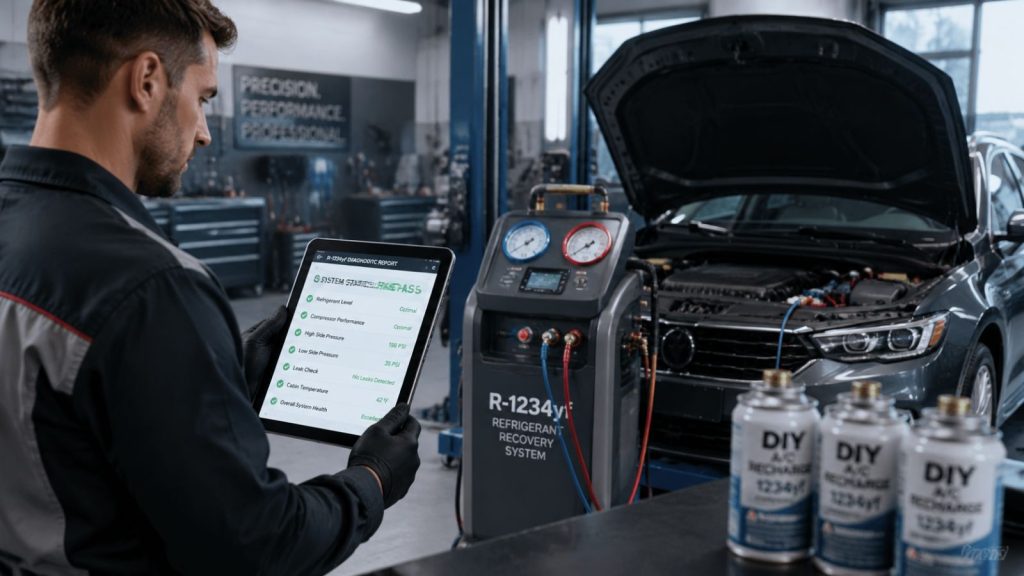
DIY refrigerant cans sold at retail display a single pressure reading on a built-in gauge — the low-side pressure at the service port. The gauge face is color-coded with a “low” zone, an “okay” zone, and a “high” zone designed to be intuitive for non-technicians. The problem is that this gauge measures pressure only, not mass.
A system can read in the “okay” zone on the can gauge while being mechanically undercharged by 100 grams or overcharged by 80 grams. Pressure varies with ambient temperature, compressor cycle state, and condenser airflow — none of which the can gauge accounts for. A first-time owner adding refrigerant on a 78°F morning and then driving into a 105°F afternoon will see pressures shift dramatically, but the can gauge has already done its job and been discarded.
Diagnostic Verdict: Recovery and weigh-back testing on a Helotes intake vehicle showed a system that had read “okay” on a DIY gauge actually contained 612 grams of refrigerant against an OEM specification of 525 grams — an overcharge of 87 grams that triggered the dashboard pressure warning.
How Overcharging by a Single Can Damages the Compressor
When refrigerant charge exceeds OEM specification by 50 grams or more, the high-side pressure climbs into the 350 to 450 PSI range at Texas summer ambients. The compressor was engineered to operate against pressures roughly half that magnitude. Sustained operation against elevated head pressure stresses the internal swashplate, accelerates seal wear, and forces the high-pressure cutout to engage more frequently — interrupting cooling and shortening the compressor’s service life.
The damage is rarely immediate. A car owner who overcharges with a single can in May may experience no obvious symptoms until July, when sustained 105°F afternoons combined with the overcharge push the system past its cutout threshold during a commute. By that point the compressor seals have been stressing under elevated pressure for weeks, and the eventual repair cost runs from compressor replacement to full system flush, expansion valve service, and condenser inspection.
Diagnostic Verdict: Teardown inspection of a compressor pulled from a vehicle DIY-overcharged the prior season revealed scoring on the swashplate consistent with prolonged high-pressure operation, confirming overcharge as the failure root cause.
Why R-1234yf Systems Require Weight-Based Recharge, Not Pressure-Based
Modern R-1234yf systems specify refrigerant charge by mass, with OEM-stated capacities typically falling between 450 and 750 grams depending on vehicle. Manufacturer tolerance on this charge is ±5 grams. Achieving that precision requires a recovery and recharge machine with an integrated scale accurate to single-gram resolution — equipment that costs between three and five thousand dollars and sits in professional service bays, not glove compartments.
DIY can-tap kits deliver between 340 and 425 grams per can with no weight feedback. The operator has no way to know how much refrigerant actually transferred into the system versus how much remained in the can or vented to the atmosphere during attachment. This means even a careful DIY operator following the can’s instructions can end up 60 to 120 grams off specification through no fault of their own — purely because the tool cannot measure mass.
Diagnostic Verdict: Side-by-side weight comparison of three DIY recharge cans at the shop showed a delivery variance of 47 grams between cans of the same brand and stated capacity, demonstrating that even consistent DIY technique cannot achieve OEM tolerance.
How Texas Summer Ambient Amplifies DIY Recharge Errors
A first-time owner driving the I-10 climb between Boerne and Comfort during summer exposes the AC system to sustained underhood temperatures above 110°F and continuous compressor load for 25 to 40 minutes. A DIY-overcharged system that reads normal at idle in a 78°F San Antonio morning trips its high-pressure cutout under this sustained Hill Country load, leaving the driver with no AC for the duration of the climb.
The same amplification effect occurs in Loop 410 stop-and-go traffic between UTSA and La Cantera during a July afternoon. Ambient temperatures push past 105°F, ram-air cooling across the condenser drops to zero, and a DIY-undercharged system that left the recharge attempt 80 to 150 grams light fails to maintain cabin temperatures below 78°F even at maximum fan speed and full recirculation. The driver concludes the AC “just isn’t strong enough,” when the actual diagnosis is inadequate charge mass.
Diagnostic Verdict: Cabin vent temperature measurement on a Loop 410 intake vehicle recorded 61°F output at maximum settings on a 104°F afternoon, with subsequent recovery confirming the system was 122 grams below OEM charge specification.
What Professional Diagnosis Reveals That DIY Cannot Detect
Beyond charge mass, professional diagnosis identifies failure modes that DIY kits not only miss but actively cause. Most DIY recharge cans contain a UV leak-detection dye blended with sealant compounds intended to plug small leaks automatically. These sealants can foul the low-pressure sensor on R-1234yf systems and contaminate the recovery machine on subsequent professional service, which is why many shops now charge a recovery-contamination fee on vehicles that show DIY sealant residue.
Sensor replacement following sealant contamination typically runs in the parts cost range Lonnie should verify against current supplier pricing before publish. Professional diagnosis also catches expansion valve restriction, condenser fan amp draw variance, evaporator surface temperature anomalies, and refrigerant identifier readings that confirm whether the system contains pure R-1234yf or has been contaminated with mixed refrigerants from prior DIY work. None of these conditions can be detected from a single-point pressure gauge on a recharge can. They require dedicated weight-based refrigerant charge service and proper recovery equipment.
Diagnostic Verdict: Refrigerant identifier testing on a DIY-recharged intake vehicle reported 14% air contamination and 7% mixed-refrigerant content, confirming the prior DIY attempt had introduced atmospheric and chemical contamination beyond the visible overcharge.
First-time car owners can have their AC system pressure validated against OEM charge specifications at Ruben’s Auto Repair, 7210 Polar Bear, San Antonio, TX 78238, before DIY damage compounds into compressor failure.