
Continuous roaring at fifty miles per hour indicates severe wheel bearing damage. Mechanics use thermal differentials, dial indicators, and rotational force tests to isolate worn hub assemblies. Early detection prevents sudden wheel lock up along major Bexar County corridors. Technicians must measure these tight mechanical clearances to ensure safe high speed highway commuting.
Frictional Heat Break Down of Factory Hub Grease
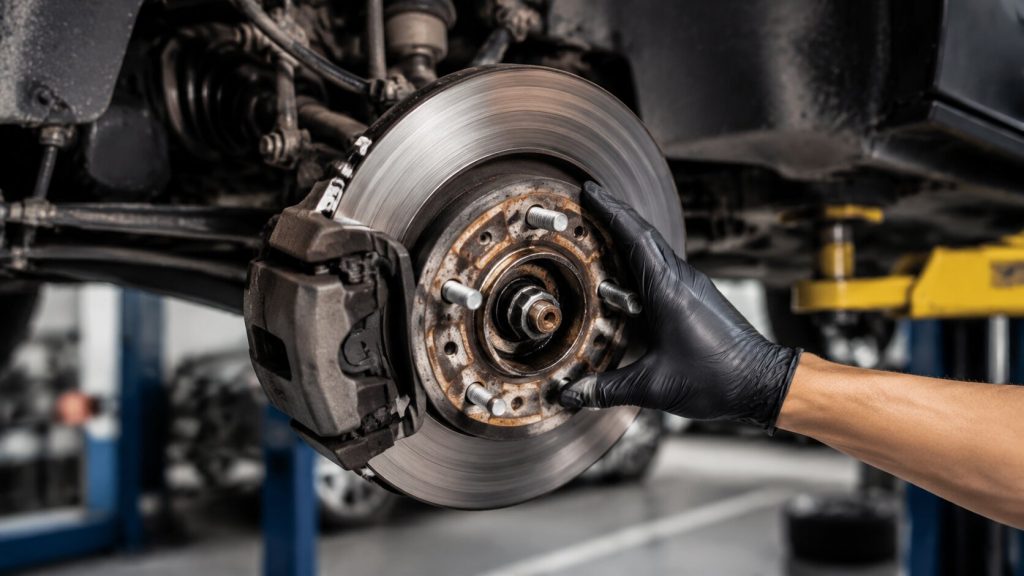
Highway speeds generate massive kinetic energy. A healthy wheel hub assembly operates between 110 to 130°F during normal South Texas highway operation. Worn internal roller bearings create intense friction that drives temperatures up to 180 to 220°F. This thermal spike destroys the dropping point rating of standard factory hub lubricants.
In vehicles we service from the Stone Oak and north Highway 281 corridor, we consistently find that front-wheel bearings on heavy luxury crossover SUVs fail roughly 15 to 20% faster than sedan baselines. The sustained elevated speeds combined with a higher curb weight accelerate oil separation inside the sealed unit. The compromised grease turns into a hard, gritty carbon residue that can no longer protect the rolling elements.
You will first notice a low-frequency rumble that mimics aggressive off-road tire tread. The sound intensifies during long acceleration ramps where the vehicle maintains high velocity for several minutes. Left unaddressed, the localized heat distorts the hardened steel bearing races and ruins the outer grease seal.
Diagnostic Verdict. Hub temperatures exceeding 180°F after a ten-mile road test confirm immediate internal lubricant breakdown.
Axial Endplay Tolerances and Excessive Hub Movement
Precise clearance prevents hub destruction. Original equipment manufacturer specifications call for 0.000 to 0.002 inches of axial endplay when measured with a professional dial indicator. A failed or deeply worn wheel bearing allows movement to exceed 0.015 inches. This mechanical play causes the brake rotor to wobble against the caliper pads.
After 25 years of servicing commuter vehicles in Bexar County, the consistent finding is that front passenger-side wheel bearings fail more frequently due to the accumulation of road debris and deep standing water along outer highway lanes. Access roads near Encino Rio collect deep water pockets during heavy seasonal thunderstorms. Submerging a hot hub creates a vacuum that pulls moisture past worn seals.
Water intrusion dilutes the grease and initiates micro-pitting along the internal steel tracks. This pitting creates micro-vibrations that transfer directly up the steering column during high-speed travel. You will feel a distinct loose sensation in the steering wheel when changing lanes at 65 miles per hour.
Diagnostic Verdict. Axial endplay measurements greater than 0.015 inches require immediate replacement of the entire integrated hub unit.
Discrepancies Between Cupped Tire Wear and Bearing Hum
Tire wear patterns often mimic bearing failures. A cupped tire tread creates a cyclical roaring noise that sounds identical to a worn hub assembly. Many drivers assume a loud highway hum always means a wheel bearing is failing. The diagnostic reality is different. Here is what the readings show.
Some sources recommend replacing hub components based solely on cabin noise symptoms. In our experience with Bexar County driving conditions, bearings with severe internal grease degradation and microscopic metal spalling can remain completely tight with zero endplay while still generating deafening noises at highway speeds. A technician must isolate the sound using a dedicated chassis ear system.
We mount electronic microphone sensors directly to the steering knuckle and the suspension strut tower. We then run the vehicle on our alignment machine rollers to monitor specific frequency outputs. Cupped tires generate a broad acoustic frequency pattern. A pitted bearing produces a sharp spike at a narrow frequency baseline.
Diagnostic Verdict. A quiet chassis ear reading on the steering knuckle proves the highway noise stems from uneven tire wear.
How Technicians Isolate Worn Wheel Hub Assemblies
Lifting the vehicle allows physical inspection. A new, properly torqued hub assembly requires approximately 5 to 15 inch-pounds of rotational torque to spin. Mechanical pitting or moisture intrusion increases resistance or causes rough notched rotations exceeding 35 inch-pounds of force. Technicians spin the wheel by hand while gripping the coil spring.
- Feel for spring vibrations. A damaged bearing transfers a distinct gritty roughness into the suspension spring.
- Check for structural play. Grab the tire at the twelve and six o’clock positions to push and pull vigorously.
- Listen with a stethoscope. Spin the wheel using a high-speed spinner tool while placing the probe on the knuckle.
We duplicate high-speed load conditions by using a digital floor hoist. Sweeping merges on the Wurzbach Parkway interchanges transfer vehicle weight drastically. Veering left loads the right front bearing, which causes an audible pitch change if the component is failing. This load test confirms which side requires service.
Diagnostic Verdict. A rough vibrational feedback felt through the coil spring during a manual spin confirms localized race spalling.
Drivers can call or schedule a diagnostic appointment with Ruben’s Auto Repair, 7210 Polar Bear, San Antonio, TX 78238, at (210) 647-1148, before a small imbalance turns into a worn suspension component.
Frequently Asked Questions
Can I drive with a noisy wheel bearing at highway speed?
No, a noisy wheel bearing can seize completely or allow the wheel assembly to separate from the vehicle at high speed.
Does wheel bearing noise change when turning the vehicle?
Yes, veering the car transfers weight to the opposite side, which changes the load and alters the pitch of the roaring noise.
How long does a wheel bearing inspection typically take?
A professional wheel bearing diagnostic inspection using digital thermal scans and dial indicators takes approximately 45 to 60 minutes to complete.
Will a worn wheel bearing trigger a dashboard light?
Yes, excessive hub play can disrupt the anti-lock braking system wheel speed sensor and illuminate the traction control or ABS dashboard light.