
A sudden MPG drop on the Loop 1604 South to Bandera Road commute traces to long-term fuel trim above plus 10% from oxygen sensor response lag, MAF sensor contamination producing airflow readings 10 to 20% below actual, and injector deposit buildup increasing pulse width beyond the OEM efficiency baseline. The MPG drop is load-specific. It accumulates on the mixed-cycle commute and does not produce a rough idle or stored code until fuel trim exceeds the P0171 threshold.
What Fuel Trim Imbalance Does to Fuel Economy During Mixed Driving Cycles
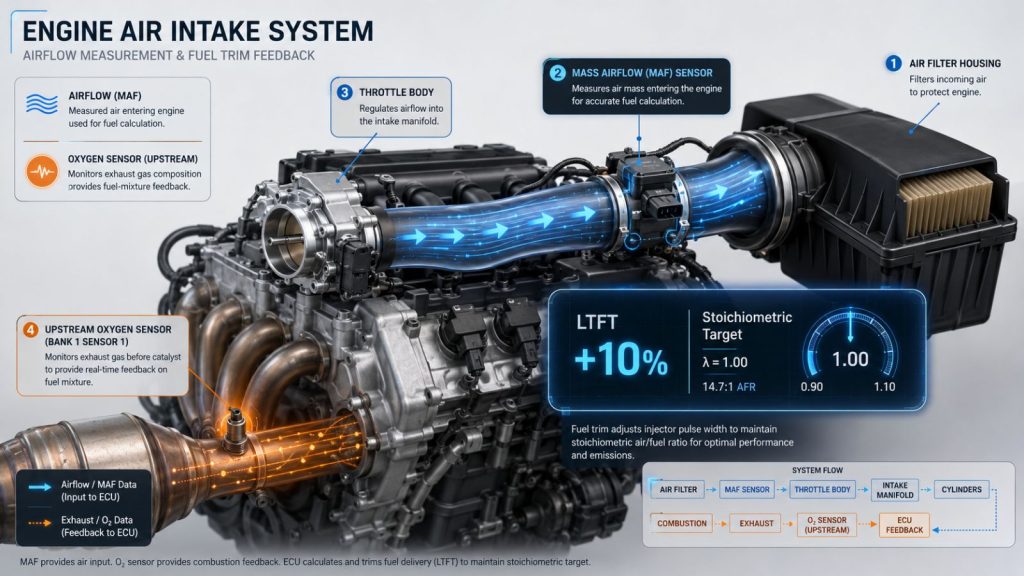
Fuel economy loss starts with a number on the scan tool. A properly calibrated fuel trim system maintains short-term fuel trim within plus or minus 5% of stoichiometric at idle and cruise. Long-term fuel trim on a healthy system holds within plus or minus 10%. When LTFT climbs above plus 10%, the PCM is adding fuel to compensate for a lean condition the sensors are not measuring accurately.
That compensation is what the driver feels at the gas pump. Every percentage point of LTFT above plus 10% represents additional fuel the engine burns beyond the OEM efficiency baseline on every mile of the commute. A vehicle with LTFT at plus 15% during Loop 1604 South cruise is burning approximately 5% more fuel than its rated fuel economy on that segment, every trip, every day of the work week.
The oxygen sensor is the primary feedback mechanism the PCM relies on for fuel trim accuracy. A functional upstream oxygen sensor switches between rich and lean at 8 to 10 times per second during closed-loop operation. A contaminated or aging sensor switches at 2 to 4 times per second. That slower response means the PCM is reacting to exhaust composition that is already 200 to 300 milliseconds old, producing fuel delivery corrections that overshoot the actual stoichiometric target.
The MAF sensor adds a second miscalculation source. A contaminated MAF sensor produces airflow readings 10 to 20% below actual at highway cruise speed. The PCM commands a leaner-than-actual fuel mixture based on that reading. The oxygen sensor detects the lean condition and LTFT climbs to compensate. The system restores combustion quality but burns more fuel than the OEM calibration intended.
Diagnostic Verdict. On vehicles presenting with Loop 1604 South corridor MPG loss complaints, scan tool LTFT data at cruise confirms readings above plus 10% in the majority of cases, with MAF sensor output voltage below OEM specification at highway cruise RPM on the same vehicles.
How the Loop 1604 South to Bandera Road Commute Pattern Loads the Fuel Trim System
The commute geometry is the stress test. The Loop 1604 South corridor between the I-10 interchange and the Bandera Road exit carries commuter traffic at sustained 65 to 70 mph, then requires deceleration to stop or near-stop at the Bandera Road interchange. That transition from sustained cruise fuel delivery to closed-throttle deceleration fuel cut to re-acceleration fuel demand within a 30 to 60 second window is the specific event that exposes oxygen sensor lag and fuel trim compensation overshoot.
During the deceleration phase, the PCM cuts fuel injection and the oxygen sensor sees a lean exhaust signal. When the driver re-accelerates from the Bandera Road stop, the PCM re-engages fuel delivery and the oxygen sensor needs to transition from lean to rich detection quickly. A slow-switching sensor lags behind that transition, causing the PCM to over-correct fuel delivery on the re-acceleration event. That overcorrection wastes fuel on each deceleration-to-acceleration transition and is invisible to the driver until the MPG drop becomes noticeable over several weeks.
Helotes and Leon Valley residents commuting southbound on Loop 1604 to the Bandera Road exit accumulate four deceleration-to-acceleration transitions per day on a round-trip commute, plus multiple additional throttle transitions within the Bandera Road surface street approach. That cycle frequency amplifies the fuel trim compensation overshoot pattern beyond what a steady-speed highway commute produces.
In vehicles we service from the Helotes and Leon Valley area with Loop 1604 South commute routes, LTFT readings at cruise consistently measure above plus 10% on vehicles presenting with MPG loss complaints, with MAF sensor contamination confirmed on inspection in the majority of those cases. The MPG drop correlates to commute frequency on this specific corridor rather than total vehicle mileage.
Diagnostic Verdict. On Helotes and Leon Valley commuter vehicles with Loop 1604 South MPG loss complaints, LTFT at cruise above plus 10% combined with MAF sensor output below OEM specification is confirmed in the majority of cases, with the LTFT reading normalizing toward plus 5% or below after MAF sensor cleaning and oxygen sensor replacement on the same vehicles.
The MPG Drop Progression From Oxygen Sensor Lag to Long-Term Fuel Trim Correction
The drop builds gradually. The driver does not notice it after one commute. It accumulates across two to four weeks of daily Loop 1604 South to Bandera Road round trips, appearing first as a vague sense that fuel stops are coming more frequently than before.
The progression follows a recognizable sequence. LTFT begins climbing above plus 10% as oxygen sensor response degrades and MAF contamination worsens. The PCM has no stored fault code yet because LTFT has not crossed the plus 15% threshold that triggers P0171. The vehicle runs smoothly. No warning light appears. The driver has no indication anything is mechanically wrong.
The second stage is a noticeable MPG decline confirmed at the pump. LTFT is holding above plus 12% to 14% at cruise, with the deceleration-to-acceleration transitions at Bandera Road producing brief LTFT spikes above plus 15% before settling. The driver connects the frequency of fuel stops to the commute but does not have a diagnostic framework for what is producing the change.
The pattern we see most often on Loop 1604 South corridor MPG loss complaints is a gradual decline over two to four weeks rather than a sudden single-event drop, with the driver noticing more frequent fuel stops before connecting the change to the commute. That gradual onset is the diagnostic signature of LTFT drift from repeated fuel trim overcorrection, distinct from a sudden MPG drop from a vacuum leak or a stuck injector.
Diagnostic Verdict. On vehicles where LTFT at cruise has climbed above plus 12% without a stored P0171 code, scan tool data confirms the LTFT spike pattern during simulated deceleration-to-acceleration transition events, with oxygen sensor switch rate below 4 Hz at operating temperature on the upstream sensor of the affected bank.
What the Diagnostic Process Confirms Before Oxygen Sensor or MAF Sensor Service
Stuck injectors and vacuum leaks get blamed for MPG drops more often than the evidence supports. A stuck-open injector produces a P0172 rich code and a rough idle detectable at all driving conditions, not a gradual MPG decline with no rough idle and no stored code. A vacuum leak produces a P0171 lean code at idle that partially corrects at higher RPM, with a rough idle on cold mornings.
LTFT-driven MPG loss from oxygen sensor lag or MAF contamination produces a gradual MPG decline with LTFT above plus 10% at cruise, no rough idle, and often no stored code until LTFT exceeds the P0171 threshold. Many Helotes and Leon Valley drivers have approved an injector cleaning service on a vehicle that returned the next month with the same MPG loss, because the sensor and MAF sources were not addressed.
The scan tool LTFT comparison test separates the sources before any part is ordered. Recording LTFT at idle, at cruise, and at the deceleration-to-acceleration transition on the Loop 1604 South to Bandera Road route confirms whether the fuel trim imbalance is load-specific or present at all operating conditions. LTFT above plus 10% at cruise that normalizes at idle points to MAF sensor contamination as the primary source. LTFT above plus 10% at both idle and cruise points toward an oxygen sensor fault or an injector issue requiring further isolation.
Drivers who need a San Antonio mechanic for fuel trim and oxygen sensor diagnosis serving the Loop 1604 South corridor benefit from that comparison test before a sensor or injector service is approved. Spark plug condition inspection rounds out the diagnostic picture, since worn plugs with gap above OEM specification contribute combustion efficiency loss on top of the fuel trim imbalance on high-mileage commuter vehicles.
Diagnostic Verdict. On vehicles where the LTFT comparison test confirms load-specific LTFT above plus 10% at cruise normalizing at idle, MAF sensor cleaning and upstream oxygen sensor replacement restore LTFT to within plus or minus 5% at cruise in the confirmed majority of Loop 1604 South corridor MPG loss cases, without injector cleaning or vacuum system repair.
Helotes and Leon Valley drivers noticing more frequent fuel stops on the Loop 1604 South to Bandera Road commute can schedule a fuel trim and sensor diagnostic with