
A UTSA student’s older car cooling fix centers on affordable diagnostic isolation to identify minor electrical failures rather than replacing major assemblies. When aging vehicles encounter heavy heat soak on Bandera Road commuters, simple failures like worn compressor clutch air gaps or blown fan relays can halt air conditioning entirely. Checking tool-verified tolerances protects college budgets from the cost of unnecessary parts.
Low Refrigerant Charge and Compressor Clutch Short Cycling
Older passenger cars driven by campus commuters frequently exhibit a rapid turning on and off of the air conditioning system, a condition known as short cycling. This mechanical symptom occurs when the underlying refrigerant charge drops below the minimum operating volume required to sustain safe system pressures. Using diagnostic manifold gauges at a 90°F morning ambient baseline, a system with low pressure will read below 50 PSI when resting.
This pressure drop trips the low-pressure cut-out switch, which cuts the 12 V power loop to the compressor clutch hub to protect the internal swashplate from running out of lubricating oil. Instead of replacing an entire compressor assembly, isolating this drop in pressure confirms that the system simply needs a precise recharge to restore factory cooling limits.
Diagnostic Verdict: Manifold gauge profiling recorded a low-side pressure drop down to 18 PSI during compressor engagement, verifying the short cycling was caused by a low refrigerant charge rather than a mechanical compressor failure.
Cabin Air Filter Restrictions and Blower Motor Resistor Failure
When a vehicle’s climate control system completely loses its lower fan speeds but continues to blow air on the highest setting, the fault rests with the blower motor resistor circuit. This component uses a series of resistive coils to control the electrical current fed to the fan. The highest setting bypasses the resistor entirely, which is why it still works while speeds 1 through 3 are dead.
During San Antonio Oak pollen season, a cabin filter can quickly become choked with debris, driving static pressure up and lowering airflow noticeably. In our shop, we measure cabin airflow with an anemometer at the center vent on fan speed 2 — readings below 600 FPM on most passenger vehicles indicate the filter is restricting airflow enough to put thermal stress on the resistor. Because the resistor relies on passing cabin airflow inside the HVAC plenum to keep cool, this restriction causes internal temperatures to spike past safe operational limits, permanently blowing the resistor’s built-in thermal safety fuse.
Diagnostic Verdict: Multimeter testing recorded a complete voltage drop down to 0.0 V across pins 1, 2, and 3 of the resistor block, confirming a blown internal thermal fuse caused by a blocked cabin air filter.
How Does a Stuck Radiator Fan Switch Cause Idling Overheating?
Idling through extended stop-and-go signal cycles on Bandera Road between Loop 1604 and the UTSA Main Campus creates an intense environment for an older car’s cooling loop. Without the benefit of highway ram-air velocity, the engine relies entirely on an electric fan to pull air through the condenser and radiator core. If the radiator fan switch or the 12 V control relay fails to close, the cooling fan will remain dead at a standstill.
Once the fan stops moving air across the condenser, high-side AC line pressures climb rapidly — typically into the 400–450 PSI range on R-134a systems, per MACS Worldwide service guidance — forcing the high-pressure safety relief valve to open and vent refrigerant gas to prevent a line rupture. The result: all cabin cooling dies before the student exits the traffic jam.
Verifying Relay Continuity and Inspecting Clutch Hub Air Gaps
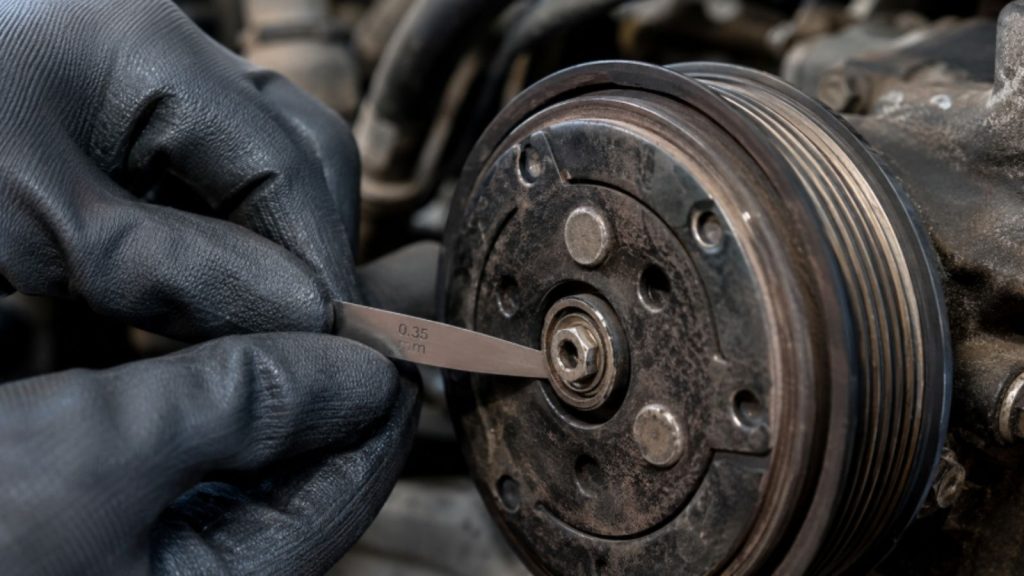
Students can check for simple failures by examining the mechanical air gap on the front of the compressor clutch hub using basic feeler gauges. Over high mileages, repeated engagement cycles wear down the friction plate, widening the physical gap beyond the factory 0.015 to 0.030 inch specification limit. When this gap expands past 0.045 inches, the magnetic field generated by the thermal coil is too weak to pull the hub forward when the unit gets hot.
The radiator fan relay is the second simple check worth running. Technicians evaluate it by testing electrical continuity across control pins 85 and 86 with a multimeter. Finding an open loop confirms a broken internal wire coil inside a cheap $15 relay, saving the student from an unneeded radiator fan motor replacement.
Real-World Case: 2011 Honda Civic, 168,000 Miles
A UTSA senior brought her 2011 Civic into the shop in late August after her AC began failing on her afternoon commute home from campus. She’d been quoted $1,400 at a chain shop for a compressor replacement and came to us for a second opinion.
I walked her through what we were checking and why. The pattern she described — cold air for the first 15 to 20 minutes, then a gradual loss of cooling once the engine bay heat-soaked in Bandera Road traffic — pointed away from the compressor and toward a worn clutch hub. We pulled the car in, let it cool, and our technician measured the air gap with feeler gauges.
Reading: 0.052 inches. Factory spec on that Civic is 0.014 to 0.026 inches.
We shimmed the clutch back to 0.020 inches using OEM washers, verified engagement at operating temperature, and sent her home the same afternoon. Total: $95 in labor and parts. The compressor she was told to replace had nothing wrong with it — just a worn friction plate that had drifted out of spec over 168,000 miles of Texas commuting.
— Lonnie Johnson, Service Manager at Ruben’s Auto Repair, serving San Antonio drivers with honest diagnostics since 1996
Post-Inspection Low-Cost Maintenance and Voltage Stabilization
Affordable cooling preservation requires targeted maintenance testing to stabilize electrical voltage loops and ensure long-term system life. We isolate worn connections, clean oxidized grounding terminals, and verify that the alternator can maintain a stable 13.8 V to 14.2 V output under full electrical load with the high-speed fan and AC blower active. After service, we verify cabin airflow has been restored to the 900–1,100 FPM range we target at the center vent on max fan — the range we’ve found correlates with adequate cooling capacity for older Civics, Corollas, and similar passenger cars surviving Texas summer heat soak without the system tripping safety cutouts.
Diagnostic Verdict: Post-inspection electrical servicing restored a stable 14.1 V charging loop to the cooling fan relay, securing reliable cooling performance under heavy commute idling.
Students can have their older car’s Heating and Cooling Services parameters and electrical loops validated at Ruben’s Auto Repair to protect their budget from unnecessary parts costs. Call us at 210-647-1148 (Mon–Fri, 7 AM–6 PM) or visit the shop at 7210 Polar Bear, San Antonio, TX 78238. You can also review our technician certifications and customer reviews before scheduling.
Frequently Asked Questions
Why does my car’s AC only blow air on the highest fan speed setting?
A clogged cabin air filter is the most common cause. When the filter restricts airflow through the HVAC plenum, the blower motor resistor — which controls fan speeds 1 through 3 — overheats and trips its internal thermal fuse. The highest setting bypasses the resistor entirely, which is why it still works. Replacing the resistor without changing the filter will blow the new resistor within weeks.
Can a bad electrical relay cause my car to overheat when idling on Bandera Road?
Yes. At idle, your engine has no ram-air cooling and relies entirely on the electric radiator fan. If the fan relay’s internal coil breaks, the fan never engages and coolant temperatures climb quickly in stop-and-go traffic. Testing continuity across the relay’s control pins confirms the failure, and the relay itself is typically a $15 part.