
Rideshare evaporator odor removal in San Antonio requires foaming bio-enzymatic chemistry injected through cleared drain lines and HVAC plenum access points, followed by a verified post-service airflow check at 900 to 1,100 FPM. The procedure eliminates mildew colonies, restores volumetric flow, and protects rideshare ratings from sour-cabin complaints.
Rideshare evaporator odor removal requires injecting specialized foaming sanitation chemistry directly into the HVAC plenum to eliminate deep-seated mildew colonies. When high-occupancy vehicles operate continuously in maximum recirculation mode across the Far West Side and Westover Hills, frequent passenger door cycling introduces heavy humidity loads that trap moisture inside the dark dash casing. Following a structured mechanical flush procedure dissolves these organic odor barriers and secures five-star passenger reviews.
Locating the HVAC Plenum Access Points and Cabin Filter Seals
Executing a professional-grade decontamination procedure requires establishing direct access to the vehicle’s interior climate control housing. The interior cabin air filter slot, typically located behind the glove compartment assembly or inside the lower passenger footwell casing, serves as the primary gateway to the upstream face of the evaporator core.
Technicians unbolt the dampening arms and lower the structural glove box door to expose the plastic plenum access panel. After unclipping the retaining tabs, the old filter element is removed. This component must be inspected for physical tracking — a dirt-blinded filter warps out of its track when static pressure drops, allowing airborne debris to bypass the seal and mat across the aluminum fins.
Diagnostic Verdict: Structural inspection of the removed filter housing revealed an unseated side flange, confirming that bypassing road dust and organic pollen had settled directly onto the wet cooling surfaces.
Clearing the Evaporator Case Drain and Verifying Volumetric Flow
Before introducing any chemical cleaners into the HVAC plenum, the lower evaporator case drain tube must be checked for blockage and cleared of organic slime. This flexible rubber drain pipe exits the floor pan directly beneath the transmission tunnel casing.
During continuous high-occupancy operations in 65%+ morning humidity, a clear casing typically dumps condensed moisture at a rate of 1.5 to 2.2 ounces during a standard 15-minute idle test — a range we have measured consistently across rideshare vehicles working Far West Side morning routes. If the line is choked with mold or dirt, water backs up into the bottom of the plenum tray, creating a stagnant pool that destroys electronics and breeds odors. Technicians apply a regulated 15 PSI air blast through the rubber tip to clear the passage and re-establish gravity drainage.
Diagnostic Verdict: Volumetric testing prior to clearing recorded an oil-slicked drain dripping less than 0.3 ounces of condensed water, proving total internal drainage failure.
Injecting Foaming Sanitation Chemistry Across the Aluminum Matrix
True odor eradication cannot be accomplished with retail aerosol sprays because thin vapors simply pass through the blower without clinging to hidden mold colonies. Technicians deploy a pressurized delivery wand through the evaporator access port or up the cleared drain line to apply an expanding, bio-enzymatic foaming cleaner directly onto the fin array.
The chemistry is formulated to self-expand throughout the tight gaps of the core, encapsulating Cladosporium mold and biological film on contact. The foam is left to sit for a strict duration limit of 15 to 20 minutes, during which it liquefies the organic matter and draws the dissolved contamination straight down out of the cleared chassis drain tube.
Diagnostic Verdict: Pressurized injection through the cleared drain line confirmed full plenum coverage when expanded foam emerged at the lower drain pan, verifying the bio-enzymatic cleaner had fully encapsulated the evaporator matrix.
Overcoming Organic Pollen Barriers with Direct Mechanical Flushing
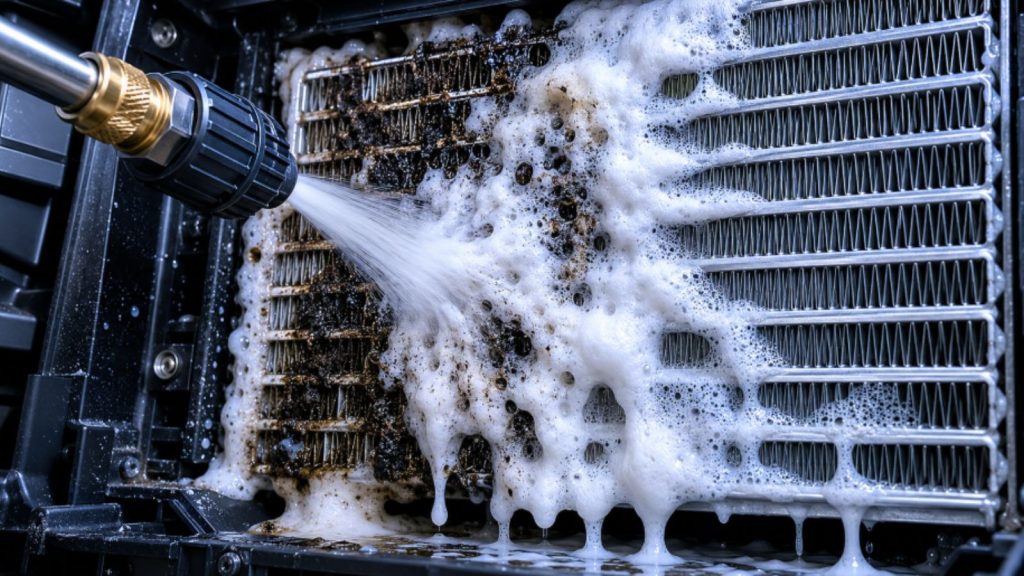
High-mileage rideshare vehicles working commuter legs on Hwy 151 between Alamo Ranch and Downtown accumulate a dense layer of microscopic San Antonio Oak pollen. At 25–30 microns, these sticky particles bond with internal moisture to form a heavy paste that blinds the aluminum core surface.
If the initial foaming cycle encounters a thick layer of this organic sludge, a second direct mechanical flush using an antibacterial rinse agent must be injected under low pressure. This secondary step breaks the surface tension of the pollen mat, washing-clearing the valleys between the cooling fins and dropping the system static pressure back to safe baselines.
Diagnostic Verdict: Digital inspection cameras captured a thick, black layer of encapsulated pollen slime breaking free from the lower evaporator bends during the second mechanical rinse sequence.
Executing the Post-Application Dry-Cycle and Airflow Verification
The final procedural phase requires stabilizing the climate control loop and thoroughly drying the treated air box internals to prevent immediate mold return. Technicians reinstall a brand-new carbon-impregnated cabin filter element to absorb secondary vapor, secure the plenum lid seals, and start the vehicle.
The HVAC module is set to full manual heat override, maximum blower speed 4, and fresh-air intake mode for a minimum run duration of 10 minutes. This high-temperature airflow flash-dries the bare aluminum fins. A digital anemometer is then placed at the center vents to confirm that volumetric delivery has been restored to the 900 FPM to 1,100 FPM range we target for adequate cooling capacity after Heating and Cooling Services restoration.
Diagnostic Verdict: Post-service testing confirmed center vent airflow velocity reached a stable 1,040 FPM with no current variance at the blower motor, proving the blower was no longer straining against a blocked core.
Drivers can have their rideshare vehicle’s HVAC plenum health and airflow parameters validated at Ruben’s Auto Repair, 7210 Polar Bear, San Antonio, TX 78238, to eliminate sour interior odors and secure professional climate performance.
Frequently Asked Questions
Why does my car AC blow a sour, vinegar smell every time a new rideshare passenger gets in?
High humidity from frequent door openings condenses inside the dark HVAC plenum, creating ideal conditions for mildew colonization on the evaporator core.
Can I fix an evaporator odor by spraying aerosol disinfectant down the dashboard vents?
No. Thin aerosol vapors cannot adhere to hidden mold colonies or break through the pollen paste matted across the aluminum core fins.
What happens if the small rubber drain tube under my vehicle becomes clogged?
A clogged drain backs up standing water inside the lower plenum tray, breeding mildew odors and risking damage to fan electronics.
How much water should my air conditioning system drop on the ground while idling?
Under normal San Antonio humidity, a healthy cooling system drains 1.5 to 2.2 ounces of condensed water every 15 minutes.
Why does my vehicle’s blower fan sound loud but barely push any air out of the vents?
Heavy bacterial colonization and dust matting on the evaporator core restrict airflow, spiking system static pressure up to 0.55 inH₂O.