Digital climate control airflow imbalance occurs when HVAC plenum actuators lose calibration or signal integrity due to 65%+ San Antonio humidity. When feedback voltage deviates by ±0.15 V, the dual-zone system fails to sync, resulting in 20°F temperature splits between vents. Validating sensor resistance and PWM duty cycles allows for computerized recovery without invasive dash disassembly.
HVAC Plenum Actuator Calibration and Digital Signal Failure Pathways
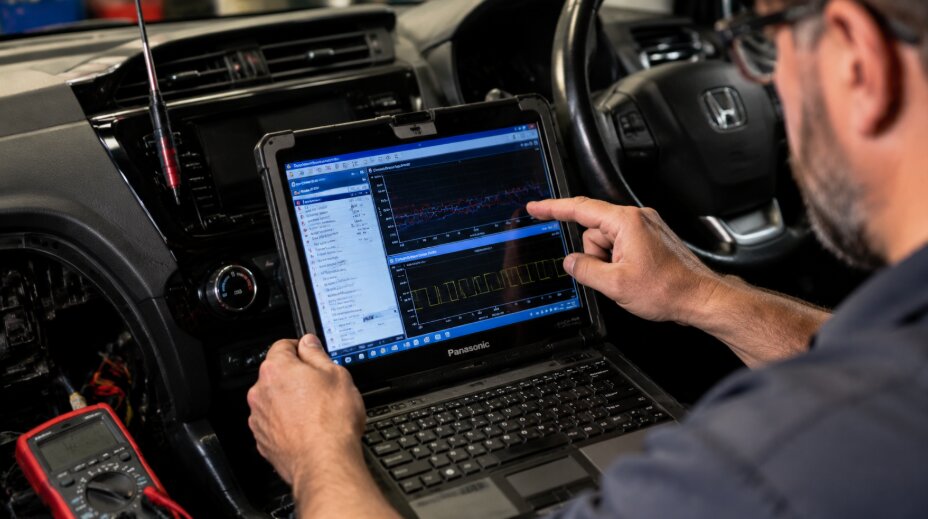
Modern computerized climate systems rely on a 5.0 V reference signal to position the internal blend doors that mix hot and cold air. In many vehicles seen in our shop, the digital climate control airflow imbalance isn’t caused by a snapped plastic door, but by a “lost” actuator. If the feedback voltage drifts outside the 0.50 V to 4.50 V operating range, the HVAC module can no longer verify the door’s position. This often results in the system defaulting to a full-cold or full-heat position on one side of the cabin to prevent component damage. We use advanced scan tool logic to force a re-calibration, “teaching” the module the physical stops of the door without removing a single trim piece.
Diagnostic Verdict: Computerized scan tool re-calibration revealed a feedback deviation of 0.22 V, which was corrected via a logic reset to restore synchronized cabin temperatures.
Braun’s Farm Morning Humidity and Evaporator Case Static Pressure
Residents in Braun’s Farm often face a unique micro-climate where high morning humidity near local creek beds settles into the vehicle’s cowl intake. As this moisture-laden air enters the evaporator case, it increases the internal static pressure. If the cabin air thermistors are slightly oxidized—a common South Texas occurrence—the digital logic miscalculates the “dew point” inside the plenum. This leads to the system aggressively closing the passenger-side blend door to prevent evaporator freeze-up, creating an unintentional temperature imbalance. We measure the static pressure and thermistor resistance to ensure the computerized “brain” is receiving accurate environmental data.
Diagnostic Verdict: Digital multimeter testing showed thermistor resistance at 10.8k Ohms (a 800 Ohm deviation), causing the HVAC module to incorrectly trigger a freeze-protection door closure.
Oscilloscope Verification of Dual Zone Blend Door PWM Duty Cycles
When a simple reset fails, we look at the Pulse-Width Modulation (PWM) signal sent to the blend door motors. Using an oscilloscope, we can see if the “brain” is actually trying to move the door or if the signal is being “clipped” by a faulty blower motor resistor or a short in the wiring harness. A healthy signal should show a clean square wave; a jagged or flat-lined wave confirms an electronic failure rather than a mechanical blockage. This level of Heating and Cooling Services ensures we aren’t just “parts-changing” but are identifying the root cause of the digital drift.
Pinpointing Sensor Resistance Deviations Without Invasive Dash Disassembly
By accessing the HVAC module data stream, we can compare driver-side and passenger-side thermistor readings in real-time. If the driver’s vent is blowing 58°F while the passenger’s vent is at 85°F, we check the resistance values at the sensor pigtails. We typically look for values that remain within 200–500 Ohms of the 10k Ohm baseline. If these values are skewed, the system thinks one side of the car is a “sauna” and reacts accordingly. This diagnostic path allows us to replace a $50 sensor rather than performing a $1,500 dash pull to find a “broken” door that was actually working perfectly.
Diagnostic Verdict: Oscilloscope verification confirmed a 60% duty cycle signal was reaching the actuator, but a high-resistance ground at the connector was dropping the effective voltage to 3.2 V.
Verification Protocols for San Antonio Computerized HVAC Recovery
Our diagnostic process concludes with a steady-state stress test on Wurzbach Pkwy. We monitor the discharge temperature delta between vents at 60 MPH to ensure that ram-air pressure isn’t overriding the calibrated door positions. A successful recovery maintains a vent delta of less than 5°F across all fan speeds. This final validation ensures that Braun’s Farm drivers can rely on their computerized climate control whether they are idling in a driveway or merging into afternoon traffic.
Diagnostic Verdict: Post-calibration road testing on Wurzbach Pkwy confirmed vent temperatures stabilized at 42°F (Driver) and 44°F (Passenger), verifying a successful digital recovery.
Drivers can have their HVAC airflow validated at Ruben’s Auto Repair, 7210 Polar Bear, San Antonio, TX 78238, before the peak summer heat sets in.
Frequently Asked Questions
Can a computer reset fix my car’s AC if it is only cold on one side?
Yes, a computerized actuator re-calibration can often re-sync the blend door positions and restore balanced cabin temperatures without replacing parts.
Do I always have to remove the dashboard to fix a stuck blend door?
No, we use advanced scan tool diagnostics and signal analysis to identify electronic faults that can be resolved without an invasive dash pull.
Does humidity in San Antonio affect how my digital climate control works?
Yes, 65%+ humidity causes condensation and connector oxidation that skews thermistor resistance, leading the HVAC module to miscalculate vent temperature settings.
Why is my passenger vent blowing hot air when the AC is on?
Yes, a feedback voltage deviation of ±0.15 V in the passenger actuator typically causes the system to default to the full-heat position.
Can a weak car battery cause my AC vents to stop syncing?
Yes, low voltage during engine cranking can “confuse” the HVAC memory, forcing the actuators to lose their calibrated home positions.