Scheduled cabin preconditioning on 2024 to 2026 connected vehicles targets a 70°F interior before driver entry. In San Antonio July ambient of 102°F to 108°F, a vehicle parked in direct sun reaches 145°F to 160°F inside within 60 minutes. A fully charged system needs 15 to 20 minutes to complete that pull-down. A borderline refrigerant charge extends it to 22 to 30 minutes.
What Cabin Preconditioning Actually Demands From Your HVAC System
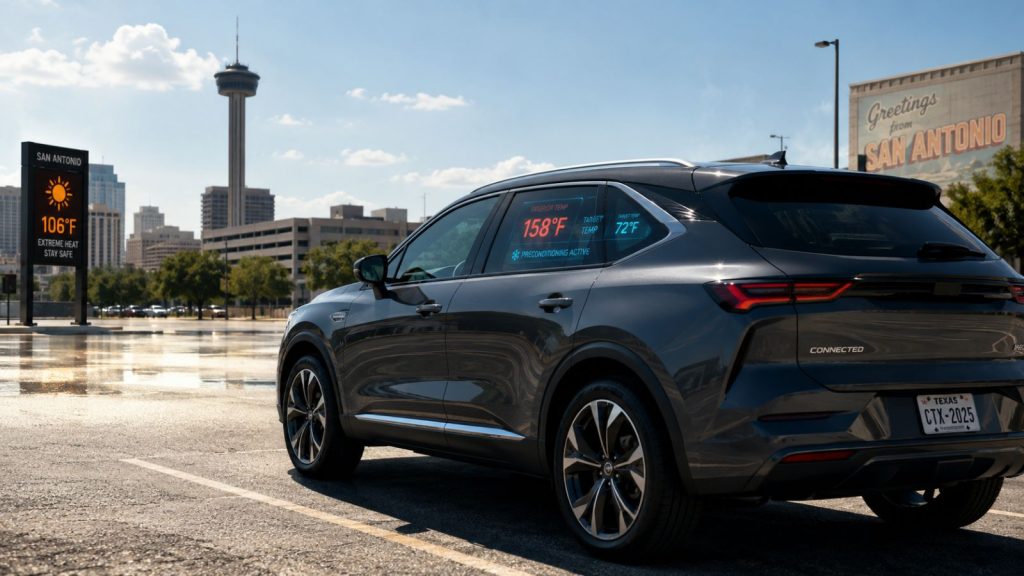
Cabin preconditioning is not a software feature. It is a full HVAC demand cycle run without the driver present. The compressor, condenser fan, blower motor, and refrigerant loop operate at or near maximum output from the moment the scheduled cycle begins.
A properly functioning compressor on an R-1234yf system draws 18 A to 24 A during sustained pull-down in 105°F ambient. That current draw runs continuously through the entire preconditioning window. A compressor with worn internal components draws the same 18 A to 24 A but produces evaporator outlet temperatures of 52°F to 58°F rather than the 38°F to 45°F baseline, extending pull-down time by 6 to 10 minutes beyond the scheduled window.
The blower motor adds a second demand layer. Effective pull-down from 150°F requires airflow of 350 CFM to 420 CFM at maximum speed. A blower motor producing 220 CFM to 280 CFM due to a failing resistor or a restricted cabin filter extends pull-down time by 8 to 14 minutes regardless of refrigerant charge condition.
Diagnostic Verdict: A vehicle completing a 15-minute preconditioning cycle with an evaporator outlet temperature of 54°F and blower airflow of 260 CFM confirms two simultaneous limiting conditions, borderline compressor efficiency and restricted airflow, each requiring separate diagnosis before the next July preconditioning season.
How San Antonio Solar Thermal Load Changes the 70-Degree Cabin Target
The 70°F cabin promise has a thermal gap built into it. Connected vehicle manufacturers calibrate preconditioning timers for parked cabin temperatures of 100°F to 115°F in temperate climates. In San Antonio in July, a vehicle parked in direct sun at Stone Oak or La Cantera reaches 145°F to 160°F inside within 45 to 60 minutes. Dashboard surface temperatures reach 180°F to 195°F in that same window.
The preconditioning feature is not defective. The thermal gap between the manufacturer’s calibration assumption and the San Antonio operating reality is what the default app timer cannot close. A 15-minute preconditioning window reaches 70°F from a 110°F starting point on a fully charged system. It delivers 85°F to 95°F at driver entry from a 155°F starting point on the same healthy system, because the thermal extraction demand is 40°F to 45°F larger.
Many Stone Oak and Shavano Park drivers interpret this as an HVAC malfunction. The diagnostic reality is different. The system is performing at specification. The app timer default was written for a climate that San Antonio does not have in July. Confirming system charge, compressor efficiency, and blower airflow before relying on preconditioning schedules is the diagnostic starting point, not the last resort.
Diagnostic Verdict: A vehicle with confirmed full refrigerant charge, 38°F to 45°F evaporator outlet temperature, and 380 CFM blower airflow delivering a 88°F cabin after a 15-minute preconditioning cycle from a 158°F thermal soak confirms a timer calibration gap, not an HVAC system fault.
What Refrigerant Charge Condition Does to Scheduled Pull-Down Time
Refrigerant charge is the single variable that most directly determines whether scheduled preconditioning reaches 70°F in a San Antonio July window. A system at full OEM charge completes a 150°F to 70°F cabin pull-down in 15 to 20 minutes in July ambient, assuming a functional compressor and clean condenser. A system 3 to 4 oz below OEM charge extends that pull-down to typically 22 to 30 minutes under the same conditions.
In vehicles we service from Stone Oak and Shavano Park, we consistently find that drivers reporting failed preconditioning performance in July arrive with refrigerant charge 3 to 5 oz below OEM specification. The preconditioning feature is functioning correctly. The HVAC system does not have the refrigerant mass flow capacity to meet the pull-down demand in the scheduled window. The driver blames the app. The diagnostic finding is a borderline charge that performed adequately in spring conditions but cannot meet July thermal extraction demand.
The Heating and Cooling Services charge and airflow evaluation at Ruben’s addresses this pattern directly. A refrigerant charge verification in June, before the first preconditioning failure, costs less time and money than a July diagnostic visit after the driver has already spent two weeks arriving at a 90°F cabin. A 3 oz deficit does not trigger a fault code. It only reveals itself under maximum demand conditions.
Diagnostic Verdict: A system measuring 3 to 4 oz below OEM refrigerant specification produces evaporator outlet temperatures of 50°F to 56°F during a July preconditioning pull-down, confirming charge deficit as the limiting factor before any compressor or blower evaluation proceeds.
Condenser Airflow and Blower CFM During Stationary Preconditioning
Stationary preconditioning removes ram airflow from the equation. A vehicle running preconditioning while parked in a Stone Oak surface lot or a Shavano Park driveway relies entirely on the condenser fan for heat rejection. That fan produces 800 CFM to 1,000 CFM of forced airflow. At 45 mph highway speed, the same condenser receives 2,500 CFM to 3,500 CFM of ram air. The efficiency difference is measurable at the condenser outlet.
In 105°F ambient with fan-only airflow, condenser outlet refrigerant temperature runs 15°F to 22°F higher than during highway operation. A condenser with 15% to 20% fin blockage from road debris reduces fan-only airflow to 650 CFM to 750 CFM, adding 4 to 7 minutes to the pull-down timeline on an otherwise fully charged system. The condenser face on vehicles from the Hwy 281 Stone Oak corridor accumulates road debris and cottonwood fiber during spring that reduces fan-only performance measurably by July.
The pattern we see most often in connected vehicle owners from the Hwy 281 Stone Oak corridor is a reliance on app default preconditioning timers set to 10 to 12 minutes. Those defaults were established for temperature-climate cabin temperatures of 95°F to 110°F. In San Antonio July, the same vehicle parked in a Stone Oak surface lot for 8 hours reaches 155°F to 165°F inside. The app timer is not wrong. It was never calibrated for this climate, and a partially blocked condenser face removes the margin that a fully clean system would otherwise provide.
Diagnostic Verdict: A condenser with confirmed 18% fin blockage producing 720 CFM of fan-only airflow at idle, combined with a 105°F ambient condition, adds 5 to 6 minutes to a 15-minute preconditioning pull-down cycle and prevents the 70°F target from being reached from a 150°F thermal soak starting point.
What Stone Oak and Shavano Park Drivers Should Verify Before Relying on Scheduled Preconditioning
Three HVAC system conditions determine whether scheduled preconditioning delivers the promised cabin temperature in San Antonio July heat. Each is independently verifiable at a service visit before the summer demand season begins.
Refrigerant charge at or above OEM specification is the first verification. A 3 to 4 oz deficit does not show up on a warning light. It shows up as a cabin that is 15°F to 20°F above the set point at the end of a scheduled preconditioning window. Charge verification in June prevents that outcome in July.
The condenser fin condition is the second. A condenser face carrying spring debris, cottonwood fiber, or compacted road grime into July operates with reduced fan-only airflow that adds measurable minutes to every stationary pull-down cycle. A condenser cleaning at the same service visit as a charge verification addresses both variables in one appointment.
Blower motor airflow at rated CFM is the third. A failing blower motor resistor or a cabin filter at 0.50 to 0.60 inH2O static pressure restricts airflow below the 350 CFM to 420 CFM threshold required for effective pull-down from high thermal soak temperatures. All three conditions are measurable. None produces a fault code before they affect preconditioning performance. Catching them before July is the only way to know the scheduled window will work when the driver needs it.
Diagnostic Verdict: Stone Oak and Shavano Park vehicles verified with full refrigerant charge, condenser airflow above 850 CFM at idle, and blower output above 360 CFM complete a 15-minute preconditioning pull-down from 150°F to 72°F to 76°F in San Antonio July ambient, within the functional range of the scheduled preconditioning feature.
Stone Oak and Shavano Park drivers can have refrigerant charge, condenser airflow, and blower CFM verified at Ruben’s Auto Repair, 7210 Polar Bear, San Antonio, TX 78238. Call the shop or book an appointment online at rubensautocare.com before July heat exposes an HVAC gap the preconditioning app cannot close on its own.
Frequently Asked Questions
Why does my car preconditioning not reach 70 degrees in San Antonio summer?
Yes, San Antonio July thermal soak of 145°F to 160°F requires 15 to 20 minutes of preconditioning on a fully charged system, exceeding most app default timer settings calibrated for cooler climates.
Does low refrigerant affect cabin preconditioning performance?
Yes, a refrigerant deficit of 3 to 4 oz extends pull-down time from 15 to 20 minutes to typically 22 to 30 minutes in San Antonio July ambient conditions.
Does a dirty condenser affect parked preconditioning in San Antonio heat?
Yes, 15% to 20% condenser fin blockage reduces fan-only airflow from 800 to 1,000 CFM to 650 to 750 CFM, adding 4 to 7 minutes to the preconditioning pull-down timeline.
What blower motor airflow is needed for cabin preconditioning from high heat soak?
Yes, effective pull-down from 150°F requires blower airflow of 350 CFM to 420 CFM at maximum speed, with restriction below 280 CFM adding 8 to 14 minutes to pull-down time.
Can a car preconditioning failure indicate an HVAC problem in San Antonio?
Yes, a cabin temperature above 85°F after a 15-minute preconditioning cycle from a 155°F thermal soak confirms refrigerant charge, condenser airflow, or blower CFM below specification.