
Dragging compressor clutch fuel loss happens when a failed AC clutch plate binds against the pulley face, creating constant 4 to 7 horsepower parasitic engine drag. This friction cuts fuel economy by 8% to 12%, even with AC off. Checking pulley torque resistance and thermal deltas restores commuter fuel efficiency.
Compressor Clutch Hub Binding and Parasitic Engine Drag
A properly operating automotive air conditioning loop isolates the heavy rotational resistance of the internal pistons using an electromagnetic clutch assembly. When the interior climate control switch is off, the compressor pulley should spin completely free on its independent bearing. This allows the main engine serpentine belt to pass without transferring energy to the internal compressor components.
However, mechanical clutch hub binding occurs when the thin steel driver plate warps or its rubber dampeners decay from age and continuous under-hood heat cycles. This physical distortion narrows the factory air gap clearance down to zero. The non-engaged clutch face then continuously scrapes against the rotating pulley.
This steel-on-steel friction forces a heavy, continuous parasitic draw of 4 to 7 horsepower from the engine crankshaft. The vehicle ends up burning excess fuel during every mile traveled.
Diagnostic Verdict: Dial torque wrench auditing recorded an unengaged pulley breakout resistance of 28 inch-pounds, confirming severe clutch plate binding and continuous parasitic crankshaft drag.
Worn Pulley Bearings and High-Velocity Drive Belt Friction
Sustained morning commutes from the Braun Farm sector down the expansive highway tracks of I-10 require vehicles to maintain constant engine speeds between 2,000 RPM and 2,500 RPM for extended intervals. This high rotational velocity exponentially multiplies the heat and friction generated by a worn compressor pulley bearing.
When the internal steel ball bearings lose their lubrication or develop structural pitting, the rotational resistance spikes. Instead of free-wheeling smoothly with less than 3 to 5 inch-pounds of breakout torque, the binding bearing drags against the accessory belt drive loop.
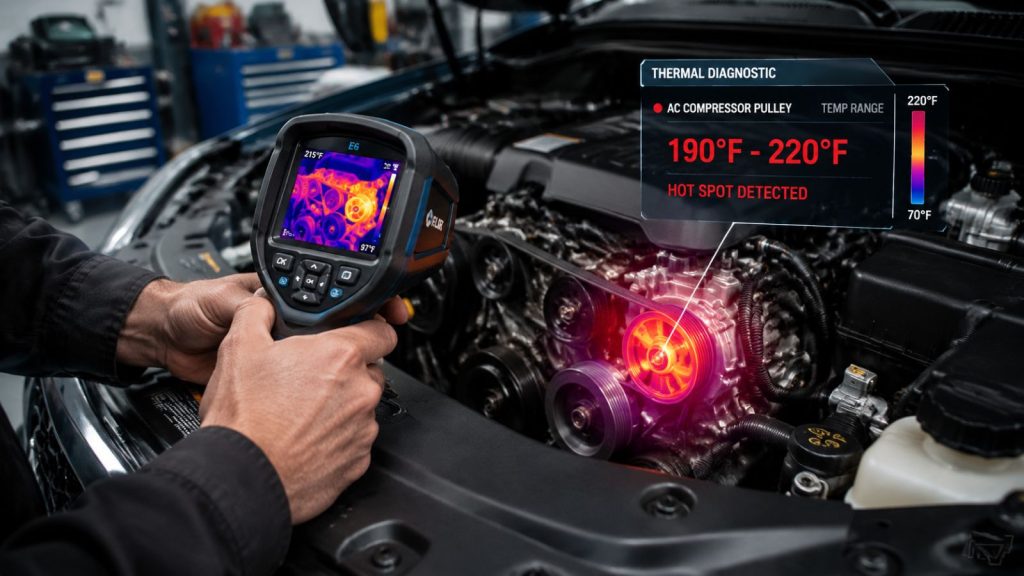
This intense mechanical drag forces the outer belt face temperatures to climb to a range of 190°F to 220°F within minutes of highway entry. The result is accelerated belt fatigue and degraded gas mileage on the daily highway haul.
Diagnostic Verdict: Infrared thermal imaging logged an accessory drive belt surface temperature of 208°F at the compressor pulley corner, proving extreme bearing friction under simulated highway speeds.
Continuous Compressor Engagement and Excess Fuel Consumption
A secondary failure pathway that destroys highway fuel economy involves a shorted air conditioning clutch relay or a fused internal wiring harness that keeps the system permanently active. When this electrical fault occurs, the electromagnetic coil remains continuously energized. The system then forces full mechanical compressor engagement regardless of the dashboard button position or cabin climate demands.
The engine is trapped into driving the heavy internal pumping components of the compressor through the entire commute. This accelerates fuel consumption and strains cooling loops.
Technicians isolate this path by executing an unbolted Heating and Cooling Services inspection to measure the electrical current lines feeding the primary coil.
Uncovering Weak Magnetic Coils and Warped Clutch Face Tolerances
When verifying compressor circuit integrity, technicians check the input current parameters to identify hidden field coil degradation. A healthy 12 V electromagnetic clutch coil should maintain a steady, clean operating current range of 3.2 A to 4.3 A.
Over years of use, internal insulation breakdowns cause shorted windings, dropping current deliveries down below 2.0 A. This weakened current results in an unstable, inadequate magnetic field that allows the clutch plate to actively slip against the spinning pulley under heavy highway acceleration.
This high-speed slipping generates immediate frictional heat that warps the clutch face tolerances. The metal surfaces eventually lock together into a binding state that ruins fuel economy.
Diagnostic Verdict: Digital multimeter current monitoring recorded a low 1.4 A draw across the field coil connector, validating an internal circuit short that induced severe plate slipping and face warpage.
Post-Isolation Pulley Balancing and Parasitic Load Elimination
Restoring factory miles-per-gallon capacity requires performing a precise mechanical isolation of the accessory pulley hub to eliminate parasitic drag lines. Technicians use dedicated puller tools to remove the compromised clutch driver assembly without disturbing the pressurized refrigerant lines inside the internal compressor body.
The snout of the compressor housing is thoroughly cleaned of rust scaling. A new double-row ball bearing assembly is pressed into the pulley channel, and a new driver plate is set with calibrated shims to restore the essential air gap.
This specialized servicing drops pulley breakout torque resistance back below 5 inch-pounds. The engine can then run at highway speeds without fighting invisible accessory drag.
Diagnostic Verdict: Post-repair clearance testing confirmed a restored 0.022-inch clutch air gap and a 4 inch-pound free-wheeling breakout torque, fully eliminating the parasitic engine load.
Commuters can have their vehicle’s accessory pulley tolerances and climate control efficiency validated at Ruben’s Auto Repair, 7210 Polar Bear, San Antonio, TX 78238, to eliminate parasitic drag and secure optimal highway fuel performance.
Frequently Asked Questions
Can a bad air conditioning compressor clutch reduce my car’s gas mileage if the AC is turned off?
Yes, a warped or binding clutch plate scrapes continuously against the pulley face, forcing a permanent 4 to 7 horsepower parasitic engine drag.
What causes my engine accessory belt to smell hot or squeal during I-10 highway commutes?
Yes, a binding pulley bearing forces extreme friction that sends belt surface temperatures climbing into a dangerous 190°F to 220°F wear window.
How do technicians verify if an air conditioning pulley is dragging and wasting fuel?
Yes, checking the unengaged pulley with a dial torque wrench reveals internal friction if breakout resistance climbs past 25 inch-pounds.
Why does a weak or shorted electromagnetic clutch coil ruin the front pulley assembly?
Yes, current draw dropping below 2.0 A weakens the magnetic field, causing the clutch plate to slip, overheat, and permanently warp.
Can an air conditioning electrical failure keep the system running when the dash button is off?
Yes, a shorted control relay keeps the clutch coil continuously energized, forcing non-stop compressor operation and increasing highway fuel consumption.