School commute cabin pull-down speed drops when variable displacement compressors experience electronic control valve lag, slowing swashplate transitions during brief neighborhood trips. When vehicles idle in low-velocity school zones, low accessory belt drive RPMs restrict refrigerant head pressures. Calibrating plenum actuators and cleaning internal expansion valves optimizes initial cooling bursts before you leave the neighborhood.
Short-Trip Duration Constraints and Compressor Displacement Delay
Modern passenger vehicles operating within Leon Valley residential zones navigate unique operational parameters that directly impede rapid interior climate management. Variable displacement air conditioning compressors use an internal swashplate to adjust the volume of refrigerant pumped through the system based on immediate demand. Upon initial morning startup, the system rests at a minimum 5% displacement baseline to protect accessory belts from sudden torque spikes. In a perfectly balanced setup, an electronic control valve shifts the swashplate angle to maximum 100% stroke within 45 to 60 seconds of acceleration. However, internal oil logging or control valve stickiness can stretch this transition beyond 180 seconds. On a brief, 7-minute trip to a neighborhood campus, a delayed swashplate response means the compressor never achieves full volumetric output before the engine is turned off.
Diagnostic Verdict: Computerized data logging captured a 190-second delay in swashplate angle transition, confirming electronic control valve lag was truncating initial refrigeration capacity.
High-Ambient Morning Cabin Heat Soak and Evaporator Core Thermal Mass
When a family vehicle sits parked under the South Texas sun, interior surface temperatures quickly climb past 130°F, creating a massive thermal load trapped within the dashboard. To counteract this heat soak, the automotive air conditioning system must rapidly lower the temperature of the aluminum evaporator core inside the HVAC plenum. This structure requires a significant, rapid injection of low-temperature refrigerant to establish full thermal mass absorption capacity. If a short-trip vehicle is limited by lazy compressor displacement, the core fails to drop to its optimal freezing threshold quickly. Instead of pulling heat out of the passenger compartment air, the stagnant evaporator allows the maximum blower fan override to push humid, warm air across the seats for the first mile of travel.
Diagnostic Verdict: Digital temperature probe monitoring logged an evaporator core temperature of 68°F after 5 minutes of operation, proving the system was failing to achieve thermal mass pull-down targets.
Sub-Mile Stop-and-Go Indexing and Low-RPM Refrigerant Head Pressure
The physical geography of suburban school drops necessitates low-speed indexing, forcing vehicle engines to operate in a low-RPM bracket between 1,200 RPM and 1,800 RPM. This restricted speed directly impacts the belt-driven accessory drive, preventing the air conditioning compressor from spinning fast enough to naturally build high-side refrigerant head pressures. For maximum efficiency, the expansion valve depends on a stable, high-pressure liquid column to meter refrigerant into the cooling loop. During sub-mile stop-and-go driving, the low-RPM head pressure stalls out well below factory spec. This starvation causes the liquid line to flash into gas prematurely, rendering the entire Heating and Cooling Services loop inefficient during the exact moments parents are idling in stop-and-go drop-off queues.
Pinpointing Plenum Door Deviation and Electronic Control Valve Lag
Technicians frequently isolate hidden climate control imbalances by cross-referencing commanded HVAC module positions against actual physical feedback data. The computerized actuators operating the plenum blend doors are built to maintain a strict matching tolerance range between 0% and +3% deviation. Over multiple hot summer cycles, internal plastic gears deform from extreme under-dash heat soak, allowing actuator deviations to stretch to +12% to +18%. This mechanical slippage causes the blend doors to rest slightly off-seat during hard acceleration bursts. As a result, a constant stream of superheated engine bay air bypasses the cooling seal and enters the cabin, completely neutralizing the initial low-speed cooling bursts.
Diagnostic Verdict: Bidirectional scan tool testing revealed a +14% positional deviation on the primary blend door actuator, confirming hot heater core air was leaking into the cooling stream.
Post-Isolation Pull-Down Auditing and Flow Velocity Restorations
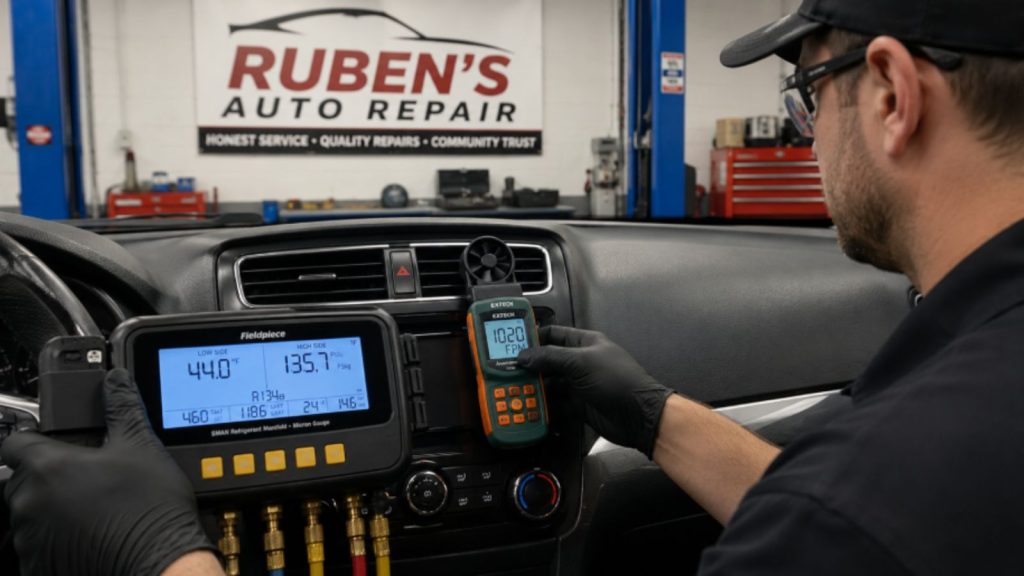
Overcoming short-trip thermal limitations requires executing a structured performance audit to clear structural flow blockages and optimize low-speed velocity. Technicians extract the vehicle’s remaining refrigerant charge to verify exact weight tolerances, as an undercharge of just 2 ounces slows initial swashplate movement. After clearing any internal debris from the expansion valve orifice, a digital anemometer is placed at the center dash registers to evaluate volumetric performance. A successfully calibrated system must deliver a stable airflow velocity range of 900 FPM to 1,100 FPM on maximum command, with discharge temperatures dropping down to 42°F to 45°F within 5 minutes of initial startup. This rapid stabilization ensures complete passenger comfort before the vehicle exits neighborhood streets.
Diagnostic Verdict: Post-calibration testing confirmed vent velocity reached 1,020 FPM with a discharge temp of 44°F within a 4-minute idle threshold, fully restoring neighborhood pull-down performance.
Drivers can have their short-trip cabin pull-down speeds and compressor swashplate operation validated at Ruben’s Auto Repair, 7210 Polar Bear, San Antonio, TX 78238, to ensure reliable neighborhood cooling performance.
Frequently Asked Questions
Why does my car’s AC take so long to get cold on short morning school trips?
Yes, low-RPM neighborhood driving delays the variable displacement compressor swashplate from reaching maximum stroke, preventing rapid cabin cooling.
Can a small leak in my AC system slow down how fast the car cools off?
Yes, a refrigerant charge loss of just 2 ounces slows down swashplate indexing, causing sluggish cooling performance on brief trips.
What causes my vents to blow warm air when I am waiting in the school drop-off line?
Yes, idling at low engine RPMs stalls out high-side refrigerant pressure, starving the expansion valve and dropping evaporator efficiency.
Why is my AC blowing cold air from the driver’s side but warm air from the passenger’s side?
Yes, an actuator gear deviation between +12% and +18% allows hot engine air to bleed past the blend door into specific passenger zones.
Is it normal for my car’s blower fan to blow hard but not feel very cold at first?
Yes, if the evaporator core has not reached its optimal thermal mass baseline due to compressor lag, the fan will simply push hot, stagnant air.