BMW electric water pumps suffer from plastic housing fatigue and internal seal degradation due to extreme thermal cycling. These structural weaknesses allow coolant to breach the control board, triggering 2E81 speed deviation codes. Proactive Cooling Services—diagnostic scans and system flushes—prevent I-10 overheating events and “silent” limp mode failures.
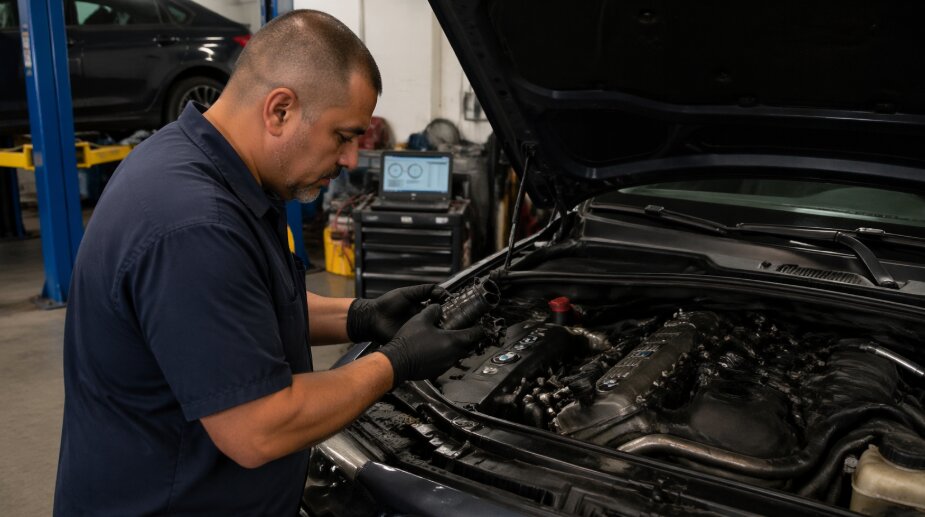
BMW Digital Cooling Map Failure Behavior
Traditional mechanical pumps were tethered to engine RPM, but your BMW utilizes a computer-controlled cooling map managed by the Digital Motor Electronics (DME). This system is decoupled from the fan belt, allowing the pump to spin at maximum speed even when the engine is at idle. The DME targets four distinct stages: Eco Mode (~105°C), Normal (~95°C), High Load (~85°C), and Emergency (~80°C). When the pump begins to fail, it cannot “actualize” the requested centrifugal impeller speed required to maintain these targets. This mismatch triggers a protection logic that limits engine power to prevent the cylinder head from melting.
Internal Seal Failure and PCB Contamination
Unlike the pumps of the past that would weep from a telltale hole, the Pierburg and Siemens VDO units used in modern BMWs suffer from “blind failures.” The internal Printed Circuit Board (PCB) is actually cooled by the very fluid it pumps. Once the internal shaft seal weakens, coolant seeps into the electronics. Because the fluid is conductive, it shorts the control board instantly. There is no noise, no external leak, and often no dashboard warning until the pump drops off the Bit Serial Data (BSD) line entirely. By the time you see a “Cooling System” message, the electronics have usually been submerged for days.
Hwy 16 Incline Load-Induced Overheating
Climbing Northwest from San Antonio toward Helotes via Hwy 16 (Bandera Rd) is the ultimate stress test for a borderline water pump. As the elevation rises, the engine load increases, and the DME commands a ~90–95% duty cycle to shed the heat. A pump with internal electrical resistance or a warping plastic impeller housing simply cannot meet this demand. We frequently see Helotes Euro owners experience their first temperature spike specifically on this incline. As the ambient heat hits ~90°F, the heat exchanger efficiency drops, and a weak pump that survived the winter mornings finally gives up under the pressure of the climb.
ISTA-D Shadow Code 2E81 Diagnostic Proof
The most dangerous BMW water pump failure is the one that hasn’t triggered a Check Engine Light yet. Using ISTA-D (BMW factory software), we look for “Shadow Codes” like 2E81 (Speed Deviation) or 2E82 (Emergency Mode). The “Moment of Clarity” comes when we run a live data log: the DME is “Targeting” 3,200 RPM, but the pump is only “Actualizing” 1,300 RPM. This 2,000 RPM deficit is proof that the pump is mechanically binding or electrically failing. Catching these codes during a routine service is the difference between a controlled repair and a $700 tow bill from I-10.
Cooling Fan Overcompensation Behavior
One of the most reliable sensory clues of a failing EWP is the “Jet Engine” sound coming from your radiator fan. When the pump stops moving coolant, the heat stays trapped in the engine block. The DME reacts by ramping the electric cooling fan to 100% duty cycle to pull air through a radiator that—ironically—has no hot coolant flowing through it. If you park your car near Helotes Park Estates or Wildhorse and the fan continues to roar at max speed after the engine is shut off, your pump is likely in a state of “Blind Failure.”
Thermostat Co-Failure and Replacement Logic
At Ruben’s Auto Repair, we rarely recommend replacing the water pump without also replacing the thermostat. Both components share the same plastic housing material and are subject to the same 2,000 thermal cycles per year. Furthermore, they share a common electrical harness. If a failing pump has caused the engine to enter the ~250°F red zone even once, the plastic thermostat housing is likely compromised. We call it the “3,000 mile trap”—drivers who save a few dollars by skipping the thermostat often end up paying for the exact same labor again within three months when the original thermostat housing cracks.
Cost Reality vs Engine Damage Risk
There is significant “sticker shock” when a Helotes owner realizes a BMW water pump and thermostat job averages ~$1,100. However, the alternative is the ~$7,000 reality of an N55 or B58 cylinder head replacement. BMW engines use aluminum heads that do not tolerate overheating. A single “Red” temperature warning on the I-10 access road can warp the head or blow the head gasket in less than sixty seconds. Proactive replacement at the first sign of a 2E81 shadow code is the only way to protect the long-term integrity of the engine.
Coolant Bleed Procedure Verification (ISTA-D)
The final step in a Master Tech repair is the automated coolant bleed procedure. Because these pumps are electric, we don’t have to run the engine to bleed the air. Using ISTA-D, we trigger a ~12-minute cycle where the pump pulses at varying speeds to purge air pockets from the heater core and the back of the cylinder head. We monitor the current draw during this cycle—a healthy pump should pull roughly ~40A at peak. If the pump struggles to maintain a consistent RPM during this test, we know there is a remaining restriction or a faulty replacement part before the vehicle ever leaves the shop.
For a precision diagnostic check of your BMW’s cooling system, visit Ruben’s Auto Repair at 7210 Polar Bear, San Antonio, TX 78238. We’ve spent over 15 years keeping Helotes Euro owners on the road and out of Limp Mode.
Frequently Asked Questions
Can I drive my BMW if the yellow temp light is on?
No. A yellow light means the DME has already entered “Limp Mode” and is cutting power to protect the head. Pull over immediately.
Why do I smell maple syrup but see no leaks?
The electric pump is tucked behind the subframe; internal leaks often evaporate off the hot engine block before they ever hit the ground.
Does the coolant color matter?
Yes. BMWs require phosphate-free HT-12 (Green) or G48 (Blue) coolant. Using generic “All-Vehicle” coolant can trigger electrolysis, which eats the pump’s internal PCB.
How long do these pumps last?
They do not have a fixed mileage, but we typically see failures start between 60,000 and 80,000 miles.