A brake warning light tells us the system found a problem, but it does not tell us which part failed. Modern brakes pair mechanical components with electronic monitoring, so the light could mean low fluid, a worn-pad sensor, or an ABS or wheel-speed sensor fault. That is why we scan for the stored fault data and inspect the brakes by hand, so the code matches what the vehicle is actually doing.
What a Brake Warning Light Is Actually Telling You
A warning light is a report, not a diagnosis. When it comes on, the system is saying it noticed something outside of normal. It is not telling you which part failed, and that distinction changes everything about how the problem gets solved.
Think of it like a smoke detector. It tells you there is a reason to look, but it does not tell you whether something is burning or the battery just got old. The light gets our attention, and then the real work of finding the cause begins.
That is why “just tell me what light means” does not have a single answer. The same symbol can stand for a few very different problems, and sorting out which one is the whole point of a proper diagnosis.
The Two Lights People Mix Up
Most vehicles actually have two separate brake-related lights, and drivers routinely confuse them.
The brake system light, often red, tends to point at the core hydraulic and mechanical side. On many vehicles it can mean the brake fluid is low, the parking brake is engaged, or there is a pressure problem in the system. It is the one you least want to ignore.
The ABS light, usually amber, points at the anti-lock braking system specifically. When it is on, the base brakes usually still work, but the anti-lock function may be disabled, which matters most during hard or slippery stops. The exact color and behavior vary by vehicle, so the safest reading is that each light is pointing at a different corner of the system, not the same one.
Why the Code Is a Starting Point, Not the Answer
A scan tool retrieves stored fault codes that isolate where the system detected an issue, but the code itself does not explicitly confirm which component failed. Diagnostic codes pinpoint the affected circuit or function, physical testing pinpoints the exact part.
Take a common example, a wheel-speed sensor code. That code can come from the sensor itself, but it can just as easily come from a damaged tone ring, a corroded connector, or chewed-up wiring near the wheel. All of those can throw the same code. If someone reads the code and simply replaces the sensor, they might swap a perfectly good part and still have the light on.
That is the difference between a code and a confirmed fault. Codes are leads, not verdicts, we perform physical testing to verify the failed component before replacing any parts.
Where the Electronic Faults Actually Live
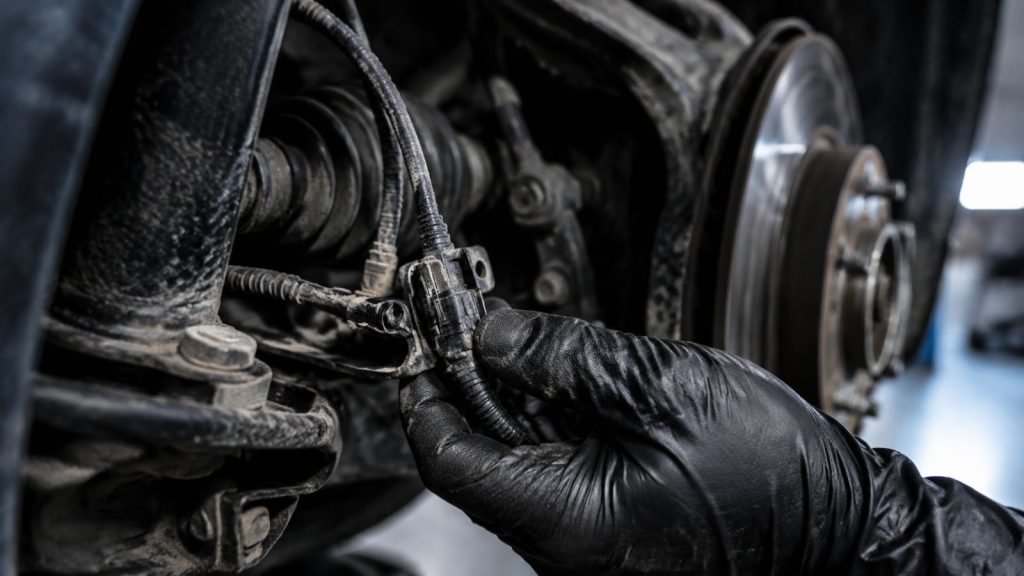
The electronic side of the brakes lives in a rough neighborhood. Wheel-speed sensors sit low, right at the wheels, along with their connectors and wiring. That location is exactly where road grime, moisture, and debris collect.
Around San Antonio, that exposure adds up. Heat and humidity encourage corrosion at low-mounted connectors, and potholes or road debris can damage a sensor, a tone ring, or a wire. A lot of ABS complaints trace back not to a failed module but to something simple and physical out at the wheel, a broken sensor tip, a rusted connector, or a wire rubbed through. When the fault turns out to be wiring or a connector rather than a brake part, that crosses into electrical diagnostics, which is a different kind of testing than checking pads and rotors.
Why We Scan and Inspect Together
This is the heart of it. The scan and the hands-on inspection are not competing methods, they are two halves of the same diagnosis.
Reading the stored fault data is part of diagnosing a brake warning light, and wheel-speed sensor signals can be checked with live scan data to see whether each sensor is reporting a plausible signal. But live data alone cannot see a corroded connector or a cracked tone ring. That takes eyes and hands at the wheel. A complete diagnosis pairs the scan results with a physical brake diagnostics inspection, so the electronic evidence and the mechanical evidence agree before we commit to a repair. When the scan says one thing and the inspection says another, that disagreement is information too. It usually means the real fault is hiding somewhere the code did not point directly.
Why a Brake Light Is Not One to Wait Out
Some dashboard lights can wait a day. A brake system light is not one of them. When the red brake light is on, it can indicate low fluid or a pressure problem, and either one can affect how well the car actually stops. That is worth checking right away.
An ABS light is a little different but still not something to ignore. Your normal brakes usually still function, but the anti-lock protection may be offline, which is exactly the safety margin you want during a panic stop or on wet San Antonio pavement. Driving with it on means driving without a system that is there for the worst moment.
Either way, a brake-related light is pointing at the system that stops the car. That is not the one to wait out and hope it clears.
Need Help Understanding a Brake Warning Light
If a brake or ABS light has come on and you are not sure what it is telling you, we can pull the fault data and inspect the system so you know the real cause, not just a guess from the dashboard. The goal is to match the code to what the vehicle is actually doing before replacing anything. You can book an inspection or call the shop at (210) 647-1148 and we will walk you through it.
Frequently Asked Questions
What is the difference between the brake light and the ABS light?
They monitor separate components. A red brake light signals a primary system fault—such as low fluid, an engaged parking brake, or loss of hydraulic pressure. An amber ABS light indicates a fault within the anti-lock braking system. While primary braking usually remains functional when the ABS light is illuminated, anti-lock features are typically disabled.
Can I drive with my ABS light on?
Yes, standard braking typically functions, but anti-lock control is disabled—reducing traction control during sudden stops or on slick roads. Have the system inspected promptly to restore full safety margins.
Why does a shop need to scan my car for a brake light?
Warning lights signal a fault without identifying the specific failed component. Diagnostic scans retrieve stored error codes to isolate the issue, which technicians verify through physical inspection to ensure targeted repairs.
Does a brake warning light always mean an expensive repair?
No. Common triggers include minor issues like low fluid levels, corroded wiring, or faulty wheel-speed sensors. Diagnostic testing and physical checks determine the precise scope before any components are replaced.