A vehicle that pulls to one side when braking is telling us the two sides are not braking evenly. That can come from a sticking caliper, a restricted brake hose, uneven pads, a tire or pressure difference, or an alignment issue. The direction of the pull is a clue, not a diagnosis. We test each side to find where the braking force is actually uneven.
What a Brake Pull Is Actually Telling You
When your car tugs to one side as you press the brakes, it means one side of the vehicle is grabbing harder than the other. That imbalance is the real message. The car moves toward the side doing more of the work, or away from the side doing less.
Here is where it gets confusing. Drivers naturally assume the problem is on the side the car pulls toward. Sometimes it is. But a pull to the right can just as easily mean the left brake stopped pulling its weight, so the right side wins by default. The direction is a clue, not the diagnosis.
That is why we do not fix the side the car points to and call it done. We want to know which side lost or gained braking force, and why.
The Hydraulic Suspects, Calipers and Hoses
The most common brake-specific causes live in the hydraulic side of the system.
A caliper is supposed to clamp when you brake and release cleanly when you let off. When a caliper sticks, often from corroded slide pins or a piston that no longer moves freely, it can drag or apply unevenly. South Texas humidity and constant heat cycling are hard on those slides, and a caliper that binds on one side will pull the car every time you brake.
The sneakier suspect is the brake hose. A hose can break down internally and act like a one-way valve, letting pressure through when you push the pedal but not releasing it fully when you let go. That side stays partially applied, so the car pulls even though the caliper itself looks fine from the outside. This is one people miss, because the part that looks healthy is not always the part causing the trouble.
The Mechanical and Tire Suspects
Not every pull is hydraulic. Sometimes the friction itself is uneven.
Pads that are worn unevenly side to side, contaminated with oil or grease, or backed by worn hardware can change how much grip each side delivers. One side bites harder, and the car leans that way under braking.
Tires belong on the list too, and they fool people. A meaningful difference in tire pressure or tire condition from one side to the other can cause a pull that gets worse under braking, because the loaded tire behaves differently than its partner. Before we ever condemn a brake part, a quick look at tire services and pressures can rule that in or out. It is a cheap thing to check and a common thing to overlook.
Braking Pull Versus a Pull That Never Stops
This is the separator that saves a lot of misdiagnosis, and it is a simple one you can feel yourself.
Does the car pull only when you are braking, or does it drift the same way all the time, even when you are just cruising with light throttle? That difference points at two different families of causes.
A pull that appears only under braking leans toward the brake system, a caliper, a hose, or uneven pads. A pull that is present whether or not you are braking leans more toward alignment, a tire, or something in the steering and suspension. Alignment issues like a camber or caster difference tend to tug the car constantly, not just when you hit the pedal. Sorting the pull into one of those two buckets is often the first real step, because it tells us whether to start in the brakes or somewhere else entirely.
How We Isolate the Real Cause
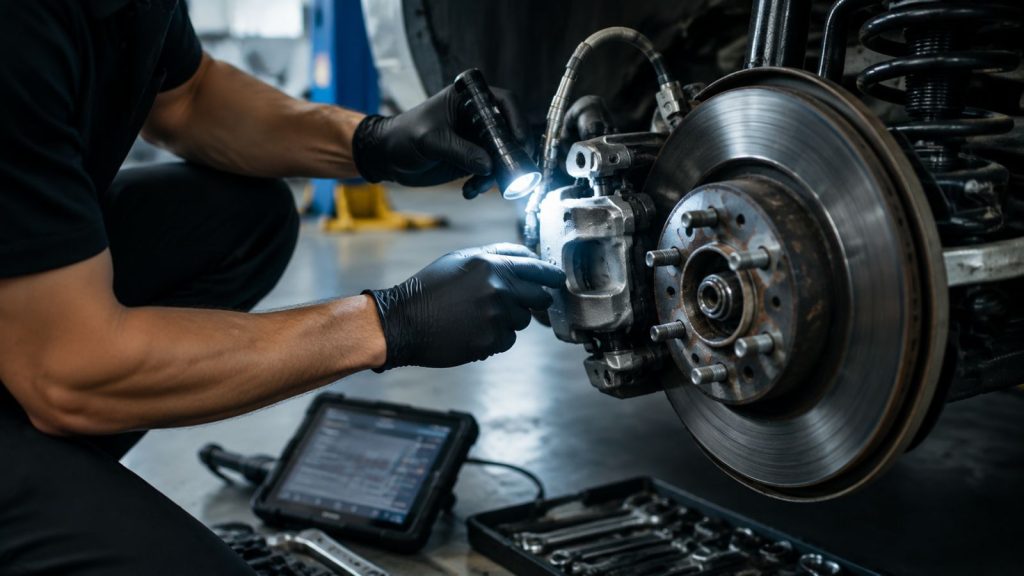
Once we know the pull is braking-related, the job is to find which corner is misbehaving and why. We would rather test each side than assume the problem is on the side the car pulls toward.
A road test helps confirm whether the pull happens only under braking or all the time, and under what conditions it shows up. From there, an inspection may include caliper movement, the condition of the brake hoses, and a comparison of the two sides, since comparing them can reveal uneven pad wear or a dragging component. A proper brake inspection looks at the whole corner rather than swapping the first part that seems suspect. We want the repair to match what the vehicle is actually doing, not just the direction it tugs at the counter.
Why This One Is Worth Checking Early
A brake pull is not only annoying, it is a handling issue. Under hard braking in traffic, a car that jerks to one side is harder to keep in its lane, and that matters on a busy stretch of Loop 410 or Loop 1604 where you might need to stop quickly.
There is a cost angle too. A sticking caliper or a dragging brake generates extra heat and wears that corner faster, so a small pull ignored long enough can turn into a larger repair. Catching an uneven-braking problem while it is still just a light tug is easier on the car and on the budget.
If your vehicle has started pulling when you brake, it is worth having looked at rather than lived with. It rarely fixes itself, and it usually points at something real.
Is Your Car Pulling When You Brake
If your car tugs to one side every time you hit the brakes, we can help find out which corner is causing it and why. The goal is to fix the actual source, not just the side it points to, so you are not paying to replace a part that was never the problem. You can contact our team or call the shop at (210) 647-1148 and we will walk you through it.
Frequently Asked Questions
Why does my car pull to one side when braking?
That pattern usually means the two sides are not braking evenly, which points toward the brake system, a sticking caliper, a restricted hose, or uneven pads. A pull that only appears under braking is different from one that is there all the time, and that difference helps narrow where to look.
Does the car always pull toward the bad brake?
Not necessarily. The car pulls toward the side with more braking force, which can mean the opposite side actually lost force. So a pull to the right does not automatically mean the right brake is the problem. That is exactly why the cause is tested rather than assumed from direction.
Can a bad tire make my car pull when braking?
Yes. A difference in tire pressure or tire condition from one side to the other can cause a pull, and it can get more noticeable under braking. It is one of the cheaper things to check, which is why tires and pressures are worth ruling out before condemning a brake component.
Is a brake pull dangerous to drive with?
It is worth taking seriously. A pull affects how the car handles during hard stops, which is when you least want a surprise. It also tends to point at a component that is wearing unevenly, so having it checked sooner is safer and usually cheaper than waiting.