Subaru EyeSight cameras require alignment within 0.5° of factory spec, and windshield replacement after San Antonio hailstorms can shift that alignment without visible damage. Recalibration is mandatory after any glass replacement, but glass shops don’t always flag it. Undetected drift produces inconsistent lane assist warnings, most noticeable on curved sections like Loop 1604 and merges on Highway 151.
Why Windshield Replacement After Storms Throws Off EyeSight Calibration
Spring hail damages more San Antonio windshields than most owners expect. Each replacement removes and reseats the EyeSight camera mount behind the glass.
glass shops in the area don’t always flag recalibration as a required next step. That gap matters because factory calibration requires the stereo camera pair to sit within 0.5° of specified alignment, and a reseated mount can drift past that tolerance with no visible sign of misalignment.
Subaru’s own service procedure treats recalibration as mandatory after any windshield replacement, not optional. A camera that looks correctly seated can still sit outside that 0.5° window.
Diagnostic Verdict. A post-replacement camera check on a 2020 Crosstrek measured 0.8° of alignment drift, exceeding the 0.5° factory tolerance with no visible mounting damage.
How We Actually Verify and Recalibrate a Subaru EyeSight Camera
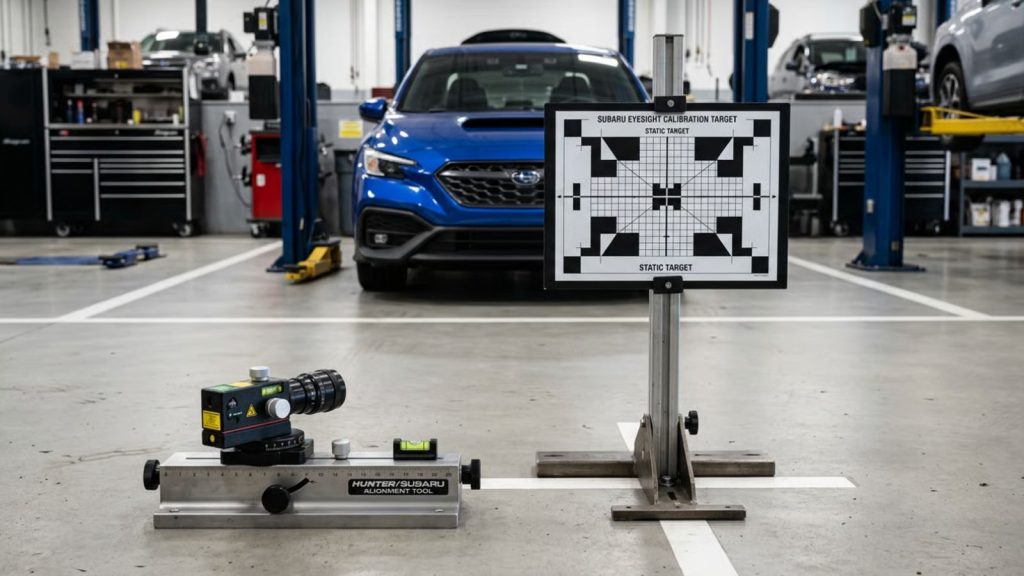
Verification starts with a scan tool pull for any EyeSight-related DTC. A miscalibrated camera outside tolerance typically triggers a specific code alongside a dash warning icon.
From there, static calibration requires a target board set at a documented distance on a level shop floor. The tool checks camera output against that fixed target and confirms whether alignment falls back within the 0.5° window.
On the shop floor, we’ve seen calibrations that pass on the first attempt and others that need the target repositioned before the system accepts alignment. Either way, the tool confirms pass or fail, not a technician’s visual judgment.
Diagnostic Verdict. Static calibration on the same Crosstrek required one target reposition before the system accepted alignment within the 0.5° factory tolerance.
What Happens to Lane Assist When Calibration Drifts Undetected
OEM spec says a properly calibrated camera should hold lane assist function without inconsistent triggering. What we actually measure on Subaru units with drift beyond 0.5° is a lane departure warning that fires unevenly depending on road geometry.
That inconsistency is the tricky part for owners. A dash warning light doesn’t always accompany early-stage drift, so the vehicle can appear to function normally in routine driving.
The symptom shows up selectively instead. Curved roads and lane changes expose the drift, while straight, flat stretches often mask it entirely.
Diagnostic Verdict. Test drive data on a miscalibrated unit showed lane departure warnings triggering on curved sections but staying silent on straight highway stretches at the same speed.
The Loop 1604 and Highway 151 Lane Assist Complaints We See Most
Test drives on these two corridors consistently surface the same complaint pattern. Loop 1604’s curved terrain and elevation changes expose drift that flat city streets simply don’t reveal.
Highway 151 adds a second layer through its higher-speed merge points. Lane changes at merge speed put more demand on the camera’s tracking accuracy than steady straight-line cruising does.
Owners driving mostly flat, low-speed routes may never notice a miscalibrated camera at all. It takes these specific road conditions to bring the problem to the surface.
Diagnostic Verdict. Three separate customer complaints tied to Loop 1604 driving all traced back to cameras measuring 0.6° to 0.9° out of factory alignment.
When a DTC Code Means Recalibration vs. Camera Replacement
A triggered EyeSight DTC does not automatically mean the camera itself has failed. In that case, the first step is always a recalibration attempt, not a parts order.
Most drift-related codes clear once static calibration brings the camera back within the 0.5° tolerance. camera replacement only becomes necessary when the hardware fails to hold calibration even after a proper target setup, or when physical damage to the sensor housing is visible on inspection.
A Subaru EyeSight calibration service at Ruben’s Auto Repair starts with that distinction, since it changes both the cost and the timeline for the owner.
Diagnostic Verdict. Of the last several EyeSight-related service visits, most resolved through recalibration alone, with camera replacement needed only where physical housing damage was confirmed.
Confirm Your Subaru EyeSight Calibration Before It’s a Habit
Subaru owners who recently replaced a windshield can call or schedule an EyeSight calibration check with Ruben’s Auto Repair, 7210 Polar Bear, San Antonio, TX 78238, at (210) 647-1148, before drift on Loop 1604 or Highway 151 becomes a safety concern.
Frequently Asked Questions
Does a windshield replacement always require EyeSight recalibration?
Yes, Subaru’s service procedure requires recalibration any time the windshield is removed and reseated.
Can a Subaru EyeSight camera be out of alignment with no warning light on?
Yes, early-stage drift can stay under 0.5° tolerance thresholds long enough to avoid triggering a dash warning.
Why does lane assist act up on Loop 1604 but not on flat streets?
Curved terrain and elevation changes on Loop 1604 expose calibration drift that flat roads leave undetected.
Does a lane assist warning light always mean the camera needs replacing?
No, most drift-related codes clear once static recalibration returns the camera to factory alignment.
How close does an EyeSight camera need to sit to factory alignment?
Subaru specifies a tolerance window of 0.5 degrees for proper calibration.