AC that takes noticeably longer to cool on the first Shavano Park drive of the day, but recovers fast later, points to elevated cold start heat baseline from overnight heat soak. A startup time past 9 to 10 minutes, or a gap more than double the midday restart time, signals inefficiency beyond normal heat soak alone.
Same car, same driveway, same AC setting, but the morning drive to work takes forever to feel cold while the afternoon errand run cools off almost right away. We hear this one constantly from Shavano Park drivers, and it’s not your imagination playing tricks on you before your first coffee.
Why Your Driveway Overnight Isn’t Actually Cooling Down
A cold start under moderate conditions is straightforward. Refrigerant pressure climbs into its working range on a predictable schedule, the compressor reaches efficient operation fast, and you’re not starting from behind. That’s the baseline most people experience without ever thinking about it.
A Shavano Park driveway in summer doesn’t give you that baseline overnight. Pavement holds onto radiant heat well past sunset, and your car’s own body panels do the same thing. Ambient air might drop into the 70s overnight, but the surfaces around and underneath your vehicle stay a lot warmer than that number suggests. So when you climb in for the morning commute, the AC isn’t starting from a cool overnight low, it’s starting from a cabin and under hood environment that never really cooled down at all.
That elevated starting point is the whole problem. Refrigerant stabilization has to work through a bigger pressure gap before it settles into its efficient range, and a bigger gap just takes longer to close. If there’s any marginal inefficiency already sitting in the system, something most drivers would never notice on an easy midday start, that inefficiency gets a lot more visible against a harder morning starting condition.
Something we tell customers who come in convinced their AC is failing. A slow morning start on its own, especially in July and August, is honestly pretty normal for this area. The number that actually matters is how that morning time compares to a restart later the same day, once the vehicle’s had a chance to run and everything’s already warmed up under the hood in a controlled way rather than baked overnight.
How We Actually Run the Diagnostic
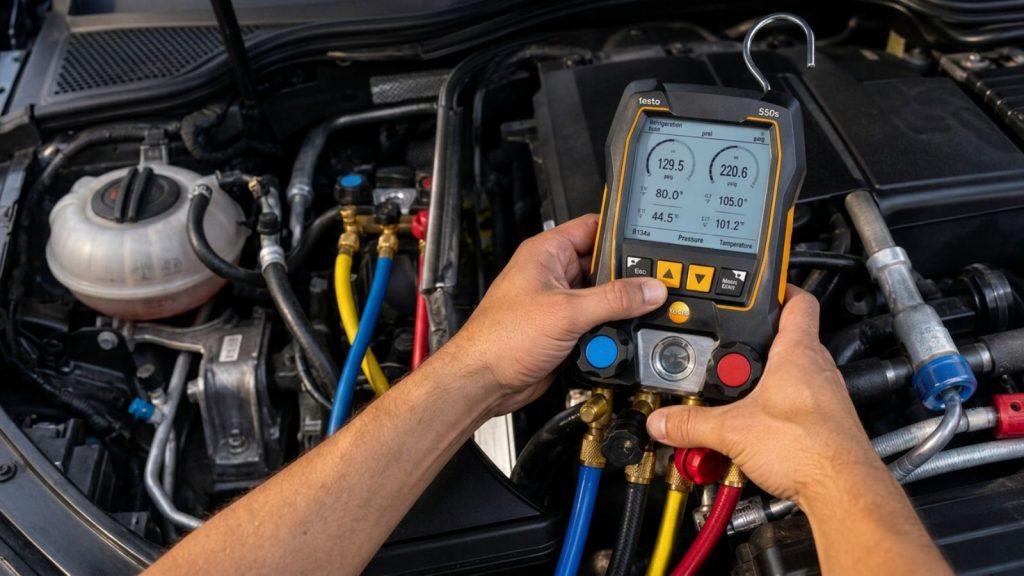
We start with a straight stopwatch comparison, because guessing at “slow” doesn’t tell us anything useful on its own.
First we time ignition to stabilize 65 to 68°F vent output on an actual morning cold start, the kind that follows a full night of Shavano Park heat soak. Under typical summer conditions that should land somewhere in the 4 to 6 minute range. Push past 9 or 10 minutes and we’re looking at something beyond ordinary heat soak.
Then, same day, same vehicle, we run the same test on a midday restart after the engine’s already been running recently. This is the comparison that actually tells the story. If the morning number and the midday number sit reasonably close, heat soak is probably explaining most or all of the delay. If the morning time runs more than double the midday time, that gap is pointing at a real inefficiency the cold start is exposing, not creating.
We also check cabin temperature against the outside ambient right at ignition. A 20 to 30 degree gap between the two is typical for summer heat soak in this area, and having that number confirmed helps us judge whether a given startup delay is proportional to the heat load or genuinely out of line with it.
Why We’d Rather Check This Now Than Wait Out the Summer
It’s easy to write off a slow morning start as just how Texas works, and a lot of the time, that’s exactly what it is. But a vehicle that’s genuinely fighting a marginal refrigerant charge or a compressor starting to lose capacity will show that gap between morning and midday performance, and that gap tends to widen as the summer goes on rather than staying flat. Catching it in June is a lot easier on your wallet than catching it in August, when the same underlying issue has had two more months of Texas heat to work against it.
Get Your Morning Startup Time Measured Before Summer Wears It Down Further
If your AC drags on the morning commute but recovers fine later in the day, we can measure your actual startup times and find out whether heat soak explains all of it or not. Talk to Ruben’s AC repair team, 7210 Polar Bear, San Antonio, TX 78238, (210) 647-1148, runs this comparison regularly for Shavano Park drivers.
Frequently Asked Questions
Is it normal for AC to be slower on the first drive of the day in summer?
Yes, to a point. Overnight heat soak means the system is starting from a hotter baseline than a midday restart would. Some delay is expected, especially in peak summer months.
How do I know if it’s just heat soak or an actual problem?
Compare your morning startup time against a midday restart the same day. If the morning time is more than double the midday time, that gap points to something beyond normal heat soak.
Could this be a sign of low refrigerant?
It’s one possibility. A marginal charge makes the system work harder to close any pressure gap, which shows up more clearly during a demanding cold start than during an easier midday restart.
Will this get worse as summer goes on?
If there’s an underlying inefficiency being exposed by heat soak, yes, it tends to compound as ambient temperatures climb through July and August rather than staying constant.
Can I test this myself before bringing the car in?
You can time how long it takes to feel cold in the morning versus midday with a phone stopwatch, but confirming the actual cause needs pressure readings we take with a manifold gauge set in shop.