Airflow cutting out for several minutes then returning during UTSA commutes points to evaporator icing, not compressor failure. Mixed city and highway speed changes combined with humidity cause refrigerants to over expand, dropping coil temperature below freezing. Low side pressure under 20 psi or evaporator temp at or below 32°F confirms icing needing inspection.
Your AC cuts out completely for a few minutes on your UTSA commute, then comes back on its own without you touching a single control. That’s not a random glitch. It’s your evaporator core icing over from a refrigerant expansion cycle that can’t keep up with your mixed city and highway driving.
Quick Diagnostic Snapshot
| Field | Detail |
| Primary Symptom | Airflow stops entirely for several minutes, then returns on its own without adjusting any controls |
| Target Component | Evaporator core and thermal expansion valve response |
| Specialized Tooling | Manifold gauge set, evaporator core inspection camera, low side pressure and temperature cross reference |
| Local or Environmental Stressor | Mixed city and highway speed changes on UTSA commuter routes combined with humidity swings |
| High Risk Profile | UTSA students and staff on stop and go campus roads transitioning into highway commutes during peak humidity months |
Why Your Evaporator Ices Over on This Commute
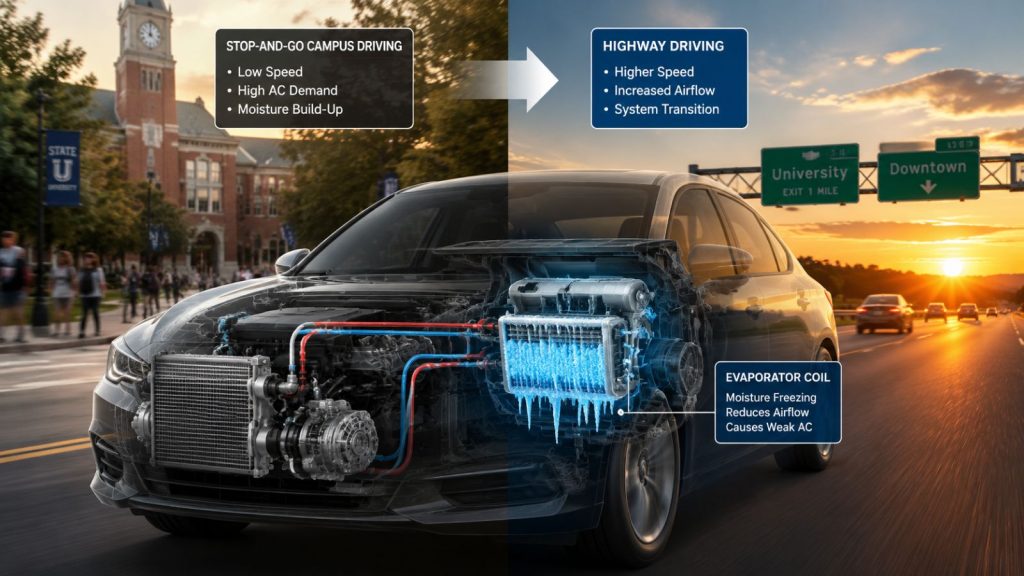
Under normal conditions, we rely on the expansion valve to regulate refrigerant flow into the evaporator core based on cooling demand. That keeps the evaporator surface temperature just above freezing, cold enough to pull heat and humidity out of cabin air without ever icing over.
Your UTSA commute doesn’t give that valve a steady rhythm to work with. Stop and go campus roads shift into sudden highway speed changes, and every one of those transitions changes airflow volume across the evaporator core fast. Add San Antonio humidity into that mix, and moisture condenses on the coil quicker than the system can account for during these speed changes.
That’s where the freezing starts.
When refrigerant expands too aggressively during those low airflow moments, evaporator surface temperature drops well below freezing, and the moisture already condensed on the coil crystallizes into ice. That ice layer blocks airflow completely. Cooling cuts out until cabin heat and whatever residual airflow remains slowly melts it back down, and then the whole cycle starts over again on your next speed transition.
Shop note. We see this pattern a lot with UTSA commuters specifically because the campus to highway transition happens so often in a single trip. If your airflow returns on its own after a few minutes without you doing anything, that self resolving pattern is one of the clearest signs of evaporator icing we look for.
Diagnostic numbers that matter
We check low side pressure first. During normal operation it should hold between 25 to 45 psi depending on ambient temperature and compressor cycling. When we see readings drop below 20 psi during an airflow loss event, that points directly to evaporator icing rather than a compressor or refrigerant charge issue.
Evaporator surface temperature should stay above 32°F during active cooling. When we confirm a reading at or below freezing while airflow is cut, that’s the clearest sign of active ice formation on the core.
We also track the time between airflow loss and airflow return. A consistent 3 to 5 minute freeze and thaw cycle tells us we’re looking at a repeating expansion valve response issue tied to your commute’s speed transitions, not a one time fluke.
Repeated freeze and thaw cycles don’t just cause temporary cooling loss on your drive. Each cycle stresses the expansion valve and can push moisture and contaminants further into the system. Left through a full commuting season, that pattern can turn a simple valve adjustment or core cleaning into a full evaporator replacement.
Get Your Evaporator Checked Before Freeze Cycles Damage the Valve
If your AC cuts out and comes back like this on your UTSA commute, we can trace the freeze and thaw pattern against your actual drive and catch expansion valve wear early. As Ruben’s certified AC repair service, 7210 Polar Bear, San Antonio, TX 78238, (210) 647-1148, we see this commute pattern often.
Frequently Asked Questions
Why does my AC stop completely for a few minutes then come back on its own?
That self resolving pattern is one of the clearest signs of evaporator icing we look for. Ice builds up on the coil, blocks airflow, then melts from residual cabin heat, restoring airflow until the next freeze cycle starts.
Is this the same as low refrigerant?
Not usually. Low refrigerant tends to cause steady weak cooling rather than complete airflow cutoffs that resolve on their own. A complete stop and return pattern points more toward icing than a charge issue.
Why does this happen specifically on my UTSA commute?
The frequent shift between stop and go campus roads and highway speed creates rapid airflow changes across the evaporator core. Combined with humidity, that’s exactly the condition that leads to icing.
Will this go away if I just let the AC run longer?
No. Running it longer without addressing the cause just repeats the freeze and thaw cycle, which continues stressing the expansion valve every time it happens.
What happens if I ignore these freeze cycles for too long?
Continued cycling pushes moisture and contaminants further into the system and stresses the expansion valve repeatedly. Over a full season of commuting, that can turn a simple valve adjustment into a full evaporator replacement.