Weakening cooling the longer you drive on Highway 281 points to condenser airflow loss, not compressor failure. Debris buildup on the fins combined with summer heat soak restricts heat rejection, raising high side pressure. Surface temp variance beyond 25 degrees or pressure within 10 psi of idle at highway speed signals wear needing inspection.
Your AC should feel strongest on the highway, not weaker the longer you drive. If cooling on Highway 281 fades the further you go, even at a steady 65 miles per hour, the condenser isn’t rejecting heat the way it needs to, and San Antonio summer heat is exposing that problem fast.
Quick Diagnostic Snapshot
| Field | Detail |
| Primary Symptom | Cooling weakens gradually the longer the vehicle stays at sustained highway speed |
| Target Component | Condenser fin surface and airflow path |
| Specialized Tooling | Manifold gauge set, visual borescope inspection of condenser face, infrared thermometer across fin surface |
| Local or Environmental Stressor | Debris accumulation and high speed heat soak on Highway 281 during continuous summer driving |
| High Risk Profile | Regular Highway 281 commuters and long distance drivers during peak summer months |
The condenser’s whole job depends on airflow moving consistently across its fin surface. That airflow pulls heat out of high pressure refrigerant as it passes through, converting it from a hot gas back into a cooler liquid before it ever reaches the expansion valve. At highway speed, this process should be working at its best.
Highway 281 complicates that in a way most drivers never think about. Road grime, insects, and fine particulates collect across the fin surface mile after mile, and that debris restricts airflow through the honeycomb structure the condenser depends on. Layer on top of San Antonio summer heat already sitting past 100 degrees, and the condenser ends up fighting a battle it can’t fully win even with the car moving fast enough to normally help it.
Here’s where that turns into a real mechanical problem.
Restricted airflow through clogged fin channels cuts down the heat exchange surface contact the condenser relies on. Refrigerant leaves the condenser hotter than it should, which pushes high side pressure up across the entire AC system. Sustained heat soaks compounds this further. Fin material can warp slightly at the points where debris packs heaviest, permanently reducing surface contact in those spots and making the airflow restriction worse over time instead of staying static.
Shop note. We see condensers that look clean from the driver’s seat but are still packed with fine debris across the fin surface. This isn’t something you catch by glancing through the grille, we always run a direct visual inspection of the fin face itself.
Diagnostic numbers that matter.
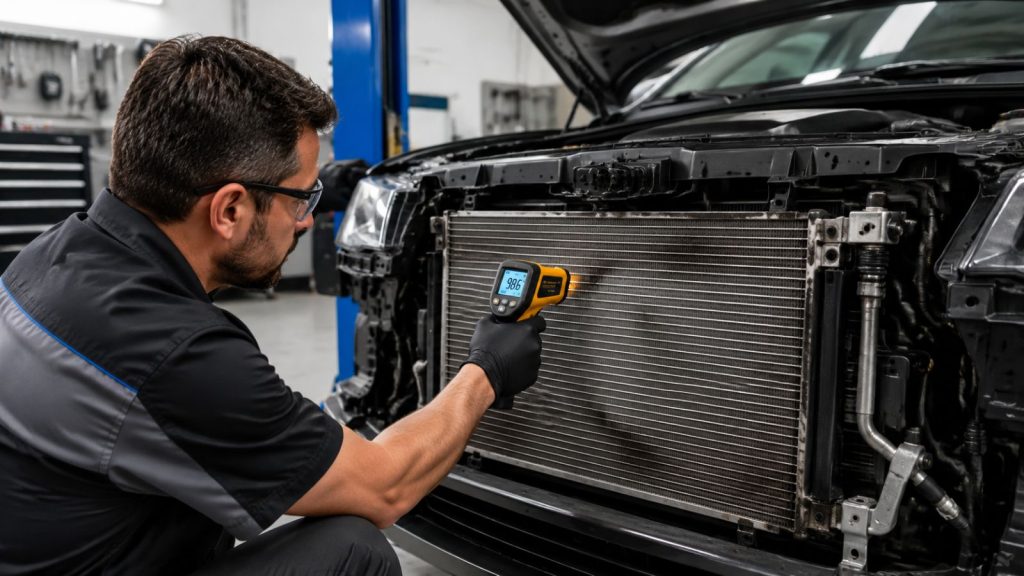
We start with a visual inspection of the condenser face, and debris packing across more than 20 percent of the surface area is the threshold where we consider airflow restriction meaningful rather than cosmetic.
Infrared surface temperature across the fin area should read within a 10 to 15 degree range from one end to the other. When we see a variance beyond 25 degrees across the surface, that points to uneven airflow caused by localized blockage rather than a system wide issue.
High side pressure is the clearest confirmation we rely on. At sustained highway speed, pressure should trend noticeably lower than idle readings thanks to the airflow boost. If high side pressure at 60 to 65 mph stays within 10 psi of what we’d expect at idle, that tells us the condenser isn’t getting the heat rejection benefit it should from all that highway airflow, debris or heat soak is canceling it out.
A condenser losing heat rejection efficiency doesn’t stop at weaker cooling on long Highway 281 drives. Sustained high side pressure from restricted airflow puts ongoing strain on the compressor itself. What starts as a simple condenser cleaning or fin repair can escalate into compressor damage if the airflow restriction runs unaddressed through a full summer of highway miles.
Get Your Condenser Airflow Checked Before It Strains Your Compressor
If your AC fades the longer you’re on Highway 281, we can inspect the condenser fin surface and confirm whether debris buildup or heat soak is behind the loss. Ruben’s AC repair specialists in 7210 Polar Bear, San Antonio, TX 78238, (210) 647-1148, know exactly what to look for.
Frequently Asked Questions
Why does my AC get weaker the longer I drive on the highway instead of staying strong?
That points to the condenser losing heat rejection efficiency as the drive continues, usually from debris buildup or heat soak restricting airflow across the fin surface, even though highway speed should normally help cooling.
Shouldn’t highway speed always improve AC performance?
It should, and that’s exactly why we see this problem get missed so often. If performance weakens instead of holding steady or improving at speed, that’s the signal something is restricting the airflow the condenser depends on.
Can I clean the condenser myself to fix this?
Surface level cleaning can help in mild cases, but debris packed deep into the fin structure and any fin warping from heat soak usually needs a direct inspection and professional cleaning to fully restore airflow. We can tell you which situation you’re dealing with.
How do I know if it’s the condenser and not the compressor?
A condenser airflow issue typically shows up as gradual cooling loss tied to driving duration and speed, while compressor issues often show up as inconsistent cycling or complete loss of cold air. We use a pressure reading at both idle and highway speed to tell the two apart.
What happens if I keep driving on Highway 281 without addressing this?
Continued airflow restriction keeps high side pressure elevated, which puts sustained strain on the compressor. Over a full summer of highway driving, that strain can turn a simple condenser fix into a much larger compressor repair.