Extended cooling loss during Loop 1604 stop and go traffic points to compressor clutch bearing strain, not low refrigerant. Sustained idle heat with reduced condenser airflow galls the bearing surface and pits the clutch plate over time. High side pressure past 275 psi or housing temps above 220°F signal wear needing inspection before a full compressor replacement.
Your AC blows warm and the second traffic on Loop 1604 grinds to a stop, then cools again once you’re moving. That pattern points straight at the compressor clutch assembly, and San Antonio’s July through September heat is what’s pushing it past its limit.
Quick Diagnostic Snapshot
| Field | Detail |
| Primary Symptom | Airflow turns warm during idle, cools again once the vehicle moves |
| Target Component | Compressor clutch bearing and shaft seal |
| Specialized Tooling | Manifold gauge set, infrared thermometer for compressor housing surface temp |
| Local or Environmental Stressor | Sustained idle heat buildup on Loop 1604 with reduced condenser airflow during congestion |
| High Risk Profile | Daily commuters on Loop 1604 during peak hours, roughly 4pm to 7pm through summer |
A compressor clutch is built to cycle. Cabin temperature demand tells it when to engage, it spins the compressor, refrigerant moves through the system under controlled pressure, and the condenser sheds that heat back out through steady airflow off the front of the vehicle. That’s the design intent.
Loop 1604 in stop and go traffic breaks that intent in one specific way. There’s no ram air. The vehicle sits still, sometimes for minutes at a stretch, and the condenser gets nothing to work with. Head pressure climbs. The compressor keeps cycling anyway because cabin demand hasn’t gone away, it’s actually gone up since the outside air is sitting at 100 degrees or better.
That combination is where the damage starts.
Sustained friction without adequate cooling galls the bearing surface inside the clutch assembly. Metal against metal, no relief, no airflow to pull the heat away. Add enough of these cycles over a Texas summer and the clutch plate contact surface starts pitting too, small pockets where the surface used to be smooth. The shaft seal hardens under the same heat load, loses its tension, and that’s usually where you start seeing slow refrigerant seepage instead of a clean seal.
Shop note. We hear this one a lot. A compressor that sounds fine at highway speed but goes quiet or weak the moment you hit standstill traffic on 1604 is almost always a clutch or seal issue, not a refrigerant charge issue. We never top off a system without checking the clutch first.
None of this happens overnight. It builds one hot commute at a time, which is exactly why we can catch it before the compressor itself needs replacing.
Diagnostic numbers that matter.
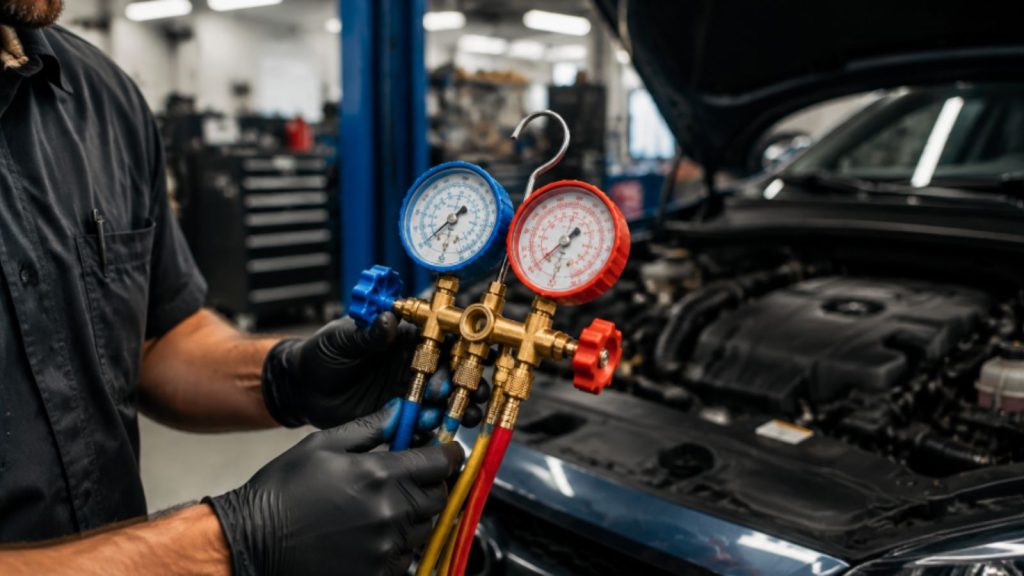
Normal high side pressure under load sits around 200 to 250 psi depending on ambient temperature. Once we see a reading pushes past 275 psi during idle on a hot day, that tells us the condenser isn’t rejecting heat the way it should while the compressor is under strain trying to compensate.
Infrared surface temp on the compressor housing above 220°F after ten minutes of idle in traffic conditions is out of spec. That’s bearing friction running hotter than tolerance allows.
Clutch engagement should be clean and immediate. Any delay past half a second on engagement tells us the bearing wear is already underway.
A compressor left to run hot through Loop 1604 traffic day after day doesn’t stop at losing cooling. It wears the bearing and seal down until the fix stops being a clutch or seal repair and becomes a full compressor swap, at several times the cost. Catching it at the pitted clutch plate stage instead of the seized bearing stage is the difference between a same day repair and a system replacement.
Get Your Compressor Checked Before Loop 1604 Traffic Wears It Out
If your AC is doing this exact thing on your Loop 1604 commute, we can pull the pressure and temperature readings needed to catch it before it turns into that full compressor swap. As the Ruben’s Auto Repair AC diagnostic team, 7210 Polar Bear, San Antonio, TX 78238, (210) 647-1148, we know this stretch of road well.
Frequently Asked Questions
How do I know if it’s the compressor clutch and not just low refrigerant?
If your cooling comes back to normal once you’re moving, then fades again the moment you’re idling in traffic, that’s a strong sign of a clutch or bearing issue rather than a refrigerant charge problem. We still need a pressure and temperature reading to confirm it.
How many times does this need to happen before it becomes an emergency repair?
There’s no exact number, but if this keeps happening on your regular Loop 1604 commute over a week or two, it’s no longer an occasional issue. That’s progressive wear we recommend getting inspected soon.
What’s the typical cost difference between a clutch bearing repair and a full compressor replacement?
The gap is significant. A clutch or seal repair costs less and takes less time than a full compressor replacement, which usually runs several times higher once you factor in parts, labor, and a full system recharge.
Can I keep driving with these symptoms?
You can for a short while, but the longer this continues, the more the bearing and seal wear progresses. That increases the chance the fix ends up being a full compressor replacement instead of a simple repair.