
U-joint binding during low-speed on-ramp acceleration traces to radial play above 0.006 inches at the needle bearing race, driveline operating angles pushed past the 5-degree smooth-operation threshold by on-ramp curve geometry, and June heat reducing grease film strength at peak torque demand. The shudder onset between 0 and 25 mph and its disappearance at highway cruise is the diagnostic signature that separates U-joint binding from torque converter shudder and traction control intervention.
What U-Joint Binding Does to Torque Transfer During Low-Speed Acceleration
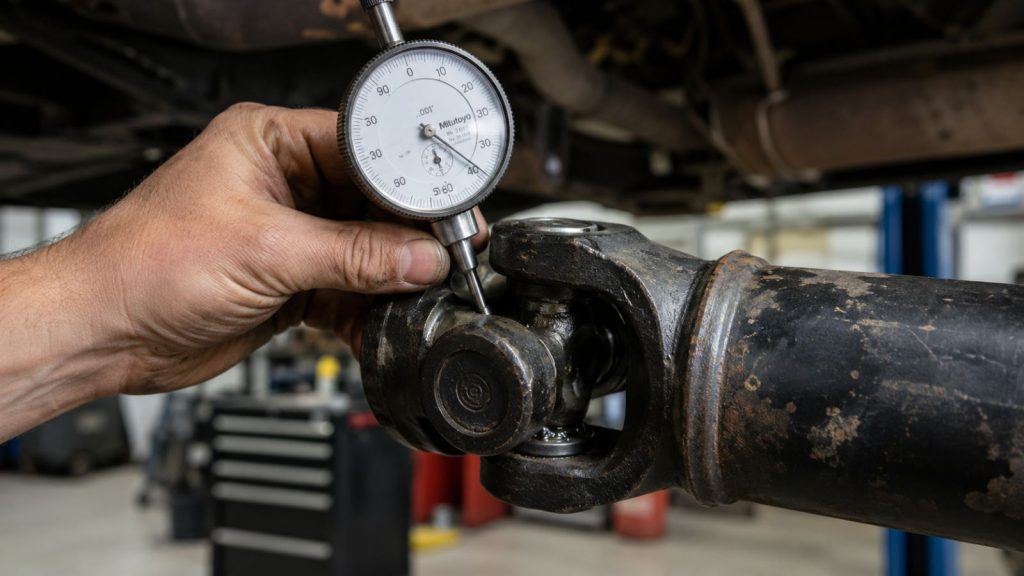
U-joint binding is a measurable failure. Acceptable U-joint radial play on a light-duty pickup truck driveshaft measures 0 to 0.006 inches (0 to 0.15 mm) under static dial indicator inspection. Play above 0.006 inches indicates needle bearing wear that introduces torque transfer resistance under load.
At or above 0.012 inches (0.30 mm) of radial play, the joint cross binds during driveline articulation. Torque no longer transfers smoothly through the bearing race. Instead, the joint transmits torque in an uneven pulse, producing a 2nd order driveshaft vibration at twice the rotational frequency of the driveshaft.
At 10 mph during on-ramp acceleration, a pickup truck driveshaft rotates at approximately 300 to 400 RPM. That produces a 2nd order binding vibration at 10 to 13 Hz. The driver feels it as a low-frequency shudder through the floorboard and seat base during the first seconds of hard throttle application. The shudder fades as road speed climbs above 20 to 25 mph and the driveline operating angle decreases.
Slip yoke condition adds a second failure input on trucks with a two-piece driveshaft. Spline clearance above 0.005 inches at the transmission output shaft allows the yoke to cock slightly in the bore under combined torque and articulation load. That produces a secondary shudder at a different frequency from the U-joint vibration, and both arrive simultaneously on a high-mileage work truck with compound driveline wear.
Diagnostic Verdict. On pickup trucks presenting with on-ramp shudder complaints, dial indicator measurement at the driveshaft U-joint confirms radial play above 0.010 inches in the majority of confirmed binding cases, with slip yoke spline clearance above 0.005 inches present simultaneously on trucks with towing history above 50,000 accumulated miles.
How Loop 1604 On-Ramp Geometry Creates Peak Driveline Articulation Load
Loop 1604 on-ramp entries are not flat or straight. The northbound on-ramp at Bandera Road curves left through the entry, placing the vehicle in a right-bank lean under hard acceleration. That lean compresses the right-front suspension and raises the rear pinion angle by approximately 1 to 2 degrees from the static driveline measurement.
A U-joint operates smoothly within a driveline operating angle of 1 to 3 degrees. Operating angles above 5 degrees introduce velocity fluctuation at the joint output, producing the cyclic torque variation that the driver feels as a shudder. On a truck with radial play already above 0.010 inches, the additional 1 to 2 degrees from on-ramp curve geometry pushes the joint past its smooth operating threshold within the first 3 to 5 seconds of acceleration.
The Loop 1604 and Hwy 151 interchange on-ramp entries add a second stress dimension. Traffic signal-controlled entries require maximum torque demand from a dead stop. That combination of zero road speed and full throttle loads the U-joint at the lowest driveshaft RPM of the entire commute, where 2nd order binding vibration frequency is lowest and felt most clearly through the seat.
Helotes work trucks carrying 500 to 1,000 lbs of bed payload enter Loop 1604 with a payload-induced pinion angle increase beyond the unloaded static measurement. Payload compresses the rear suspension further, raising the pinion angle and reducing the margin between the current operating angle and the 5-degree binding threshold. A loaded Helotes work truck with U-joint play above 0.008 inches reaches the binding threshold at a lower speed than the same truck would unload.
Diagnostic Verdict. On Helotes and Leon Valley work trucks with payload history and on-ramp shudder complaints, driveline operating angle measurement under simulated load confirms angles above 4.5 degrees at the rear U-joint during on-ramp acceleration simulation, placing these trucks inside the velocity fluctuation range on every Loop 1604 entry.
The Vibration Onset Pattern From Initial Throttle to Full Driveline Engagement
The shudder has a precise speed window. It begins within the first 3 to 5 seconds of hard on-ramp acceleration and fades as the truck reaches 20 to 25 mph. Above 25 mph, the driveline operating angle decreases as the suspension settles and the on-ramp straightens. The U-joint moves back inside its smooth operating range. The shudder stops.
That speed-specific onset and disappearance is the behavioral signature of U-joint binding. A driver who notices the shudder only on Loop 1604 on-ramp hard acceleration, and never at highway cruise on the same road, has described U-joint binding behavior with diagnostic precision. The component name does not matter. The behavior does.
June heat sharpens the onset. Driveshaft tunnel temperatures on vehicles sitting in pre-merge stop-and-go traffic on Bandera Road or Culebra Road reach 140°F to 160°F before the on-ramp entry. At those temperatures, grease film strength in a worn U-joint with needle bearing pitting deteriorates faster than in a healthy joint at the same temperature. The torque spike of hard on-ramp acceleration arrives at the moment of worst grease protection in the daily drive cycle.
In pickup trucks we service from the Helotes and Leon Valley area, U-joint radial play above 0.010 inches is a consistent finding on vehicles whose owners report an on-ramp shudder that disappears above 25 mph. The Loop 1604 northbound on-ramp at Bandera Road is the most commonly named driving event in these complaints. The shudder onset at low speed and disappearance at cruise is the diagnostic signature we see repeatedly on northwest side work truck platforms.
Diagnostic Verdict. On trucks where the shudder onset is confirmed between 0 and 25 mph on hard acceleration and absent at 55 to 70 mph steady cruise, driveshaft vibration measurement confirms 2nd order vibration amplitude above 0.2 in/sec in the 10 to 13 Hz range during on-ramp acceleration simulation, dropping below 0.1 in/sec at highway cruise speed.
What the Diagnostic Process Confirms Before U-Joint or Driveshaft Replacement
Torque converter shudder and traction control intervention are the two most common misdiagnoses for on-ramp U-joint binding. Both produce a vibration or shudder sensation during acceleration. Neither produces the specific low-speed onset and high-speed disappearance pattern that U-joint binding creates.
Torque converter shudder occurs at a specific speed and throttle combination during lockup clutch engagement, typically between 35 and 45 mph under light throttle on a level road. It does not occur during hard acceleration from a stop. Traction control intervention produces a rhythmic deceleration pulse as the system brakes the spinning wheel. The driver feels a pulsing reduction in forward motion, not a smooth continuous shudder through the seat.
Many northwest side truck owners have scheduled a transmission service for an on-ramp shudder that was U-joint binding from the first complaint. The transmission service does not resolve the symptom because the source is mechanical play at the needle bearing race, not fluid condition or torque converter clutch wear. The throttle-lift test separates the two sources before any parts are ordered.
The throttle-lift test is performed during on-ramp acceleration at the point of shudder onset. Releasing throttle at 10 to 15 mph eliminates U-joint binding vibration immediately. The shudder stops and the instant torque load is removed from the driveshaft. Torque converter shudder persists briefly after throttle lift because the lockup clutch takes a moment to release. That behavioral difference, immediate stop versus brief continuation after throttle lift, is the diagnostic distinction that routes the repair correctly. Drivers who need a San Antonio mechanic experienced with driveline and U-joint diagnosis on the northwest side benefit from that test before a transmission service is scheduled.
The pattern we see most often on Loop 1604 corridor truck vibration complaints is a shudder that begins within the first 3 to 5 seconds of hard on-ramp acceleration and fades as the truck reaches 20 to 25 mph. That speed window matches the driveshaft RPM range where 2nd order U-joint vibration is most pronounced. Drivers who describe the shudder only on on-ramp acceleration and never at highway cruise have identified U-joint binding with precision.
Diagnostic Verdict. On trucks where the throttle-lift test eliminates the shudder immediately at 10 to 15 mph during on-ramp acceleration, U-joint radial play above 0.010 inches is confirmed on dial indicator inspection in the majority of cases, with driveline operating angle above 4.0 degrees under simulated on-ramp lo