Repeated angled driveway entry causes torsional flex cycles that concentrate stress at subframe corner weld points and compress mount bushings beyond their deflection threshold. On northwest San Antonio residential lots with clay-soil settlement and aged concrete aprons, this load repeats twice daily. Subframe mount bushing deflection above 3 mm and bolt torque loss of 15 to 25 ft-lb below OEM specification are the confirmed diagnostic findings.
What Torsional Flex Does to a Subframe on a Repeated Driveway Entry Cycle
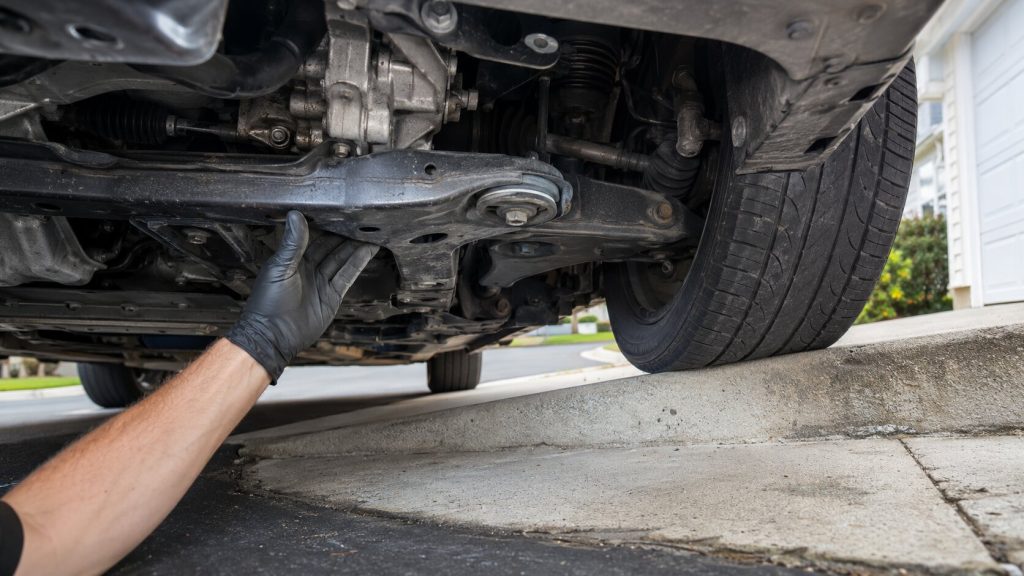
Angled driveway entry loads the chassis diagonally. When one wheel sits 4 to 6 inches higher than the opposing wheel at the driveway apron, the vehicle’s unibody absorbs a torsional flex cycle across its full length. On a vehicle with a wheelbase of 104 to 112 inches, that elevation difference produces a cross-axle articulation angle of approximately 2.0 to 3.5 degrees.
Most unibody subframe mount systems are engineered for road surface irregularities below 2 degrees of sustained diagonal articulation. A driveway entry at 2.0 to 3.5 degrees exceeds that design tolerance on every approach. The subframe mount bushings absorb that excess load. Acceptable bushing deflection under static load measures 0 to 2 mm. Deflection above 3 mm indicates bushing deterioration that the driveway entry cycle is accelerating.
The chassis weld points at the subframe corners absorb what the bushings do not. Fatigue crack initiation in mild steel weld zones begins after repeated stress cycles at loads exceeding the material’s endurance limit. A vehicle entering an angled driveway twice daily accumulates approximately 700 torsional flex cycles per year from driveway entry alone. That cycle count is concentrated at the forward subframe corner welds, where the torsional load path transitions from the subframe rails to the unibody structure.
The creak or knock a driver hears on entry is not a minor annoyance. It is the sound of metal movement at a mounting interface that should have zero play. A sharp floorboard creak on the diagonal load of driveway entry, absent on flat pavement, is the primary symptom that separates subframe mount stress from other chassis noise sources.
Diagnostic Verdict. On vehicles presenting with driveway entry creak, shop-floor torque checks confirm subframe mounting bolts measuring 15 to 25 ft-lb below OEM specification on at least one mounting point, with bushing deflection above 3 mm at the same location on teardown inspection.
How Northwest San Antonio Driveway Geometry Loads the Chassis and Mounting Points
Northwest Crossing sits on Bexar County’s expansive clay soil. Residential driveway aprons in this neighborhood experience vertical settlement of 1 to 3 inches at the apron edge as clay contracts under June surface temperatures approaching and exceeding 100°F. That settlement increases the effective elevation differential at driveway entry beyond the original construction angle. With school out in June, driveway entry frequency increases as household vehicles cycle in and out throughout the day, adding to the total torsional flex count on the subframe mount system.
Westover Hills and Castle Hills compound the problem with aged infrastructure. Concrete driveway aprons in these mature neighborhoods were installed 20 to 40 years ago. Oak pollen season has just cleared by June, but the root systems driving apron heave continue expanding through summer. Root heave creates localized elevation differentials of 2 to 5 inches at the street-to-driveway transition. Vehicles crossing these heaved aprons multiple times daily load subframe mount bushings at a rate that accelerates compression and bolt torque loss compared to vehicles on flat residential driveways.
June heat adds a thermal factor. Subframe mount bushings on most unibody platforms use rubber compounds with a Shore A durometer of 55 to 70. After sustained stop-and-go driving on Loop 1604 or Bandera Road in June ambient temperatures of 98°F to 104°F, underhood heat soak raises bushing temperatures into a range where rubber stiffness measurably decreases. A thermally softened bushing absorbs less torsional load and deflects further under the same driveway entry angle. The driver returning home from a Loop 1604 commute in June loads already-warm bushings at the worst point in the daily drive cycle.
In vehicles we service from Northwest Crossing and Castle Hills, subframe mount bushing deflection above 3 mm is a consistent finding on vehicles with fewer than 60,000 miles when the owner reports a driveway creak. The creak onset correlates to driveway approach angle, not highway mileage. Owners from these neighborhoods report the symptom appearing within 2 to 3 years of ownership on vehicles showing no other suspension wear.
Diagnostic Verdict. On northwest side vehicles with confirmed driveway creak, cradle-to-body clearance at the forward mount points measures 2 to 4 mm on inspection, down from the OEM nominal gap of 8 to 12 mm, confirming metal-to-metal contact under torsional load at the subframe flange.
The Fatigue Progression From Stress Concentration to Subframe Mount Failure
The failure does not arrive suddenly. It builds across a predictable progression. The first stage is an intermittent creak on angled driveway entry that disappears on flat pavement. At this stage, bushing deflection is typically in the 3 to 4 mm range and bolt torque loss is 10 to 15 ft-lb below OEM specification.
The second stage extends the symptom to other diagonal load events. Parking lot speed bumps, uneven pavement on residential streets, and sharp curb entries begin to produce the same creak. Bushing deflection at this stage typically measures 4 to 5 mm. The subframe has begun to shift position under load because the mount interface no longer holds it in a fixed plane.
The third stage is a persistent knock on surfaces that previously produced no symptom. At this point, metal-to-metal contact between the subframe flange and body rail has compressed the remaining clearance to 2 mm or less. The forward subframe corner weld points show visible stress marks on inspection. Subframe bolt torque on at least one mounting point has dropped 15 to 25 ft-lb below OEM specification, which ranges from 85 to 148 ft-lb depending on platform.
The pattern we see most often on northwest side vehicles with subframe complaints is exactly this three-stage progression. By the time the knock is present on flat surfaces, the diagnostic findings confirm that the driveway entry cycle drove the failure timeline. Highway mileage and road condition history on these vehicles is often unremarkable. The driveway is the stress source.
Diagnostic Verdict. On vehicles at stage three of this progression, forward subframe corner weld points show stress mark patterns consistent with repeated torsional flex concentration, and bushing deflection measures 5 mm or above on both forward mount points simultaneously.
What the Diagnostic Process Confirms Before Subframe or Mount Replacement
Sway bar end links and ball joints produce chassis creak. Both are common misdiagnoses for subframe mount noise. The distinction matters because replacing end links or ball joints on a vehicle with subframe mount failure does not resolve the symptom.
A sway bar end link creak occurs on lateral body roll during cornering and low-speed parking lot maneuvering. A ball joint creak occurs under vertical suspension travel on bumps and dips. A subframe mount creak occurs specifically on diagonal chassis articulation. That is a different load direction, and it produces a different symptom location. The creak from a failing subframe mount is felt through the floorboard at the center of the vehicle, not through the steering wheel or the door sill.
Many drivers and some service advisors treat the driveway creak as an end link or ball joint issue based on the vehicle’s age and mileage. The diagnostic reality is different. End link and ball joint wear produce symptoms on every bump and corner. Subframe mount stress produces symptoms specifically on the diagonal load of angled surface entry. A vehicle that creaks on the driveway and rides silently on flat pavement is describing subframe mount failure, not end link wear.
The diagonal ramp test confirms the source. Placing one wheel on a ramp of 4 to 6 inches while the opposing wheel remains on flat ground reproduces the torsional chassis load of driveway entry without cornering input. If the creak reproduces on the ramp and not during a suspension bounce test or a slow figure-eight, the subframe mount is the confirmed source. Drivers who need a chassis and suspension diagnosis on the northwest side benefit from that test sequence before any parts are ordered.
Diagnostic Verdict. On vehicles where the diagonal ramp test reproduces the creak and the suspension bounce test does not, subframe mount bushing deflection above 3 mm and bolt torque below OEM specification are confirmed on inspection in the majority of cases, with sway bar end links and ball joints measuring within acceptable tolerance on the same vehicle.
Drivers in Northwest Crossing, Westover Hills, and Castle Hills noticing a floorboard creak on driveway entry can schedule a subframe mount diagnostic with Ruben’s Auto Repair, 7210 Polar Bear, San Antonio, TX 78238, at (210) 647-1148, before bushing deflection and bolt torque loss progress to metal-to-metal contact at the subframe flange.
Frequently Asked Questions
Does angled driveway entry cause subframe damage in San Antonio?
Yes, repeated diagonal torsional flex cycles from angled driveway entry compress subframe mount bushings above the 3 mm deflection threshold and reduce mounting bolt torque 15 to 25 ft-lb below OEM specification.
What does a subframe creak on driveway entry mean?
Yes, a creak specific to angled surface entry indicates subframe mount bushing deflection above 3 mm and metal-to-metal contact at the subframe flange when cradle-to-body clearance drops below 4 mm.
Can clay soil in Bexar County make driveway subframe stress worse?
Yes, June clay-soil contraction under surface temperatures approaching 100°F causes driveway apron settlement of 1 to 3 inches, increasing the elevation differential at entry and worsening torsional load on subframe mount bushings.
What is the correct subframe mounting bolt torque for my vehicle?
Yes, OEM subframe bolt torque ranges from 85 to 148 ft-lb depending on platform, and torque loss of 15 to 25 ft-lb below that specification confirms micro-rotation from repeated torsional flex cycles.
How do I know if my driveway creak is the subframe or a ball joint?
Yes, a creak that reproduces on a diagonal ramp test but not during a suspension bounce test isolates the subframe mount as the source, with ball joints and end links measuring within tolerance on the same vehicle.
Does June heat in San Antonio make subframe bushings wear faster?
Yes, sustained underhood heat soak after Loop 1604 commuting in June ambient temperatures of 98°F to 104°F reduces rubber bushing stiffness measurably, increasing deflection under the same driveway entry load.