Pickup truck axle vibration during highway merging traces to U-joint radial play above 0.006 inches, pinion bearing preload below 8 in-lb, or slip yoke clearance above 0.005 inches. San Antonio’s short merge lanes on I-10 and Loop 1604 apply peak drivetrain torque under July heat, compressing the wear timeline on high-mileage work trucks. Vibration onset correlates to throttle load, not road speed. That distinction separates drivetrain failure from tire imbalance before any parts are ordered.
What Torque Load Does to a Pickup Truck Drivetrain Under Hard Acceleration
Peak torque arrives fast on a V8 pickup. A Ford F-150 with the 5.0L engine produces 400 ft-lb of peak torque. A Chevrolet Silverado with the 5.3L produces 383 ft-lb. That load reaches the driveshaft and rear axle within 2 to 4 seconds of wide-open throttle acceleration from a near-stop merge entry.
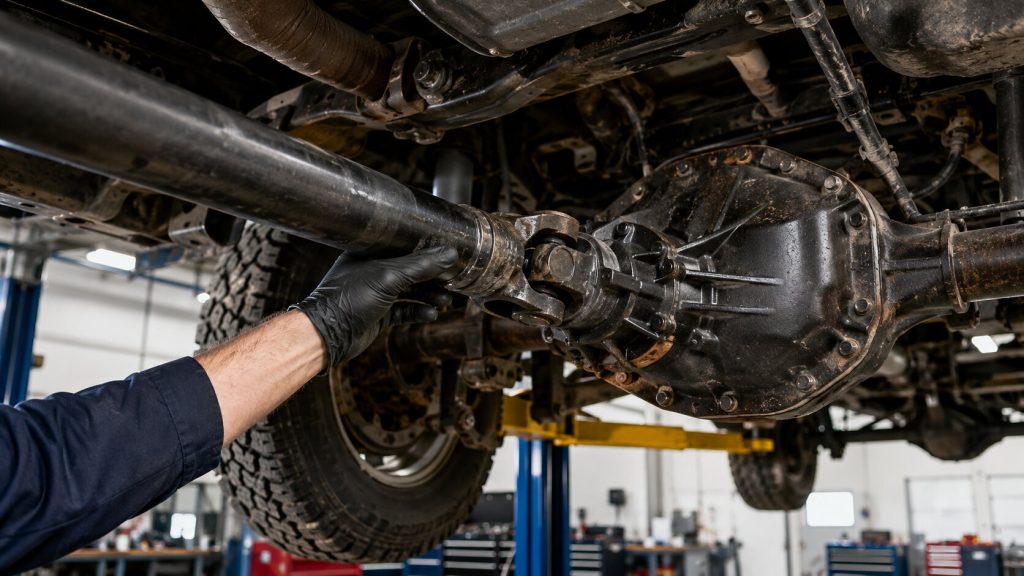
The driveshaft absorbs that torque through two U-joints and a slip yoke. Each component has a measurable wear threshold. U-joint radial play above 0.006 inches (0.15 mm) produces vibration felt through the floorboard and seat during acceleration. At or above 0.010 inches (0.25 mm), the vibration becomes audible as a low-frequency clunk under hard torque load.
The slip yoke adds a second failure mode. Acceptable spline clearance between the yoke and transmission output shaft runs 0.001 to 0.003 inches. Clearance above 0.005 inches allows the yoke to oscillate under torque reversal. That oscillation produces a fore-aft shudder felt at the seat base on throttle application and lift-off. It is a distinct symptom from U-joint vibration and requires separate measurement to confirm.
The rear axle pinion bearing carries the third failure point. OEM pinion bearing preload on the Ford 8.8-inch axle specifies 10 to 20 in-lb of rotating torque. The GM 8.6-inch axle specifies 15 to 25 in-lb. The Toyota 8-inch specifies 10 to 18 in-lb. Preload below 8 in-lb on any of these platforms allows pinion movement under torque. That movement amplifies driveshaft vibration during the exact acceleration event a merge demands.
Diagnostic Verdict. On light-duty pickup trucks presenting with merge vibration complaints, we measure U-joint radial play above 0.008 inches in the majority of confirmed drivetrain cases, with pinion preload below 10 in-lb present simultaneously on trucks showing bearing discoloration on teardown.
How San Antonio Highway Merge Conditions Stress the Driveshaft and Rear Axle
San Antonio’s merge geometry is punishing on drivetrain components. The I-10 westbound acceleration lane from Wurzbach Pkwy requires reaching 65 to 70 mph within approximately 800 feet. July ambient temperatures of 102°F to 108°F raise driveshaft tunnel temperatures to 130°F to 150°F during pre-merge idling in stop-and-go traffic. Elevated tunnel temperature reduces U-joint grease viscosity, increasing metal-to-metal contact precisely when the torque spike of rapid acceleration arrives.
The Loop 1604 northbound entry at Bandera Road compounds the problem for northwest side commuters. That merge requires acceleration across multiple lanes from a near-stop condition in a high-traffic window. Drivers applying full throttle before the drivetrain reaches steady operating temperature place maximum stress on cold U-joint grease, where internal resistance is highest and film strength is lowest.
In pickup trucks we service from the Helotes and Leon Valley area, the vibration complaint consistently arrives after the driver begins a daily commute that includes the Loop 1604 northbound merge at Bandera Road. That merge-load cycle repeats five days a week. U-joint wear that takes years on a highway cruiser accelerates to a diagnostic finding within 18 to 24 months on a high-mileage work truck from that corridor.
Trucks used for towing or hauling loads compress the timeline further. Northwest side work truck owners pulling trailers or equipment loads place above-average stress on U-joints and pinion bearings on every merge event. The drivetrain absorbs tow-load torque multiplication on top of the engine’s peak output, and worn components reach the vibration threshold faster than on an unloaded passenger truck.
Diagnostic Verdict. On northwest side work trucks with towing history and merge vibration complaints, we find U-joint radial play above 0.010 inches and driveshaft vibration amplitude above 0.3 in/sec at 60 to 70 mph, placing these trucks above the 0.2 in/sec threshold where drivetrain imbalance becomes a confirmed finding.
The Vibration Onset Pattern from Throttle Application to Drivetrain Oscillation
The vibration does not arrive at a fixed road speed. It arrives at a fixed throttle demand. A driver merging onto I-35 southbound through the downtown interchange may feel nothing at 45 mph on light throttle, then feel a sharp floorboard vibration the moment full acceleration is applied. That throttle-correlation is the diagnostic signal that separates drivetrain failure from tire imbalance.
The I-35 southbound curved ramp geometry adds lateral load to the longitudinal torque stress of merge acceleration. On a truck with unequal U-joint wear between the front and rear joints of the driveshaft, this combined load produces a harmonic vibration distinct from straight-line acceleration vibration. The frequency felt through the seat changes as the ramp straightens. That frequency shift on a curve is a field observation that points directly to driveshaft phase angle misalignment compounding worn U-joint play.
The pattern we see most often on northwest side truck vibration complaints is an onset that the driver first notices under hard throttle at the merge, then feels at progressively lower acceleration thresholds as U-joint wear advances. By the time the vibration registers at moderate acceleration, joint play typically measures above 0.010 inches. Pinion preload on those same trucks is usually approaching the lower end of the OEM specification window.
Diagnostic Verdict. On trucks where the driver reports vibration onset at the merge but not at steady cruise, road test data consistently shows vibration amplitude above 0.2 in/sec at wide-open throttle and below 0.1 in/sec at the same road speed under light throttle, confirming torque-correlated rather than speed-correlated vibration.
What the Diagnostic Process Confirms Before Replacing Axle or Driveshaft Components
Tire imbalance gets blamed for merge vibration more often than the evidence supports. Tire imbalance produces a speed-dependent vibration frequency that is consistent at a given road speed regardless of throttle position. The steering wheel trembles at 65 mph whether the driver is accelerating, coasting, or holding speed. That behavior does not change with throttle input.
Drivetrain vibration behaves differently. U-joint wear and pinion preload loss produce torque-dependent vibration that changes with throttle demand, not road speed. A truck with confirmed U-joint play above 0.010 inches will vibrate under hard acceleration at 40 mph and ride smoothly at steady cruise at 70 mph. Many drivers have left a tire balance service with the vibration unchanged, because the tire shop addressed speed-correlated frequency while the torque-correlated drivetrain failure remained undiagnosed.
The correct diagnostic sequence separates these two sources before any parts are ordered. A vibration analyzer road test at steady cruise, then under hard acceleration at the same speed, identifies whether the amplitude changes with throttle input. If it does, the driveshaft and U-joints are measured next. Static U-joint play is checked with a dial indicator. Pinion preload is measured with an inch-pound torque wrench after marking the pinion flange position. Slip yoke clearance is measured with a feeler gauge at the yoke-to-transmission interface.
Drivers who rely on a San Antonio mechanic experienced with truck drivetrain diagnosis benefit from that sequencing because it prevents replacing tires or performing an alignment on a truck whose vibration source is a worn rear axle pinion bearing.
Diagnostic Verdict. On trucks referred after a tire balance service that did not resolve the vibration complaint, we find U-joint radial play above 0.007 inches and pinion preload below 12 in-lb in the majority of cases, confirming the vibration source was torque-correlated drivetrain wear, not speed-correlated tire imbalance.
Truck drivers noticing floorboard vibration or seat shudder during merge acceleration on I-10 or Loop 1604 can schedule a drivetrain diagnostic with Ruben’s Auto Repair, 7210 Polar Bear, San Antonio, TX 78238, at (210) 647-1148, before worn U-joints or low pinion preload progress to a driveshaft failure on the freeway.
Frequently Asked Questions
Does pickup truck axle vibration get worse during highway merging in San Antonio?
Yes, rapid throttle application during short merge lanes on I-10 and Loop 1604 places peak torque on worn U-joints and pinion bearings, amplifying vibration beyond what steady cruise produces.
What U-joint play measurement means a driveshaft needs replacement?
Yes, radial play above 0.006 inches produces vibration onset under torque load, and play above 0.010 inches creates audible drivetrain clunk during hard acceleration.
Can tire imbalance cause the same vibration as a worn U-joint?
No, tire imbalance produces speed-correlated vibration consistent at a fixed road speed, while U-joint wear produces torque-correlated vibration that changes with throttle input at the same speed.
What is the pinion bearing preload specification for a Ford F-150 rear axle?
Yes, the Ford 8.8-inch axle specifies 10 to 20 in-lb of rotating pinion preload, and readings below 8 in-lb indicate bearing wear that amplifies driveshaft vibration under load.
Does towing a trailer accelerate U-joint wear on San Antonio highways?
Yes, tow-load torque multiplication on merge acceleration compresses the U-joint wear timeline, and northwest side work trucks with towing history typically reach diagnostic play thresholds within 18 to 24 months.
What does slip yoke clearance above 0.005 inches cause on a pickup truck?
Yes, clearance above 0.005 inches at the transmission output shaft allows yoke oscillation under torque reversal, producing a fore-aft seat shudder distinct from U-joint vibration.