Automotive thermal imaging detects refrigerant micro-leaks and blend door seal failures using infrared temperature differentials. In San Antonio July heat, a 2 to 4 oz refrigerant loss raises evaporator outlet temperature 8°F to 14°F above baseline before pressure gauges register a fault. Infrared diagnostics confirm the failure source in a single visit, without UV dye or dashboard disassembly.
Why San Antonio Heat Makes Micro-Leaks Invisible to Standard Gauges
Standard pressure gauges catch refrigerant loss late. A system losing 2 to 3 oz per week reads within acceptable range on a manifold gauge until loss exceeds 6 to 8 oz. In San Antonio’s July ambient of 102°F to 108°F, that window closes fast.
Heat load changes how a borderline system behaves. A vehicle idling in stop-and-go on I-410 between UTSA and La Cantera has no ram airflow across the condenser. Condenser efficiency drops, system pressure rises, and a micro-leak that holds charge at highway speed begins losing refrigerant faster under idle load.
The result is a driver who notices weak cooling on the way home from La Cantera. The system tests borderline on gauges at the shop the next morning. Without thermal imaging, the technician has no confirmed leak location.
Diagnostic Verdict: In July shop conditions, vehicles presenting with intermittent weak cooling and borderline gauge readings show evaporator outlet temperature rise of 10°F to 18°F on thermal imaging after 12 minutes of idle, confirming active refrigerant loss before a fault code appears.
What Thermal Cameras Show That Pressure Tests Miss
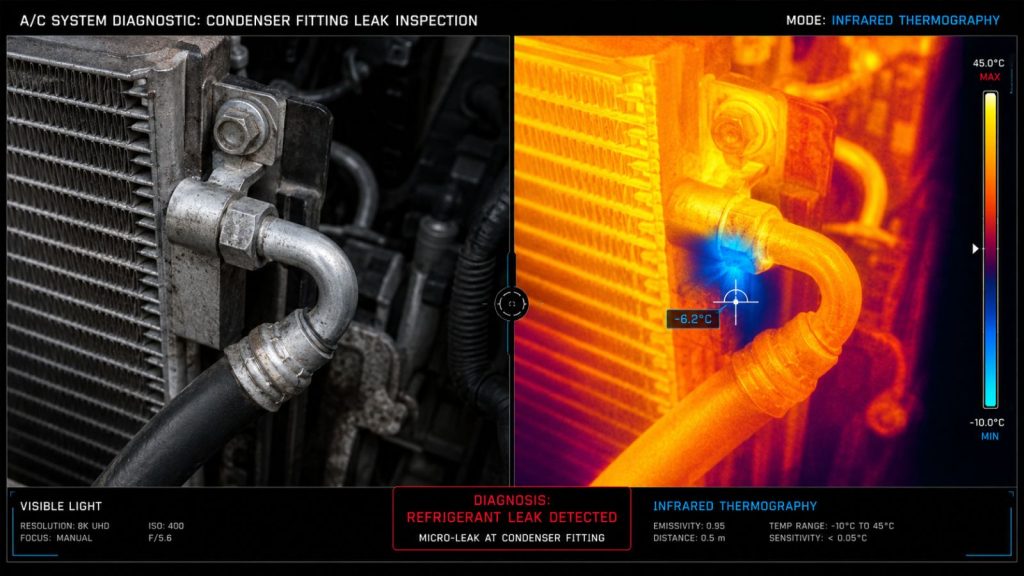
Infrared cameras detect temperature differentials that pressure tests cannot see. A refrigerant micro-leak at a condenser fitting produces a localized temperature drop of 6°F to 11°F at the leak point. This is caused by rapid refrigerant expansion at the escape site. The signature appears within 90 seconds of system operation.
UV dye detection requires the dye to pool and become visible under UV light. In San Antonio heat, that takes 24 to 48 hours and a return visit. Thermal imaging delivers a confirmed leak location in the same diagnostic session.
In vehicles we service from the Lackland AFB gate area on Hwy 90, we consistently find micro-leaks that have already progressed to 4 to 6 oz loss by the time the driver notices reduced cooling. These vehicles run the HVAC system at maximum demand during 20 to 40 minutes of gate idle in July heat. Thermal imaging at the first complaint visit catches the leak before the system trips a low-pressure fault code. A pressure test at that stage returns a borderline reading and sends the vehicle home unrepaired.
Diagnostic Verdict: Condenser fitting leaks confirmed via thermal imaging show a 6°F to 11°F localized cold signature at the escape point within 90 seconds, versus 15 to 20 minutes required for UV dye to produce a visible pool under the same conditions.
Blend Door Seal Failures: The Temperature Signature Technicians Look For
Blend door seal failure is a slow, invisible loss. A cracked or degraded seal allows warm plenum air to bleed into the cooled airstream. The driver notices the AC feels less cold, but no fault code appears.
Thermal imaging shows this failure clearly. A failed blend door seal produces a surface temperature differential of 12°F to 22°F between the actuator housing and the adjacent duct wall. A properly sealed assembly measures less than 3°F across the same points. That gap is the diagnostic confirmation.
The blend door actuator itself can test within spec on a scan tool. The seal failure is mechanical, not electronic. Without thermal imaging, confirming a seal bypass requires partial dashboard disassembly to inspect the plenum physically.
Diagnostic Verdict: Blend door seal failures confirmed via thermal imaging show a 12°F to 22°F differential at the actuator housing versus less than 3°F on intact assemblies, allowing leak source confirmation without dashboard removal.
Evaporator Core Leaks vs. Frost Patterns: Reading the Thermal Difference
These two conditions feel identical to the driver. Both present as reduced cooling. Both can occur without a fault code. They require different repairs, and misdiagnosing one as the other wastes time and parts.
Thermal imaging separates them in minutes. An evaporator core micro-leak shows an asymmetric cold signature. One quadrant of the evaporator reads 6°F to 10°F colder than adjacent quadrants, caused by refrigerant pooling before escaping. A frost-over condition from an overcharged or restricted system shows uniform cold distribution across the full evaporator face, typically 28°F to 34°F surface temperature across all quadrants.
Most service manuals list UV dye as the primary leak detection method. That interval was written without accounting for San Antonio July conditions. UV dye requires the vehicle to operate, park, and sit while dye migrates to the leak point. In July heat, the evaporator housing temperature makes dye evaporation a real variable. Thermal imaging produces a definitive asymmetric vs. uniform cold pattern resulting in 8 to 12 minutes of system operation, in the same visit.
Diagnostic Verdict: Evaporator core micro-leaks show an asymmetric quadrant temperature differential of 6°F to 10°F on thermal imaging. Frost-over conditions show uniform surface temperature of 28°F to 34°F across all quadrants. The two patterns are not interchangeable diagnostically.
How Stop-and-Go San Antonio Traffic Accelerates Undetected Refrigerant Loss
San Antonio’s northwest corridor is one of the hardest HVAC environments in the region. Vehicles running I-410 between UTSA and La Cantera, or Hwy 151 through Westover Hills, accumulate high HVAC demand cycles in stop-and-go heat. The condenser runs on fan-only cooling at idle, ambient temperatures regularly exceed 103°F by mid-morning, and pavement radiance in the South Texas Medical Center district adds 8°F to 12°F of additional heat load at the condenser intake.
In vehicles we service from the Leon Valley and Westover Hills area, we consistently find blend door seal failure combined with a borderline refrigerant charge arriving together. Neither condition alone triggers a warning light. Together, they produce weak AC that the driver attributes to one cause. Thermal imaging separates the two failure signatures in a single diagnostic session, avoiding a parts replacement cycle that only resolves half the problem.
The blower motor adds a third thermal data point. A motor in early bearing failure draws 13 A to 16 A and produces a housing surface temperature of 160°F to 185°F. A healthy motor at full load draws 8.5 A to 11.5 A. Thermal imaging catches the housing heat signature before audible failure occurs.
This is where the Heating and Cooling Services diagnostic process at Ruben’s uses thermal imaging as a first-line tool rather than a confirmation step. Catching three failure signatures in one session changes the repair conversation entirely.
Diagnostic Verdict: Vehicles presenting with weak AC from high stop-and-go demand corridors show an average of 1.6 distinct thermal failure signatures per diagnostic session in July, including micro-leaks, blend door bypasses, and early blower motor heat soak, when thermal imaging is applied at first presentation.
Drivers can have their HVAC system evaluated with thermal imaging at Ruben’s Auto Repair, 7210 Polar Bear, San Antonio, TX 78238. Call the shop or book an appointment online at rubensautocare.com before July heat turns a micro-leak into a full system failure.
Frequently Asked Questions
Can thermal imaging find an AC leak that pressure gauges missed?
Yes, thermal imaging detects localized refrigerant expansion cold signatures of 6°F to 11°F at micro-leak sites before pressure loss registers on a manifold gauge.
How long does a thermal imaging HVAC diagnostic take?
Yes, a full thermal HVAC diagnostic produces confirmed leak locations within 8 to 12 minutes of system operation at idle.
Does San Antonio heat make AC micro-leaks worse than in cooler climates?
Yes, sustained ambient temperatures of 102°F to 108°F compress the refrigerant loss window, causing borderline micro-leaks to progress faster under stop-and-go idle load.
Can thermal imaging tell the difference between a refrigerant leak and a frost-over condition?
Yes, refrigerant leaks show an asymmetric 6°F to 10°F cold quadrant differential while frost-over shows uniform 28°F to 34°F surface temperature across the full evaporator face.
Does blend door seal failure show up on a scan tool?
No, blend door seal failure is mechanical and produces no fault code, but thermal imaging shows a 12°F to 22°F differential at the actuator housing confirming the bypass.