Leon Valley school zone driving concentrates cold starts and low-speed braking into twice-daily windows. Battery voltage often reads below resting range from frequent short trips, condensation builds inside the engine when it never reaches full operating temperature, and brake pads wear from repeated drop-off cycling. Ruben’s Auto Repair adjusts inspection timing to match this specific driving pattern.
Why Frequent School Zone Trips Wear Subarus Differently Than Highway Driving
A school run rarely lasts long enough to fully warm an engine. Leon Valley’s drop-off and pickup pattern repeats that short cycle twice a day.
That repetition matters more than the mileage itself. Cold starts, low-speed braking, and incomplete warm-up all stack together into a distinct wear signature, different from a single longer commute covering the same distance.
Three systems absorb most of that stress. Battery, engine condensation clearing, and brakes each show measurable effects tied specifically to this drop-off and pickup rhythm.
Diagnostic Verdict. Scan and battery data across several Leon Valley school-zone Subarus showed measurable deviation across all three systems within the same service visit.
What Battery Drain Looks Like on Short Cold-Start Trips
The pattern we see most often in San Antonio school-zone driving on Subaru electrical systems is voltage readings sitting below the healthy resting range. Frequent cold starts are the main driver.
A cold start places more load on the battery and starter than a warm restart. Vehicles making mostly short trips accumulate more cold starts per week than a single daily commute would, without enough drive time in between to fully recharge.
That drain builds gradually. Most owners don’t notice anything until a start feels slower than usual, which is often already a sign voltage has been running low for a while.
Diagnostic Verdict. Battery voltage testing on a Leon Valley school-zone commuter Subaru measured below the manufacturer’s resting range, consistent with frequent short cold-start cycling.
Why Condensation Buildup Matters More on This Driving Pattern
Subaru engineers the engine to clear condensation during normal warm-up. School zone driving conditions change that timeline considerably.
A cold engine produces condensation inside the intake and exhaust path at startup. Reaching full operating temperature normally burns that moisture off, but a short school-zone trip often ends before that happens.
Repeated short cycles let condensation accumulate gradually instead of clearing regularly. Over a full school year of twice-daily short trips, that buildup becomes a real maintenance consideration, not just a one-time event.
Diagnostic Verdict. Inspection of a school-zone commuter vehicle’s exhaust path showed condensation residue consistent with repeated incomplete warm-up cycles.
What Brake Cycling From Drop-Off Traffic Actually Does Over Time
Caliper measurements from school-zone drop-off vehicles show a pattern worth flagging. Repeated low-speed braking during drop-off and pickup produces a distinct wear signature.
Unlike highway braking, which happens less often and at higher speed, school zone braking repeats constantly within a short window twice a day. That frequency adds up differently than the occasional hard stop on a highway commute.
In contrast to steady highway driven vehicles, school-zone commuter Subarus tend to show more consistent, lower-intensity pad wear rather than occasional sharp wear events.
Diagnostic Verdict. Front pad thickness on a Leon Valley school-zone Subaru measured toward the lower end of the safe range, consistent with frequent low-speed brake cycling.
How Ruben’s Auto Repair Actually Times Inspections for This Driving Pattern
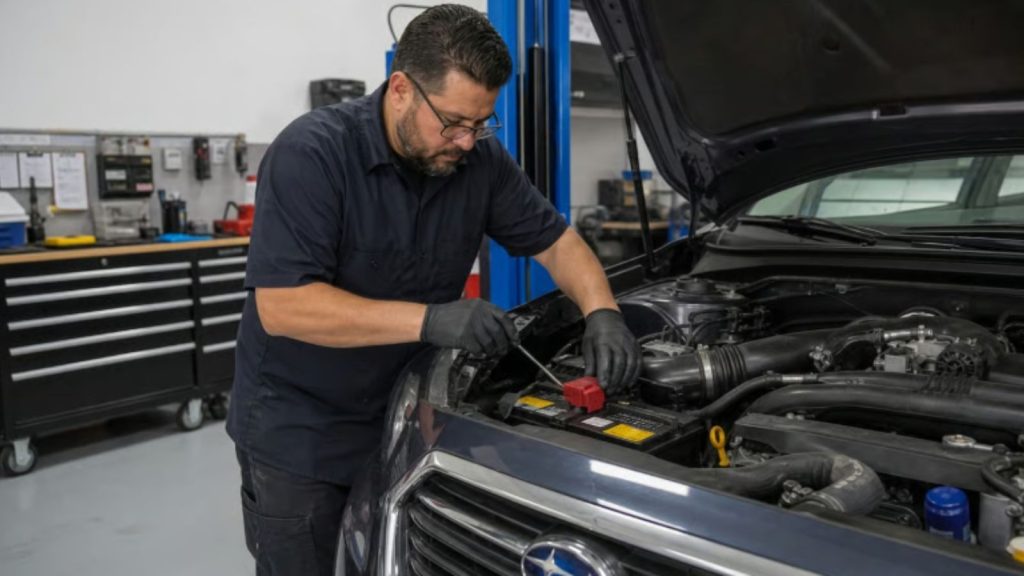
Standard inspection intervals assume regular drive cycles reaching full operating temperature. School zone driving patterns don’t match that assumption closely.
Battery and condensation-related checks move up on the schedule for vehicles matching this pattern, catching voltage drain and moisture buildup before either becomes symptomatic. Brake inspections follow a similar shortened interval, given the concentrated low-speed cycling this route produces.
A Subaru maintenance planning at Ruben’s Auto Repair visit built around the school-zone driving pattern catches these three systems together, rather than treating each as a separate, unrelated concern.
Diagnostic Verdict. Vehicles following this adjusted inspection schedule have shown no unplanned battery, brake, or drivability issues tied to condensation across recent school-year service cycles.
Build an Inspection Schedule Around Your School Zone Routine
Leon Valley Subaru owners running the school zone drop-off routine can call or schedule a battery, condensation, and brake check with Ruben’s Auto Repair, 7210 Polar Bear, San Antonio, TX 78238, at (210) 647-1148, before short-trip wear turns into an unplanned repair.
Frequently Asked Questions
Does short-trip school zone driving really drain a Subaru battery faster?
Yes, frequent cold starts without enough drive time between them lower battery voltage below the resting range.
Can condensation build up in a Subaru engine from short trips alone?
Yes, trips too short to reach full operating temperature don’t clear condensation the way normal warm-up does.
Why do school-zone Subarus show different brake wear than highway-driven ones?
School-zone driving produces frequent low-speed braking cycles rather than occasional higher-speed stops.
Should inspection intervals change for frequent short-trip drivers?
Yes, battery and condensation checks are recommended earlier than standard intervals for this driving pattern.
Is short-trip driving actually gentler on a car than highway driving?
No, frequent cold starts and incomplete warm-up cycles can stress a car more than steady highway miles.