Automotive CO2 refrigerant (R-744) systems operate in a transcritical cycle with high-side pressures of 1,450 PSI to 1,600 PSI, compared to 200 PSI to 350 PSI in current R-1234yf systems. In San Antonio July ambient of 102°F to 108°F, those pressures rise further. Standard HVAC service equipment, leak detectors, and refrigerant recovery tools cannot service these systems safely.
What Makes CO2 Refrigerant Different From R-134a and R-1234yf
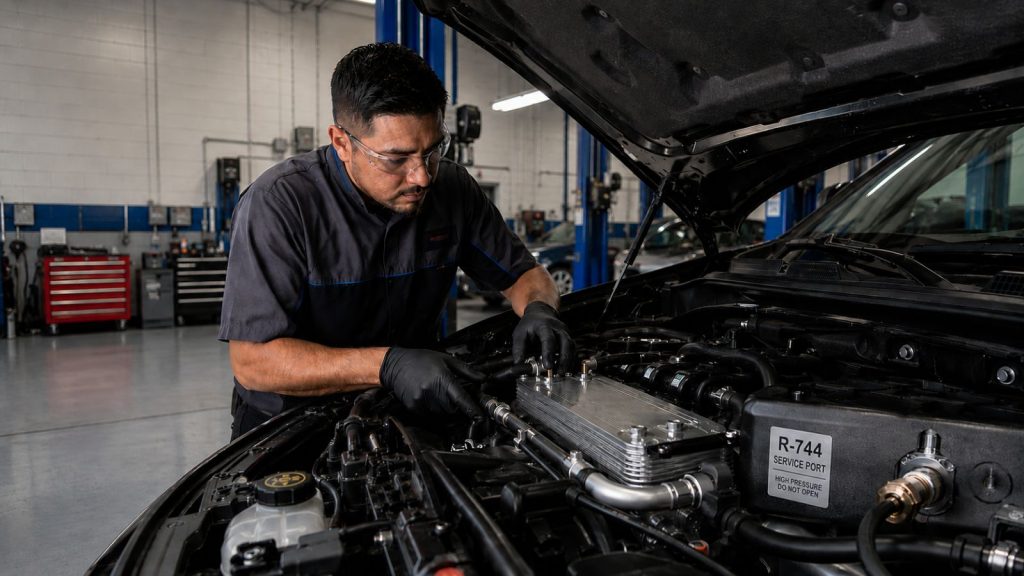
CO2 refrigerant is not an incremental update. R-744 operates on a transcritical cycle, meaning the refrigerant never fully condenses into liquid form on the high-pressure side. That is a fundamentally different thermodynamic process from the subcritical cycles used by R-134a and R-1234yf.
The pressure difference is the most immediate practical change. R-134a high-side pressure runs 150 PSI to 250 PSI under normal operating conditions. R-1234yf runs 200 PSI to 350 PSI. CO2 systems run 1,450 PSI to 1,600 PSI at baseline. That is not a marginal increase in system stress. It is a different service category entirely.
The regulatory driver behind this shift is verifiable. CO2 carries a Global Warming Potential of 1, compared to R-134a at 1,430 and R-1234yf at 4. EPA and EU F-Gas regulations targeting refrigerants above GWP 150 are pushing CO2 adoption into 2027 model year vehicles. This is not a manufacturer preference. It is a compliance requirement.
Diagnostic Verdict: A CO2 system at baseline operating pressure of 1,450 PSI to 1,600 PSI exceeds the maximum rated pressure of standard R-134a and R-1234yf recovery equipment by a factor of 4 to 6, making equipment verification a mandatory pre-service step.
CO2 System Operating Pressures San Antonio Technicians Train For
San Antonio ambient changes the pressure picture. In July heat of 102°F to 108°F, CO2 transcritical system high-side pressures rise 150 PSI to 200 PSI above the temperate-climate baseline. That puts operating pressure consistently in the 1,600 PSI to 1,800 PSI range during normal Helotes commute conditions.
The Heating and Cooling Services training at Ruben’s covers high-pressure CO2 system diagnostics with South Texas ambient conditions as the baseline, not the 75°F to 85°F conditions used in most manufacturer training materials. That distinction matters when the pressure relief valve on a CO2 system is typically rated at 1,750 PSI to 1,900 PSI. In San Antonio July heat, a system running near the relief threshold is not a malfunction. It is normal operation for this climate.
In vehicles we service from Helotes and Shavano Park, we consistently find that drivers with newer model-year vehicles ask about refrigerant type during routine HVAC service appointments. The question comes up most often when the vehicle is still under its original factory charge. Knowing which refrigerant generation is under the hood changes the entire service approach, and that distinction becomes critical as CO2 systems enter the Bexar County used vehicle market through 2027 and beyond.
Diagnostic Verdict: CO2 system high-side pressure measured at 1,650 PSI to 1,780 PSI during a San Antonio July service visit falls within the elevated-ambient normal operating range and does not indicate system fault, provided gas cooler airflow and outlet temperature are within specification.
What a CO2 Gas Cooler Does and How South Texas Heat Affects It
CO2 systems do not use a condenser. They use a gas cooler. The distinction matters for diagnosis. A condenser removes heat by changing refrigerant from vapor to liquid. A gas cooler removes heat from high-pressure CO2 gas without a phase change, relying entirely on temperature differential between the gas and the ambient air moving across the cooler face.
Industry training materials for CO2 systems are largely developed for European and northern US climates where ambient temperatures rarely exceed 90°F. Those materials present gas cooler outlet temperatures of 104°F to 113°F as the normal operating range. In San Antonio July ambient of 102°F to 108°F, that range shifts to 115°F to 125°F under normal operation. A technician applying temperate-climate thresholds to a Helotes vehicle in July would flag a correctly functioning gas cooler as overheating. The San Antonio ambient baseline must be applied here, not the training material default.
On I-10 between Helotes and the Hill Country grade, sustained highway operation at 105°F ambient with full HVAC demand produces gas cooler outlet readings at the upper end of the adjusted range. Stop-and-go conditions on Camp Bullis Road push outlet temperatures to 128°F to 135°F at idle, where fan-assisted airflow becomes the only mechanism keeping the system within operating bounds.
Diagnostic Verdict: A CO2 gas cooler outlet temperature of 118°F to 123°F measured during a San Antonio July service visit at idle confirms normal operation under South Texas ambient conditions, not a cooling fault requiring intervention.
CO2 Leak Detection Requirements and Why Standard Tools Do Not Work
Standard halogen leak detectors and infrared sniffers used for R-134a and R-1234yf cannot detect CO2. CO2 is not a halogenated compound. It does not trigger the molecular response those detectors are built around. Running a standard leak detector on a CO2 system produces no reading at an active leak point.
CO2 leak detection requires dedicated non-dispersive infrared sensors, called NDIR detectors, calibrated specifically to the CO2 molecular signature. A CO2 leak producing a pressure drop of 100 PSI to 150 PSI from the 1,500 PSI operating baseline represents a smaller refrigerant volume loss than the same pressure drop in a conventional system. That means small leaks are harder to detect by pressure monitoring alone and require NDIR confirmation.
The UV dye detection method used on R-134a and R-1234yf systems is also not applicable to CO2 systems. CO2 does not carry dye through the system in the same way. Attempting UV dye injection into a CO2 system introduces contamination risk at 1,500 PSI operating pressure. The only compliant leak detection method under SAE J3159 is NDIR sensing.
Diagnostic Verdict: A CO2 system leak confirmed by NDIR sensor response at a fitting or joint, with a corresponding high-side pressure drop of 100 PSI to 150 PSI from baseline, requires component repair before any recharge procedure begins, per SAE J3159 service sequence requirements.
What Helotes and Shavano Park Drivers Should Know Before 2027
The 2027 vehicle model year is not a distant deadline. Vehicles sold in late 2026 will carry CO2 systems into the San Antonio used vehicle market within 12 to 18 months of their first registration. Drivers in Helotes, Shavano Park, and Castle Hills who purchase late-model vehicles during that window may already be driving a CO2-equipped vehicle without knowing it.
The pattern we see most often in the northwest San Antonio service population is drivers arriving with newer vehicles that have had HVAC service performed elsewhere without refrigerant type verification. After years of servicing vehicles from the Castle Hills and Shavano Park corridors, the consistent finding is that refrigerant misidentification at a prior service visit is the leading cause of avoidable HVAC component damage on late-model vehicles. A CO2 system that receives R-1234yf during a misidentified recharge is exposed to pressure incompatibility that standard system components are not rated to contain.
The practical step for any Helotes or northwest Bexar County driver is to confirm refrigerant type before any HVAC service appointment on a 2027 or newer vehicle. The refrigerant label is on the underhood service port. If the label reads R-744, the vehicle requires CO2-specific service equipment, NDIR leak detection, and pressure-rated tooling. Bringing that vehicle to a shop still running standard R-1234yf equipment is a component and safety risk, not a minor service variation.
Diagnostic Verdict: A 2027 model year vehicle presenting with an underhood R-744 refrigerant label and a high-side pressure reading below 1,200 PSI at 100°F ambient confirms an active leak or prior incorrect service requiring full CO2 system evaluation before recharge.
Drivers with 2027 or newer vehicles can confirm refrigerant type and schedule a CO2-compatible HVAC inspection at Ruben’s Auto Repair, 7210 Polar Bear, San Antonio, TX 78238. Call the shop or book an appointment online at rubensautocare.com before the next HVAC service need arrives.
Frequently Asked Questions
What pressure does a CO2 car AC system run at?
Yes, automotive CO2 refrigerant systems operate at 1,450 PSI to 1,600 PSI at baseline, rising to 1,600 PSI to 1,800 PSI in San Antonio July ambient temperatures.
Can a regular AC shop service a CO2 refrigerant system?
No, CO2 systems require pressure-rated recovery equipment, NDIR leak detectors, and service training specific to SAE J3159 transcritical cycle procedures.
What is the difference between a condenser and a gas cooler in a CO2 AC system?
No, a gas cooler does not condense CO2 into liquid form but instead removes heat from high-pressure gas using ambient air temperature differential across the cooler face.
Does San Antonio heat affect CO2 car AC system pressure?
Yes, San Antonio July ambient of 102°F to 108°F raises CO2 system high-side pressure 150 PSI to 200 PSI above the temperate-climate baseline operating range.
Can UV dye be used to find a CO2 AC refrigerant leak?
No, CO2 systems require dedicated NDIR sensor detection because UV dye injection into a 1,500 PSI CO2 system introduces contamination risk and produces no reliable leak indication.