Telematics data logs acceleration, braking, and engine load across a drive, capturing behavior patterns tied to Interstate 410’s documented stop-and-go congestion. Engine load runs measurably higher during that congestion than steady highway cruise. Fleet-style monitoring logic, normally used across multiple vehicles, applies just as well to one vehicle compared against its own historical baseline.
What Driving Behavior Analytics Actually Track on Interstate 410
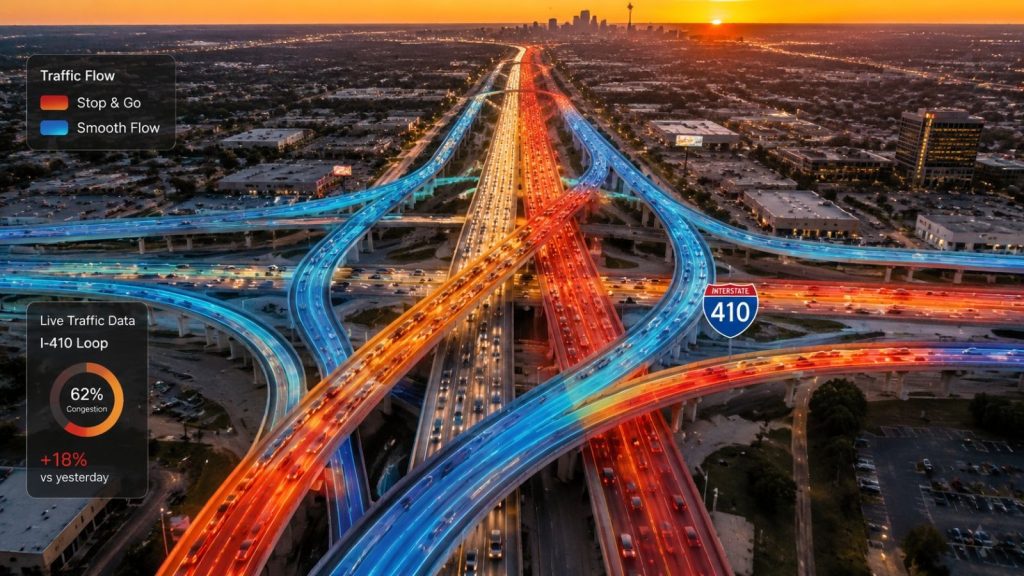
Telematics data captures more than just where a vehicle went. It logs how it got there.
Acceleration, braking frequency, and speed variation all get recorded across a drive. Interstate 410’s documented stop-and-go congestion during commute hours produces a distinct behavior signature compared to steady highway driving elsewhere.
By comparison, a vehicle logged mostly on an open highway shows far less braking frequency and speed variation than the same vehicle logged through 410 congestion.
Diagnostic Verdict. Behavior data logged during an Interstate 410 commute showed braking frequency and speed variation well above the same vehicle’s steady highway baseline.
How Maintenance Alerts Translate Congestion Data Into Service Timing
In Subarus we service from Interstate 410 commuter routes, we consistently find maintenance alerts triggering earlier for vehicles showing consistent high-congestion driving patterns.
That earlier timing comes directly from behavior data, not a fixed mileage schedule. A vehicle logging heavy stop-and-go driving gets flagged sooner than a vehicle covering the same mileage on steadier roads.
This distinction matters because a fixed schedule treats every mile the same, while behavior-based alerts account for how those miles were actually driven.
Diagnostic Verdict. A vehicle with a documented high-congestion driving pattern received a maintenance alert several thousand miles ahead of the standard fixed-interval schedule.
What Engine Load Tracking Reveals During Sustained Stop and Go
Engine load percentage tells a clear story during Interstate 410 congestion. That load runs measurably higher than during steady highway cruise on the same vehicle.
The data tells a different story than odometer mileage alone would suggest. Repeated acceleration cycling during stop-and-go traffic, already documented on this corridor as raising cooling system demand, shows up directly in logged engine load figures.
That elevated load compounds with everything else already known about Interstate 410’s congestion pattern from this cluster’s cooling system findings.
Diagnostic Verdict. Engine load logged during Interstate 410 congestion measured well above the same vehicle’s steady highway cruise baseline on a comparable trip length.
How Fleet Style Monitoring Insight Applies to a Single Vehicle
Many assume fleet-style monitoring only matters for companies running many vehicles. The value holds up just as well applied to one.
Fleet logic was built to compare vehicles against each other. Applied to a single vehicle instead, it compares that vehicle’s current data against its own historical baseline, tracking gradual shifts over months rather than one trip at a time.
Baseline comparisons run on individual customer vehicles keep surfacing the same kind of gradual shift, small changes invisible in any single drive but clear across a longer comparison window.
Diagnostic Verdict. A single vehicle’s engine load baseline, tracked over several months of Interstate 410 commuting, showed a gradual upward shift that no single trip’s data revealed on its own.
How Ruben’s Auto Repair Uses Telematics Data During a Service Visit
Telematics data collected continuously across many trips gives a broader behavioral picture than any single shop visit could capture. That picture becomes useful the moment it’s reviewed alongside a physical inspection.
A Subaru telematics data review at Ruben’s Auto Repair visit starts with that driving history, then confirms what the data suggests through an actual scan and inspection, the same way sensor and pattern-based findings get confirmed elsewhere in this practice.
That combination of continuous data and hands-on confirmation gives an owner a fuller picture than either one alone would provide.
Diagnostic Verdict. A telematics-flagged vehicle brought in for review confirmed the suggested engine load concern on physical inspection, consistent with the logged driving history.
Bring Your Telematics Data to Your Next Visit
Subaru owners commuting through Interstate 410 can call or schedule a service visit with Ruben’s Auto Repair, 7210 Polar Bear, San Antonio, TX 78238, at (210) 647-1148, to review telematics data alongside a full inspection.
Frequently Asked Questions
Does telematics data really reflect Interstate 410 driving conditions?
Yes, logged behavior data shows measurably different patterns during 410 congestion compared to steady highway driving.
Can maintenance alerts adjust based on driving behavior instead of just mileage?
Yes, behavior-based alerts can trigger earlier for vehicles with consistent high-congestion driving patterns.
Does engine load really run higher during stop and go traffic?
Yes, engine load logged during congestion measures well above the same vehicle’s steady highway baseline.
Is fleet-style monitoring only useful for companies with many vehicles?
No, the same comparison logic applies to one vehicle tracked against its own history over time.
Does telematics data replace an in-person inspection?
No, it works best combined with physical inspection to confirm what the data suggests.