A hard restart after a South Park Mall errand stop in July heat traces to fuel rail vapor formation from check valve pressure decay, ignition coil output reduction under sustained underhood heat soak, and battery CCA derating compounded by extended crank demand. The diagnostic signature is normal cranking speed with delayed fire and a brief rough idle before the engine smooths out. That sequence points to the fuel system, not the battery.
What Heat Soak Does to Fuel Delivery and Ignition Output on a Hot Restart
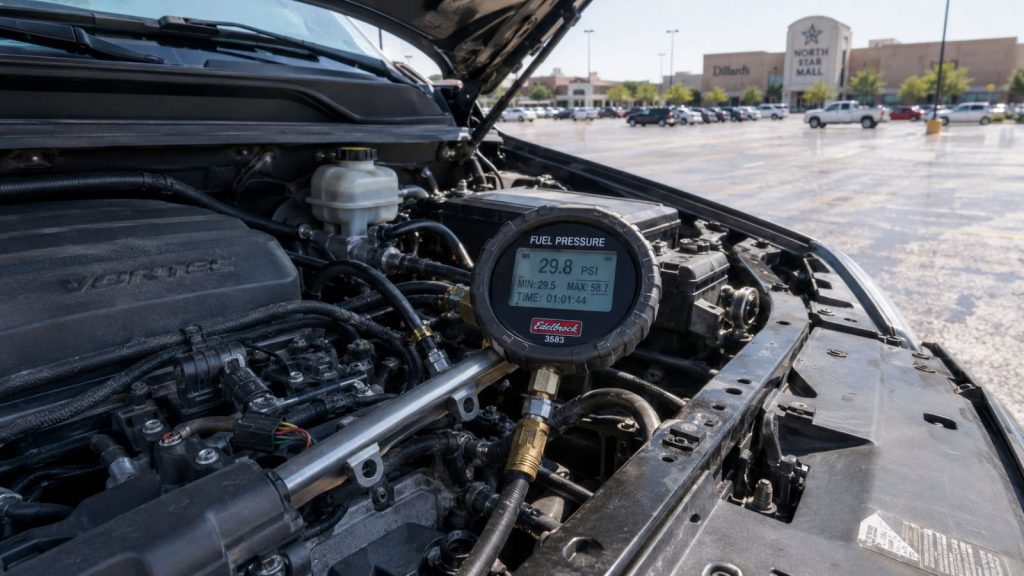
Heat soak begins the moment the engine shuts off. At shutdown, the fuel pump stops delivering pressurized fuel to the rail but residual rail pressure holds at 40 to 60 PSI on most port-injected platforms. As underhood temperature rises during a parking stop, fuel rail temperature above 130°F to 150°F causes dissolved fuel vapor to come out of solution, reducing effective rail pressure.
On restart, the fuel pump must re-pressurize the rail and purge vapor from the injectors before the engine can fire cleanly. That purge extends crank time from the normal 0.5 to 1.5 seconds to 3 to 8 seconds or longer on a vehicle with marginal fuel pump output or a leaking fuel pressure check valve. The driver hears the engine cranking normally but notices the delayed fire and assumes the battery or starter is struggling.
The fuel pressure check valve compounds the problem. The check valve in the fuel pump module prevents fuel rail pressure from bleeding back into the tank when the pump is off. A worn check valve allows rail pressure to drop from 40 to 60 PSI at shutdown to 10 to 20 PSI within 15 to 30 minutes of engine off. Combined with vapor formation from heat soak, that pressure loss requires significantly more crank time to recover.
Ignition coil output adds a third factor. A coil that delivers adequate secondary voltage at normal operating temperature can show reduced output under sustained underhood heat soak above 200°F to 220°F, reached during a 15 to 30 minute parking stop in July ambient heat following a sustained approach drive. Reduced coil output lowers spark energy at the plug gap, requiring more crank cycles to ignite a vapor-contaminated mixture on hot restart.
Diagnostic Verdict. On vehicles presenting with South Park Mall area hot restart complaints, fuel pressure decay testing confirms rail pressure drop to 15 to 25 PSI within 20 minutes of pump shutoff in the majority of cases, with ignition coil secondary resistance testing outside specification on vehicles where extended crank persists after fuel pressure is restored.
How South Park Mall Errand Stop Conditions Create Peak Heat-Soak Restart Stress
South Park Mall’s parking environment concentrates the heat-soak problem. The mall’s primary parking areas on SW Military Drive sit on exposed asphalt under direct July solar load. In July ambient temperatures of 102°F to 108°F, unshaded parking spaces absorb radiant heat from the asphalt surface. A vehicle parked in an unshaded space for 20 to 30 minutes after arriving from the SW Military Drive or Loop 410 South approach reaches peak underhood heat soak temperature approximately 15 to 25 minutes after engine shutdown.
That peak timing coincides exactly with when the driver returns from a typical errand stop. The hottest underhood moment is not at shutdown. It is 15 to 25 minutes later, after convective cooling from the moving vehicle has stopped and residual engine block heat has radiated into the still underhood air. The restart attempt happens at the worst possible point in the heat-soak temperature curve.
The approach drive builds on that problem. Vehicles arriving at South Park Mall via SW Military Drive or Loop 410 South in July stop-and-go traffic arrive with engine coolant and fuel rail temperatures already elevated before the parking stop begins. That pre-parking heat build reduces the cool-down time available during the errand, meaning the fuel rail is already warmer than a vehicle arriving from a cooler driving cycle when the engine shuts off.
In vehicles we service from the south side and SW Military Drive corridor with hot restart complaints after South Park Mall stops, fuel pressure decay testing consistently shows rail pressure dropping to 15 to 25 PSI within 20 minutes of pump shutoff on vehicles with a leaking fuel pressure check valve. The complaint arrives most frequently during July and August afternoon errand runs.
Diagnostic Verdict. On south side vehicles with afternoon South Park Mall hot restart complaints, fuel rail pressure measured immediately after a simulated heat-soak shutdown and again 20 minutes later confirms pressure decay to 15 to 25 PSI in the majority of confirmed check valve fault cases.
The Hard Restart Pattern From Vapor Formation to Extended Crank Time
The restart sequence tells the diagnostic story. The engine cranks at normal starter speed, typically 200 to 250 RPM on a healthy battery. It does not fire for 3 to 5 seconds. When it does fire, it runs rough for 10 to 20 seconds before smoothing out. Then it drives normally for the rest of the errand run.
That sequence, extended crank at normal speed, delayed fire, brief rough idle, then smooth running, is the diagnostic signature of fuel rail vapor formation. The engine cannot fire cleanly until the fuel pump re-pressurizes the rail and pushes the vapor pocket through the injectors. Once pressure is restored and liquid fuel reaches the combustion chamber, the engine fires, runs rough briefly on the rich vapor-air mixture remaining in the intake, then normalizes.
Residents of communities adjacent to Lackland AFB making multiple short errand stops along the SW Military Drive corridor accumulate repeated heat-soak restart stress across a single afternoon. A vehicle that starts with a 3-second crank at the first South Park Mall stop may require a 5 to 6 second crank at the third errand stop of the same afternoon run, because each successive restart depletes fuel pressure from a check valve that barely recovered between stops and compounds battery heat-soak derating across each successive crank event.
The pattern we see most often on south side heat-soak hard restart complaints is exactly this extended crank followed by rough initial idle before smooth running. That sequence, not slow or labored cranking, is what separates a fuel rail vapor problem from a battery issue in the diagnostic picture.
Diagnostic Verdict. On vehicles where the restart sequence confirms normal cranking speed, delayed fire at 3 to 5 seconds, and rough idle for 10 to 20 seconds before smooth operation, fuel pressure decay testing confirms the fuel system as the source in the majority of south side errand-run hot restart cases.
What the Diagnostic Process Confirms Before Fuel System or Ignition Service
Battery replacement gets approved for hot restart complaints more often than the evidence supports. A weak battery produces slow or labored cranking, where the starter turns the engine over more slowly than normal. Heat-soak fuel rail vapor produces normal cranking speed with delayed fire and a subsequent rough idle before the engine smooths out. These are different symptoms that feel similar in the moment but point to completely different repair paths.
Many south side drivers have approved a battery replacement on a vehicle that produced the same 4-second crank and rough initial idle on the next July afternoon South Park Mall stop, because the battery was not the source. The fuel pressure check valve and the vapor-contaminated rail were the confirmed sources. A new battery does not change the check valve condition or the fuel rail temperature.
The PCM’s hot start enrichment calibration adds a nuance worth understanding. At coolant temperatures above 180°F to 200°F, maintained through a short errand stop, the PCM commands a reduced fuel enrichment pulse on restart because it interprets the hot engine as needing less starting fuel. If the actual intake charge is vapor-rich from rail heat soak, this reduced pulse under-fuels the first few combustion events, producing the extended crank and rough initial idle even when the battery and ignition are both healthy.
The fuel pressure decay test is the correct first diagnostic step. Measuring fuel rail pressure immediately after a simulated heat-soak shutdown and again 20 minutes later confirms whether the check valve is holding pressure within the acceptable decay range of 5 to 10 PSI loss over 30 minutes. A drop to 15 to 25 PSI within 20 minutes confirms the fuel system as the restart delay source. Drivers who need a San Antonio mechanic for fuel system and hot restart diagnosis on the south side benefit from that pressure decay test before a battery or ignition repair is approved.
Diagnostic Verdict. On vehicles where the fuel pressure decay test confirms a drop to 15 to 25 PSI within 20 minutes of pump shutoff, fuel pump module replacement resolves the hot restart complaint in the confirmed majority of South Park Mall area cases, without battery or ignition coil replacement.
South side drivers noticing extended crank times after South Park Mall or SW Military Drive errand stops in July heat can schedule a fuel pressure decay test with Ruben’s Auto Repair, 7210 Polar Bear, San Antonio, TX 78238, at (210) 647-1148, before check valve leakdown and fuel rail vapor formation advance to a no-start on a hot afternoon.
Frequently Asked Questions
Does parking at South Park Mall in July heat make a car hard to restart in San Antonio?
Yes, July ambient temperatures of 102°F to 108°F raise underhood heat to peak levels approximately 15 to 25 minutes after engine shutdown, coinciding with a typical errand stop return and the first restart attempt.
Is an extended crank after a short errand stop in San Antonio a battery problem?\
No, a battery problem produces slow or labored cranking, while fuel rail vapor formation produces normal cranking speed with delayed fire and a rough idle before the engine smooths out.
What causes a car to crank for 3 to 5 seconds before starting after a South Park Mall stop?
Yes, fuel rail pressure dropping to 10 to 20 PSI from a leaking check valve combined with vapor formation above 130°F requires the fuel pump to re-pressurize the rail before the engine can fire cleanly.
Does making multiple errand stops in San Antonio July heat make hot restart worse?
Yes, each successive restart depletes fuel pressure from a marginal check valve that barely recovers between stops, compounding heat-soak restart difficulty across a full afternoon errand run.
What fuel pressure decay confirms a check valve fault causing hot restart in San Antonio?
Yes, rail pressure dropping to 15 to 25 PSI within 20 minutes of pump shutoff confirms check valve leakdown, compared to the acceptable decay of 5 to 10 PSI loss over 30 minutes on a healthy system.
Can a reduced PCM hot start fuel pulse make heat-soak restart worse in San Antonio?
Yes, the PCM commands reduced enrichment above 180°F to 200°F coolant temperature, which under-fuels the first combustion events when the intake charge is already vapor-rich from fuel rail heat soak.