
Warning lights triggered by heavy rainfall driving on Hwy 281 through Stone Oak trace to moisture intrusion at sensor connectors or chassis ground points, not sensor failure. A connector with a degraded seal allows water to bridge pin contacts, producing an out-of-range signal the PCM logs as a fault. Codes that self-clear within 1 to 3 drive cycles after the vehicle dries confirm moisture intrusion rather than a failed component.
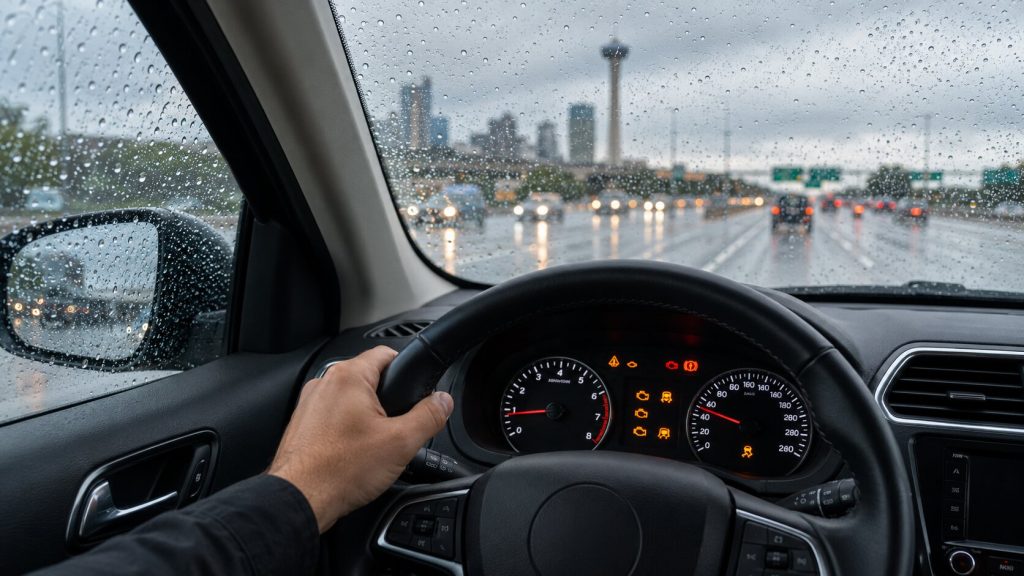
What Moisture Intrusion Does to Sensor Signal Integrity and Connector Grounding
A warning light starts with a signal the PCM does not expect. OEM sensor connector seals on most modern passenger vehicle wiring harnesses are rated to resist water intrusion under normal splash and submersion exposure. A connector with a degraded or aged seal allows moisture to bridge pin contacts.
That moisture bridge introduces resistance changes at a sensor signal pin that the PCM interprets as an out-of-range reading. The sensor itself may be functioning correctly the entire time. The fault is at the connection, not the component, but the warning light and stored code look identical to a genuine sensor failure on the dashboard.
Ground points add a second failure path. Most vehicle sensor systems reference a 5V or 12V supply against a chassis ground point for accurate signal interpretation. A corroded ground connection adds resistance to that ground path, causing voltage reference drift at the sensor signal line. That drift is most pronounced when moisture bridges the ground connection during heavy rainfall, producing a transient signal error the PCM logs as a fault even though the underlying sensor and wiring are otherwise intact.
Underhood components face a third exposure point. The mass airflow sensor and upstream oxygen sensor connectors sit in the engine bay, where high-speed driving in heavy rain can drive water spray through wheel well openings and underbody airflow paths. A MAF or oxygen sensor connector with a compromised seal exposed to that spray pattern produces an intermittent signal dropout, commonly logged as a P0100 series or P0130 series code, that clears once the connector dries after the vehicle is parked.
Diagnostic Verdict. On vehicles presenting with post-rain warning light complaints, connector and ground point inspection confirms moisture residue or light corrosion at the affected pin in the majority of cases, with the sensor testing within specification when checked independently on the bench.
How Hwy 281 Stone Oak Heavy Rainfall Conditions Expose Vulnerable Sensor Connectors
Hwy 281 through Stone Oak has a road geometry problem, not just a weather problem. The corridor traverses significant elevation change with sections that experience standing water and heavy spray during San Antonio’s occasional severe summer thunderstorms. Vehicles maintaining highway speed of 60 to 70 mph through these sections generate substantially higher wheel spray volume and pressure against underbody connectors than the same vehicle would experience in stop-and-go or low-speed driving.
That high-speed spray exposure is the specific condition that pushes marginal connector seals past their splash-resistance rating. A connector that handles a slow residential street puddle without issue can fail under the sustained pressure of highway-speed spray sustained over several miles of Hwy 281.
Vehicles exiting Hwy 281 onto Stone Oak Pkwy during or immediately after heavy rainfall encounter surface street standing water in low-lying sections before reaching higher ground. That transition from sustained high-speed spray exposure on the highway to standing water crossing at the exit ramp compounds moisture exposure within a single drive, increasing the likelihood that a marginal seal crosses its failure threshold during that specific trip.
In vehicles we service from the Stone Oak area with post-rain warning light complaints, connector and ground point inspection consistently shows light corrosion or moisture residue on the affected connector pin, even though the sensor itself tests within specification when checked independently on the bench. The complaint arrives most frequently after a documented severe thunderstorm event rather than light rain.
Diagnostic Verdict. On Stone Oak area vehicles presenting after a documented severe thunderstorm event, wheel speed sensor connector inspection confirms moisture intrusion at the pigtail or harness splice in the majority of ABS-related complaints, correlating to highway speeds above 50 mph at the time the code set.
The Warning Light Pattern From Connector Moisture to Transient Signal Fault
The light comes on while driving, not before. The driver is on Hwy 281 in heavy rain, the dash lights up, and the symptom feels alarming in the moment. The pattern that follows is what separates moisture intrusion from a genuine failure.
ABS warning lights triggered by wheel speed sensor signal interruption commonly correlate to vehicle speeds above 50 mph during heavy rainfall, when road spray volume and pressure exceed the connector’s normal splash-resistance rating. The ABS module logs a wheel speed sensor implausibility code when one wheel’s signal drops out or becomes erratic relative to the other three. That single-wheel signal dropout, rather than a complete ABS system failure, is the telltale sign of a localized connector issue.
A warning light triggered by genuine sensor or component failure typically remains illuminated and the corresponding code remains active on subsequent drive cycles regardless of weather. A warning light triggered by moisture intrusion at a connector commonly self-clears within 1 to 3 drive cycles after the vehicle dries out, with the code transitioning from active to a stored historical code without recurrence.
The pattern we see most often on Stone Oak area post-rain warning light complaints is a code that was active when the vehicle arrived at the shop but had already transitioned to a stored, non-recurring code by the time the scan tool history was pulled. That self-clearing pattern across the drive cycles immediately following the rain event is the diagnostic signature associated with moisture intrusion rather than a genuine sensor failure.
Diagnostic Verdict. On vehicles where the warning light correlates to a documented heavy rainfall event on Hwy 281, scan tool drive cycle history confirms the fault code transitioned from active to stored within 1 to 3 drive cycles in the confirmed majority of cases, with no recurrence on subsequent dry-weather driving.
What the Diagnostic Process Confirms Before Sensor or Connector Service
A warning light gets routed to sensor replacement more often than the evidence supports. Many drivers and some service advisors assume a warning light means the sensor itself has failed and needs replacement, since that is the most common cause of a check engine or ABS light in dry conditions. The diagnostic reality after heavy rainfall driving is different.
A warning light that triggers specifically after a rain event and either self-clears or recurs only during subsequent rain events points toward connector or ground point moisture intrusion, not sensor failure. Replacing a sensor that tests within specification does not resolve a connector seal problem, and the warning light returns on the next Hwy 281 trip through standing water.
The drive cycle history comparison test confirms the source before any part is ordered. Pulling scan tool freeze frame and drive cycle history confirms whether the code is active and persistent regardless of weather, which points to genuine sensor failure, or whether the code correlates specifically to rainfall events and clears between them, which points to connector or ground moisture intrusion. That history check takes minutes and prevents an unnecessary sensor purchase.
Drivers who need a San Antonio mechanic for sensor and electrical diagnosis serving the Hwy 281 corridor benefit from that history review before a sensor replacement is approved. When connector or ground intrusion is confirmed, the repair is a seal replacement, dielectric grease application, or ground point cleaning rather than a sensor swap.
Diagnostic Verdict. On vehicles where drive cycle history confirms the fault correlates to rainfall events and clears between them, connector seal repair and ground point cleaning resolve the warning light in the confirmed majority of Stone Oak area cases, without sensor replacement.
Stone Oak drivers whose warning lights appear after heavy rain on Hwy 281 can schedule a connector and sensor diagnostic with Ruben’s Auto Repair, 7210 Polar Bear, San Antonio, TX 78238, at (210) 647-1148, before moisture intrusion advances to a recurring fault.
Frequently Asked Questions
Why does my warning light come on after driving in the rain on Hwy 281 in San Antonio?
Moisture bridging a degraded sensor connector seal or a corroded ground point produces an out-of-range signal that the PCM logs as a fault during heavy rainfall driving above 50 mph.