A no-crank after a short parking stop at Ingram Park Mall on Loop 410 traces to battery voltage collapse under heat soak, starter relay contact resistance increase under high underhood temperature, and CCA derating above the starter motor’s minimum cranking threshold. A single click followed by silence is not a failed starter. It is a confirmed voltage collapse at the motor terminals under June heat-soak conditions.
What Heat Soak Does to Starter Circuit Voltage and Cranking Reliability
Battery voltage and temperature are directly linked. A fully charged 12V battery at 77°F holds 12.6 V at rest. At 110°F battery case temperature, the same battery holds approximately 12.3 to 12.4 V at rest due to electrolyte thermal expansion reducing effective plate surface contact.
A battery with 60 to 70% state of health that reads 12.4 V at 77°F drops to 11.8 to 12.0 V at 110°F case temperature. Starter motor minimum voltage for reliable cranking is 9.6 V under load on most passenger vehicle platforms. A battery at 11.8 V rest with 60% state of health drops below 9.6 V under starter load in heat-soak conditions. That drop produces the no-crank or single-click symptom at the Ingram Park Mall restart attempt.
CCA rating compounds the problem. Battery Cold Cranking Amp rating is measured at 0°F. At 77°F, a battery delivers approximately 115 to 120% of its CCA rating. At heat-soak battery case temperature from a June San Antonio parking stop, that same battery delivers approximately 85 to 90% of its CCA rating. A battery rated at 550 CCA delivers approximately 467 to 495 A under heat-soak conditions before state of health reduction is factored in.
A battery with 60 to 70% state of health at heat-soak temperature delivers 280 to 350 A of available cranking current. Most V6 and V8 platforms require more than that for reliable no-load cranking. The starter motor receives enough current to engage the relay and click once. It does not receive enough to spin the armature through the compression cycle.
Diagnostic Verdict. On west side vehicles presenting with heat-soak no-crank complaints after Ingram Park Mall stops, battery load test results confirm state of health below 65% in the majority of cases, with available cranking current below the starter minimum threshold at battery case temperature measured immediately after the parking stop.
How Ingram Park Mall Parking Conditions Create Peak Heat-Soak Restart Risk
The parking environment is the stress source. Ingram Park Mall’s main parking field on Loop 410 West Side is a large exposed asphalt surface under June solar load. In June ambient temperatures of 98°F to 104°F, asphalt surface temperatures reach 140°F to 160°F in unshaded spaces. Radiant heat from that surface raises underbody and battery tray temperatures on parked vehicles throughout the mall stop.
The hottest underhood temperatures on a heat-soaked vehicle do not occur at engine shutdown. They occur approximately 20 to 30 minutes after shutdown, as convective cooling from the moving vehicle stops and residual engine block heat radiates into the still underhood air. That timing matches exactly when a driver returning from a typical mall errand turns the key. The peak heat-soak window and the restart attempt coincide.
The Loop 410 westbound approach from Leon Valley to the Ingram Park Mall exit carries vehicles through stop-and-go commercial traffic with frequent signal stops. That approach raises underhood temperatures above the highway baseline before the vehicle reaches the parking lot. A battery that might have adequate cranking reserve after a clean highway run arrives at Ingram Park Mall already thermally stressed from the approach.
Westover Hills and Northwest Crossing residents driving to Ingram Park Mall with maximum AC demand during the approach reduce battery state of charge before the parking stop begins. A vehicle running AC at full cooling demand in stop-and-go Loop 410 traffic arrives at the mall with slightly reduced battery SOC compared to a vehicle driven with minimal electrical load. That reduction narrows the voltage reserve margin on the restart attempt.
Diagnostic Verdict. On vehicles arriving at Ingram Park Mall after Loop 410 stop-and-go approach from Leon Valley, battery case temperature measured at the restart attempt confirms values above 105°F in the majority of heat-soak no-crank cases, with battery rest voltage reading 12.0 V or below before the load test is applied.
The No-Crank Failure Pattern From Short Parking Cycle to Ignition Interruption
The symptom has a specific sound. The driver turns the key. One click comes from under the hood. Then silence. No cranking. No labored turning. One click and nothing.
That single-click pattern is not a dead battery. A dead battery produces no click, because the relay cannot energize without sufficient voltage to pull in the relay coil. A single click means the relay received enough voltage to engage. It sent current to the starter motor. The motor received that current, attempted to energize the armature, and the available voltage collapsed below the motor’s minimum operating threshold before rotation could begin. The relay clicked. The motor could not turn.
Automotive starter relays are rated for operation up to 257°F (125°C). A relay with 50,000 or more switching cycles at elevated underhood temperature develops increased contact resistance compared to a new relay at room temperature. At 200 A starter current draw, even a modest increase in relay contact resistance produces a voltage drop that reduces available motor terminal voltage. That voltage reduction, combined with a battery already near the no-crank threshold from heat soak, is enough to produce the single-click pattern consistently.
The pattern we see most often on San Antonio west side heat-soak no-crank complaints is exactly this single click followed by silence, not slow labored cranking. That single-click pattern is the diagnostic signature of starter circuit voltage collapse under heat-soak conditions. It repeats on the same vehicle at the same Ingram Park Mall parking stop during the same afternoon heat window, and resolves on the drive home after the battery and underhood components have had time to cool.
Diagnostic Verdict. On vehicles where the single-click no-crank resolves after a 20 to 30 minute cool-down period without any other intervention, battery load test at ambient temperature confirms state of health below 70%, and starter circuit voltage drop test at the motor terminals under cranking load confirms available motor terminal voltage below 9.6 V during the heat-soak restart simulation.
What the Diagnostic Process Confirms Before Starter or Battery Replacement
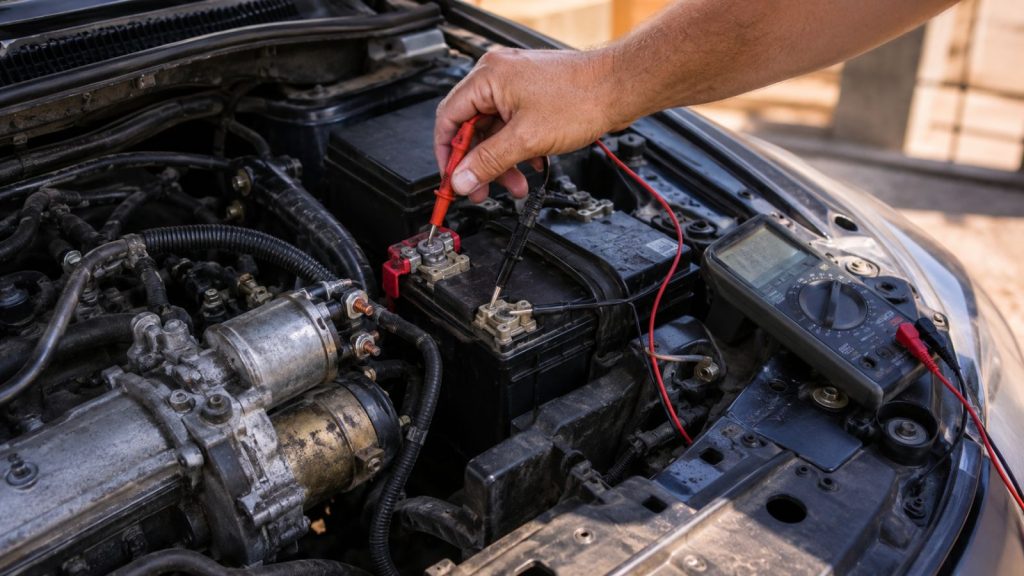
The single-click no-crank gets misdiagnosed as a failed starter more often than the evidence supports. A failed starter motor produces no click at all. The relay cannot energize a motor with an open armature winding or a seized field assembly, so the circuit produces silence rather than a click. The click confirms the relay is functional. The silence after the click confirms the voltage at the motor terminals was insufficient to complete the armature rotation.
Many San Antonio west side drivers have approved a starter replacement on a vehicle that returned with the same single-click symptom on the next June afternoon mall stop, because the starter was not the problem. The battery state of health and the starter circuit voltage drop were the confirmed sources. Replacing the starter on a heat-soak voltage collapse complaint does not change the battery SOH or the circuit resistance. The symptom returns to the next hot park.
The correct diagnostic sequence separates the sources before any part is ordered. A battery load test performed at heat-soak battery case temperature reveals whether available cranking current drops below the starter minimum under the actual thermal conditions of the Ingram Park Mall parking environment. A starter circuit voltage drop test measures available voltage at the motor terminals under cranking load, confirming whether the voltage collapse occurs at the battery, the relay, the cable connections, or the motor itself.
Drivers who need a San Antonio mechanic experienced with battery and starter circuit diagnosis near Loop 410 benefit from that two-step sequence before a starter or battery is replaced. In vehicles we service from the Leon Valley and Westover Hills area with heat-soak no-crank complaints, battery load test results consistently show state of health below 65% on batteries that passed a simple voltage check at the last service visit. The voltage check at rest shows 12.4 V and appears acceptable. The load test at heat-soak battery case temperature reveals available cranking current below the starter minimum on the same battery.
Diagnostic Verdict. On vehicles where the load test confirms battery state of health below 65% and the starter circuit voltage drop test confirms motor terminal voltage below 9.6 V under cranking load at heat-soak temperature, starter motor resistance measurement confirms the motor itself is within specification in the majority of confirmed heat-soak no-crank cases, ruling out starter motor failure as the primary source.
West side drivers experiencing a single-click no-crank after short stops at Ingram Park Mall or other Loop 410 area destinations can schedule a battery load test and starter circuit diagnostic with Ruben’s Auto Repair, 7210 Polar Bear, San Antonio, TX 78238, at (210) 647-1148, before a heat-soak voltage collapse strands them in a June afternoon parking lot.
Frequently Asked Questions
Why won’t my car crank after a short stop at Ingram Park Mall in San Antonio?
Yes, battery voltage collapse under heat soak at Ingram Park Mall exposed parking drops available cranking current below the starter minimum threshold during the 20 to 30 minute peak heat-soak window after engine shutdown.
What does a single click and no crank mean on a San Antonio heat soak restart?
Yes, one click followed by silence confirms the starter relay engaged but motor terminal voltage collapsed below 9.6 V under heat-soak load before the armature could begin rotating.
Is a single click no-crank a bad starter or a battery problem in San Antonio heat?
No, a failed starter produces no click at all, while a single click followed by silence confirms voltage collapse at the motor terminals from battery heat-soak derating and circuit resistance increase.
How much does June heat reduce battery cranking amps on a San Antonio vehicle?
Yes, battery CCA delivery drops to approximately 85 to 90% of rated capacity at heat-soak case temperature, and a battery at 60 to 70% state of health delivers 280 to 350 A under those conditions.
Why does my car start fine in the morning but won’t crank after a short stop in the afternoon?
Yes, peak underhood heat soak occurs 20 to 30 minutes after engine shutdown in June ambient temperatures of 98°F to 104°F, reducing battery cranking capacity below the no-crank threshold at the afternoon restart.
What test confirms a heat-soak no-crank before replacing the battery or starter in San Antonio?
Yes, a battery load test at heat-soak case temperature and a starter circuit voltage drop test at the motor terminals under cranking load confirm the failure source before any component is replaced.