
Worn body mount rubber with compression set above 40% loses the isolation capacity needed to block road frequency from entering the cabin during sustained highway driving. San Antonio’s concrete freeway surfaces on I-10 and Loop 1604 generate expansion joint inputs at 4 to 6 Hz at 65 mph. That frequency range falls directly inside the resonant band of degraded body mount rubber, producing cabin buzz that worsens above 55 mph and peaks at highway cruise speed.
What Worn Body Mount Rubber Does to Cabin Vibration Isolation Under Highway Load
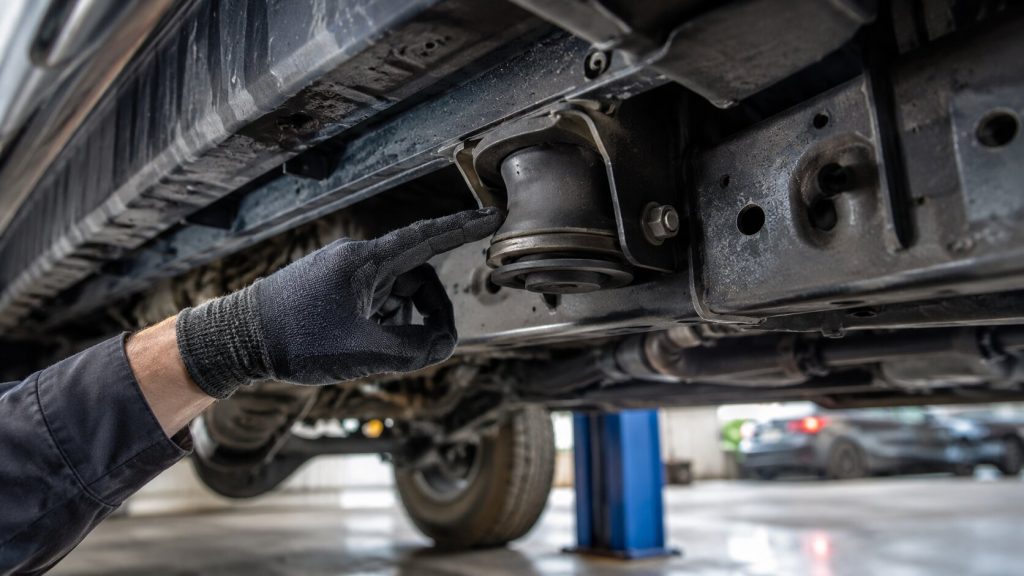
Body mount rubber fails gradually. New body mount rubber maintains a free height of 18 to 25 mm and reduces cabin vibration amplitude by 85 to 95% compared to the road input signal at highway cruise frequency. That isolation capacity drops to 40 to 60% as the compression set advances beyond 40% of original free height.
At compression set above 40%, the metal collar inside the mount contacts the body bracket under highway vibration load. That metal-to-metal contact transmits road frequency directly into the cabin floor and seat structure. The driver feels it as a persistent buzz through the seat base and floorboard that is absent at low speeds and intensifies above 55 mph.
Body mount bolt torque compounds the failure when it drops below OEM specification. Ford F-150 body mount bolts specify 74 ft-lb. GM Silverado body mount bolts specify 90 ft-lb. Torque below 80% of those specifications allows micro-movement at the mount interface under sustained highway vibration. That micro-movement adds a second vibration input on top of the degraded rubber isolation, and the two combine into a cabin buzz that no wheel balance service can address.
The buzz felt through the seat on a sustained I-10 cruise is a specific sensory signal. It is not a single-frequency tone. It is a broadband vibration that changes character as the road surface changes. That surface-sensitivity is the diagnostic signature of body mount isolation failure, and it is distinct from both tire imbalance and shock absorber wear.
Diagnostic Verdict. On vehicles presenting with sustained highway cabin buzz, shop-floor body mount inspection confirms compression set above 35% on at least two mount positions, with metal collar contact visible on the body bracket face at the mount with the most advanced compression set.
How San Antonio Highway Commute Conditions Accelerate Body Mount Rubber Breakdown
San Antonio’s June commute environment is punishing on body mount rubber. Ambient temperatures of 98°F to 104°F raise underside temperatures on vehicles sitting in stop-and-go traffic approaching I-10 and Loop 1604 on-ramps to 130°F to 160°F before the vehicle reaches cruise speed. Body mount rubber at those temperatures loses stiffness measurably, reducing its isolation frequency and moving it closer to the road input frequency band before the freeway commute even begins.
The concrete surface on Loop 1604 northbound through the Stone Oak corridor delivers consistent expansion joint inputs at sustained cruise speed. Stone Oak commuters logging 20 to 35 miles of daily freeway driving on this concrete surface accumulate sustained body mount vibration cycles that compress mount rubber faster than mixed city and highway driving on asphalt. The combination of June heat softening and sustained concrete frequency loading compresses the body mount wear timeline on these vehicles significantly.
I-35 southbound through the downtown interchange adds a thermal cycling dimension. The repeated transition from 65 mph cruise to stop-and-go idling and back raises and lowers body mount temperatures repeatedly within the same commute. That thermal cycling accelerates rubber compression set faster than either sustained cruise or pure stop-and-go driving alone. The rubber never reaches thermal equilibrium before the next load cycle begins, and each cycle advances compression beyond what mileage alone would predict.
In vehicles we service from the Stone Oak and Helotes corridors, body mount compression set above 35% is a consistent finding on vehicles with 60,000 to 80,000 miles driven primarily on Loop 1604 and I-10 concrete surface. The daily freeway mileage on concrete at sustained speed compresses the body mount wear timeline compared to vehicles of the same age driven primarily on city streets with mixed surface types.
Diagnostic Verdict. On Stone Oak and Helotes corridor commuter vehicles with cabin buzz complaints, body mount free height measurements confirm compression set above 35% on vehicles with fewer than 85,000 miles, consistent with accelerated rubber breakdown from sustained concrete freeway frequency loading under June heat cycling conditions.
The Vibration Amplification Pathway From Road Frequency to Cabin Structural Transfer
Road frequency amplification is the mechanism that turns a worn body mount into a cabin noise source. San Antonio’s concrete freeway surfaces on I-10 and I-35 feature expansion joints at intervals of approximately 15 to 20 feet. At 65 mph, a vehicle crosses 4 to 6 expansion joints per second. That produces a road input frequency of 4 to 6 Hz at cruise speed.
A healthy body mount isolates road input above its natural frequency threshold, which sits above 15 Hz on a mount with full rubber integrity. Degraded rubber with compression set above 40% drops the mount’s natural frequency to 4 to 8 Hz. That range overlaps directly with the expansion joint input frequency at San Antonio freeway cruise speed. Instead of isolating the road input, the degraded mount amplifies it through resonance.
The amplified frequency travels from the mount through the body bracket into the floor pan and seat structure. Drivers feel it as a buzz that begins around 55 mph and peaks between 60 and 70 mph on I-10 and Loop 1604. The pattern we see most often on San Antonio highway commuter vehicles with cabin buzz complaints is exactly this speed-correlated onset. It matches the expansion joint crossing frequency on San Antonio concrete freeways at cruise speed, confirming the road input has moved inside the degraded mount’s resonant band.
Diagnostic Verdict. On vehicles where the cabin buzz onset correlates to 55 to 70 mph on concrete freeway surface, vibration frequency measurements at the seat base confirm a dominant frequency of 4 to 6 Hz, matching the expansion joint crossing rate on I-10 and Loop 1604 at San Antonio highway cruise speed.
What the Diagnostic Process Confirms Before Body Mount Replacement
Tire imbalance and shock absorber wear are the two most common misdiagnoses for body mount vibration transfer. Both are legitimate highway vibration sources. Neither produces the specific symptom pattern that body mount failure creates.
Tire imbalance produces a speed-correlated vibration that is consistent at a given road speed regardless of surface type. A vehicle with an imbalanced tire vibrates at 65 mph on smooth asphalt and on concrete expansion joints equally. Body mount vibration transfer is surface-correlated, not just speed-correlated. The buzz intensifies on concrete expansion joint surfaces and reduces or disappears on smooth asphalt at the same speed. That surface sensitivity is the diagnostic distinction that separates body mount failure from tire imbalance before any parts are ordered.
Shock absorber wear produces a vertical body motion on bumps and dips, a float or wallow feeling on undulating road surfaces. It does not produce a sustained buzz on smooth concrete at cruise speed. Many San Antonio commuters have left a tire balance or shock absorber service with the cabin buzz unchanged, because the vibration source was the body mount isolation system, not the tires or the shocks.
The surface-change road test confirms the source. Driving the vehicle at 65 mph on concrete freeway surface, then moving to smooth asphalt at the same speed, identifies whether the buzz is surface-correlated or speed-correlated. If the buzz reduces on asphalt and returns on concrete, the body mount is the confirmed source. San Antonio commuters who need a mechanic near me experienced with highway NVH and body mount diagnosis benefit from that test sequence before scheduling a tire balance or suspension service that will not resolve the complaint.
Body mount free height measurement and compression set calculation confirm the finding. Mount bolt torque is verified against OEM specification at each position. Any mount position showing compression set above 40% or bolt torque below 80% of OEM specification is flagged for replacement before the vehicle returns to daily I-10 or Loop 1604 commuting.
Diagnostic Verdict. On vehicles where the surface-change road test confirms buzz reduction on asphalt and return on concrete, body mount inspection finds compression set above 40% on at least two mount positions and bolt torque below OEM specification on at least one mounting point in the majority of confirmed cases.
San Antonio commuters noticing a seat-base buzz that worsens on I-10 or Loop