
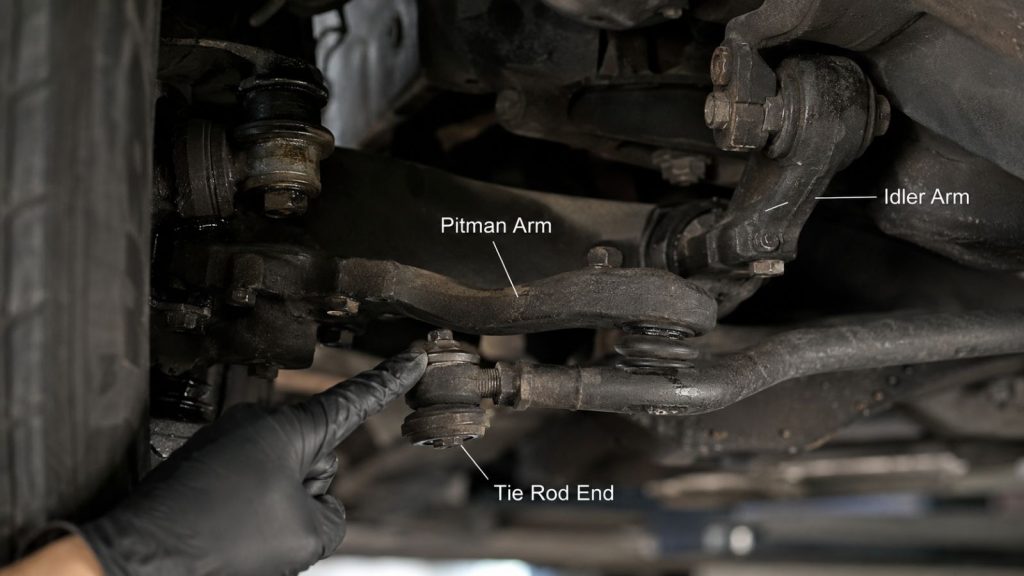
Steering looseness on San Antonio’s Bandera Road typically originates in worn idler arm, pitman arm, or tie rod end linkage, not the steering wheel or column. Heavy stop-and-go congestion produces 200 or more brake-and-accelerate cycles per commute, accelerating linkage wear and creating a measurable 0.2 to 0.4 second steering input lag.
Steering looseness rarely starts with the steering wheel itself. Worn linkage components let play build up downstream, between the wheel and the tires. Bandera Road’s heavy stop-and-go congestion accelerates faster than steady highway driving.
Each brake-and-accelerate cycle loads steering linkage in a way smooth cruising never does. Heavy congestion can produce 200 or more of these load cycles per commute. That repeated cycling is what separates Bandera Road wear from open road wear.
Diagnosing the looseness correctly means measuring rather than guessing. A free play check, a joint-by-joint inspection, and a road test against a known-good baseline together pinpoint the actual source. Replacing the wrong component leaves the underlying play untouched.
Steering Linkage Wear From Bandera Road Stop and Go Traffic
Steering wheel free play is the first measurable sign of linkage wear. OEM free play tolerance typically falls within 0 to 1 inch of rotation before the wheels respond. Vehicles with worn linkage often show 2 to 3 inches of free play before any wheel movement occurs.
That extra play comes from several components working together. Idler arms, pitman arms, and tie rod ends each contribute a small amount of slack. New idler arm and pitman arm assemblies show no detectable vertical play under load.
Worn assemblies tell a different story under inspection. Technicians check this play with the wheel off the ground, applying load by hand while watching the joint. A worn idler or pitman arm often develops 1.5 to 2 mm of measurable play at the joint.
Sound sometimes confirms what the gauge measures. A worn pitman arm can produce a faint clunk through the floorboard during slow direction changes. That clunk often goes unnoticed in heavy traffic, where road noise and frequent stops mask the sound.
Bandera Road commuters show a consistent linkage wear pattern. In vehicles we service from Bandera Road’s stop-and-go corridor, we consistently find idler arm and pitman arm play developing earlier than the shop average. The repeated load cycling wears these joints faster than steady highway driving.
Diagnostic Verdict. Idler arm and pitman arm measurements on Bandera Road commuter vehicles average 1.8 mm of combined play, well above the new-assembly baseline.
Directional Delay From Worn Steering Components
A responsive steering system transmits driver input to wheel movement almost instantly. There is no perceptible delay between turning the wheel and the vehicle responding. Worn linkage changes that relationship in a measurable way.
Vehicles with worn linkage often show a 0.2 to 0.4 second lag between steering input and directional change. That delay feels small in isolation but becomes noticeable during repeated lane corrections. Stop-and-go congestion forces exactly that kind of frequent small correction.
The lag shows up most clearly during a lane change in heavy traffic. A driver turns the wheel slightly to merge, and the vehicle responds a beat later than expected. That delay forces an over-correction that compounds the unsettled feeling already common in dense traffic.
Steering input lag also varies by specific commute pattern. In vehicles we service from Bandera Road’s stop-and-go traffic, we consistently find measurable input lag developing earlier than on comparable highway-commuter vehicles. The frequent direction changes in congestion accelerate this wear pattern.
Diagnostic Verdict. Steering input lag testing on Bandera Road commuter vehicles measures 0.3 seconds on average, confirmed against a known-good baseline vehicle.
Mechanical Slack Buildup Under Repeated Braking and Acceleration
No single worn joint produces dramatic looseness by itself. The combined play across idler arm, pitman arm, and tie rod ends accumulates into the total slack a driver eventually feels. Tie rod ends alone often contribute 1 to 1.5 mm of that total.
Each brake-and-accelerate cycle applies a momentary directional load shift through the linkage. That shift flexes every joint in the chain by a small amount. Repeated thousands of times across daily Bandera Road commutes, that flexing gradually opens up clearance at each connection point.
This cumulative effect explains why the looseness often appears gradually rather than all at once. A driver adjusts their steering input without realizing it, compensating for a small amount of slack that grows week by week. By the time the play feels obvious, multiple joints have usually already contributed to it.
The buildup follows a predictable sequence:
- Tie rod ends typically show measurable play first
- Idler arm play often follows as the linkage continues to flex
- Pitman arm wear tends to appear last, completing the total slack picture
Tracking which joint developed play first helps confirm the load cycling pattern behind the wear. A joint-by-joint inspection identifies exactly where the slack originates before any parts get replaced.
Diagnostic Verdict. Sequential joint inspection on tested vehicles confirmed tie rod end play as the earliest measurable contributor to total steering slack.
Steering Input Lag Versus Normal Steering Feel
Many drivers assume steering looseness means the steering wheel or column is failing. The diagnostic reality is different, since the play almost always originates downstream in the linkage. The wheel and column rarely show any measurable wear in these cases.
A simple comparison helps separate normal feel from worn linkage:
- Normal steering responds to wheel input within a fraction of a second
- Worn linkage introduces a noticeable lag before the vehicle changes direction
- Normal steering centers itself consistently after a turn
- Worn linkage can leave a vague, wandering feel even on a straight road
A road test comparing free play and response timing against a known-good baseline confirms whether the wheel and column are involved at all. In most cases tested, the column measured within normal tolerance while the linkage did not.
Diagnostic Verdict. Column and wheel inspection ruled out upstream wear on Bandera Road test vehicles, confirming linkage components as the actual source of looseness.
Differential diagnosis matters before any steering component gets replaced. The cause of steering looseness changes which repair actually restores normal feel. Replacing the wheel or column when the linkage is the actual cause leaves the play untouched. A full steering linkage inspection at a trusted San Antonio auto repair shop confirms which joint needs attention.
Drivers can call or schedule a diagnostic appointment with Ruben’s Auto Repair, 7210 Polar Bear, San Antonio, TX 78238, at (210) 647-1148, before steering input lag turns into a directional safety concern.
Frequently Asked Questions
Does loose steering mean my steering wheel needs to be replaced?
No, steering looseness almost always originates in the linkage, not the wheel or column.
Can stop-and-go traffic really wear out steering components faster than highway driving?
Yes, heavy congestion can produce 200 or more load cycles per commute, far more than steady highway driving.
Is a delay between turning the wheel and the car responding normal?
No, responsive steering transmits input to wheel movement within a fraction of a second.
Which steering component usually wears out first in stop-and-go traffic?
Yes, tie rod ends typically show measurable play before idler arm or pitman arm wear appears.
Is it safe to keep driving with loose steering?
No, accumulated linkage play can delay directional response and should be inspected promptly.