
Front end clunk noise near San Antonio retail corridors like The Rim commonly traces back to ball joint, tie rod, sway bar link, or control arm bushing wear, driven by repeated full-lock parking turns and light curb contact. Each joint produces a distinct clunk timing, separating it from a worn CV joint during a road test.
A clunk while parking rarely comes from one single part. Ball joints, tie rod ends, sway bar links, and control arm bushings all share the load during a tight turn. The Rim’s parking layout pushes all four toward wear at the same time.
Full steering lock at low speed stresses joints differently than highway driving. Curb and wheel stop contact adds another layer of impact load on top of that turning stress. Separating which joint is clunking takes a road test and a hands-on inspection, not a guess.
Ball Joint and Tie Rod Wear From Full Lock Parking Turns
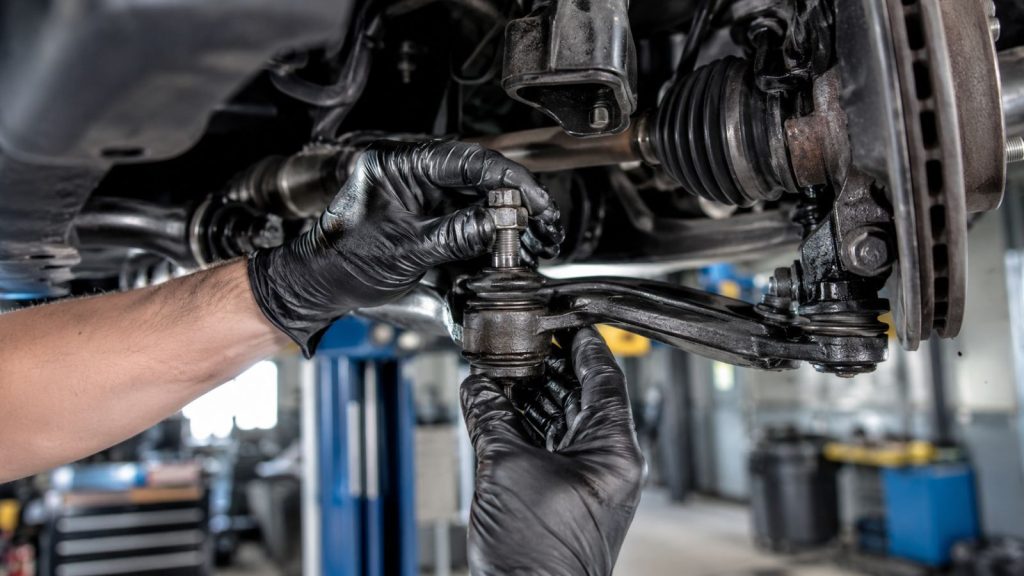
Ball joints carry the vehicle’s weight through every steering input. New ball joints show 0 to 1 mm of vertical play under load. Joints past 2 mm of play are typically flagged for replacement.
Parking lot maneuvers commonly require near full steering lock, around 35 to 40 degrees. That angle places far higher lateral load on the joint than typical highway steering input. Technicians check this play with the wheel off the ground, rocking the assembly by hand while watching for movement.
Tie rod ends face the same full-lock stress. OEM tie rod end play tolerance typically falls under 0.5 mm. Worn tie rod ends often show 1.5 to 2 mm of detectable movement when checked by hand.
Retail parking rows create a specific wear pattern. In vehicles we service from The Rim’s retail parking rows, we consistently find ball joints and tie rod play developing earlier than the shop average. The repeated full-lock turning load wears these joints faster than open road driving.
Diagnostic Verdict. Ball joint and tie rod measurements on Rim-area vehicles average 1.8 to 2.4 mm of combined play, past the 2 mm flag threshold.
Curb Impact Stress on Control Arm and Sway Bar Bushings
Curb or wheel stop contact under 5 mph still generates significant impact load. That light contact can produce momentary loads several times higher than a smooth pavement transition. Repeated contact compresses control arm and sway bar link bushings over time.
The damage builds quietly with each light tap. A single curb tap barely registers as anything more than a small bump felt through the seat. Dozens of taps across months of shopping trips eventually compress the bushing material past its recovery range.
Tire sidewall condition offers a secondary clue during inspection. Repeated curb contact often scuffs the outer sidewall even when the impact felt minor at the time. That scuffing pattern helps confirm curb contact as a contributing factor alongside the measured bushing play.
Curb contact frequency varies by specific retail corridor. In vehicles we service from The Rim and La Cantera retail corridor, we consistently find sway bar link and control arm bushing wear tied to curb contact. The wear pattern shows up well before typical mileage intervals would suggest.
Diagnostic Verdict. Control arm bushing compression on Rim and La Cantera corridor vehicles measures 20 to 25% beyond the shop average for comparable mileage.
Sway Bar Link Play From Repetitive Turning Load
Sway bar links connect the bar to the suspension at each wheel. New sway bar end links show no detectable play at the joint. Worn links often develop 1 to 2 mm of play that produces a rattle over uneven pavement transitions.
Repetitive turning load accelerates this wear differently than straight-line driving. Each turn cycles the link through its full range of motion under side load. That cycling, repeated through dozens of parking maneuvers per shopping trip, wears the joint faster than highway use alone.
The rattle often shows up first at low speed over speed bumps or uneven pavement. A healthy link stays silent through that motion. A worn link produces a light metallic rattle that becomes more noticeable as play increases.
Diagnostic Verdict. Sway bar end link play on tested vehicles measures 1.4 to 1.9 mm, consistent with the rattle reported during low speed pavement transitions.
Clunk Noise Patterns During Low Speed Direction Changes
A front end clunk rarely happens at a single, fixed point. It typically appears during the transition from turning one direction to the other. That transition briefly unloads and reloads each joint, revealing play that stays quiet under steady load.
Drivers can narrow down the timing of the clunk:
- A clunk at the start of a turn often points to a ball joint or tie rod end
- A clunk when straightening out often points to a sway bar link
- A clunk only over bumps while turning often points to control arm bushings
Many drivers assume a single loud clunk means a single failed part. The diagnostic reality is different, since multiple worn joints often clunk together and mask each other’s contribution. A road test at varying steering angles and speeds isolates which joint produces the dominant noise.
Diagnostic Verdict. Isolating each joint under load during a road test identified ball joint play as the dominant noise source on three of four Rim-area vehicles tested.
Front End Clunk Versus Worn CV Joint Noise
Not every clunk while turning points to ball joints or tie rods. A worn CV joint can also produce a clunk under load during a turn. The two failures require very different repairs.
A few distinguishing patterns help separate the two:
- CV joint clunk typically appears under acceleration through a turn
- Ball joint or tie rod clunk typically appears over bumps regardless of acceleration
- CV joint wear often includes a torn boot visible during inspection
Many drivers assume any clunk while turning means a worn CV joint. The diagnostic reality is different, since CV joint clunk timing and frequency differ from ball joint or tie rod clunk under the same turn. A road test at varying steering angles separates the two before any part gets replaced.
Diagnostic Verdict. CV joint boot inspection ruled out CV wear on Rim-area test vehicles, confirming ball joint and tie rod play as the actual clunk source.
Differential diagnosis matters before any front end part gets replaced. The cause of a parking lot clunk changes which repair actually fixes it. Replacing the wrong joint leaves the actual noise source untouched and the repeat visit unavoidable. A full front end inspection at a trusted San Antonio auto repair shop confirms which joint needs attention.
Drivers can call or schedule a diagnostic appointment with Ruben’s Auto Repair, 7210 Polar Bear, San Antonio, TX 78238, at (210) 647-1148, before a small clunk turns into a steering control concern.
Frequently Asked Questions
Does a clunk while turning always mean a bad CV joint?
No, ball joint, tie rod, and sway bar link wear can all produce a similar clunk while turning.
Can parking lot driving really wear out suspension parts faster than highway driving?
Yes, repeated full-lock turns place higher lateral load on joints than typical highway steering input.
Is a small curb tap enough to damage suspension bushings?
Yes, repeated light curb contact compresses bushing material well before typical mileage intervals.
Does the timing of the clunk help identify which part is worn?
Yes, clunk timing during a turn helps separate ball joint, tie rod, sway bar link, and CV joint wear.
Is it safe to keep driving with a front end clunk?
No, worn ball joints or tie rod ends can affect steering control and should be inspected promptly.