Highway speed vibration on San Antonio’s Loop 1604 corridor commonly stems from wheel imbalance, tire runout, worn CV joints, or wheel bearing wear, each producing a distinct pattern tied to road speed. Sustained 60 to 75 mph cruising and expansion joint impacts accelerate these failures faster than smoother surface streets.
Highway speed vibration on Loop 1604 rarely has a single cause. Wheel imbalance, tire runout, worn struts, CV joint wear, and bearing wear each produce a distinct vibration signature. Sustained 60 to 75 mph cruising and frequent expansion joints make this corridor a tough environment to drive through.
Pinpointing the right cause starts with measured data, not guesswork. A road test across a range of speeds, paired with a wheel balancer and runout gauge, separates these overlapping symptoms before any parts get replaced.
Wheel Imbalance Vibration at 60 to 75 MPH on Loop 1604
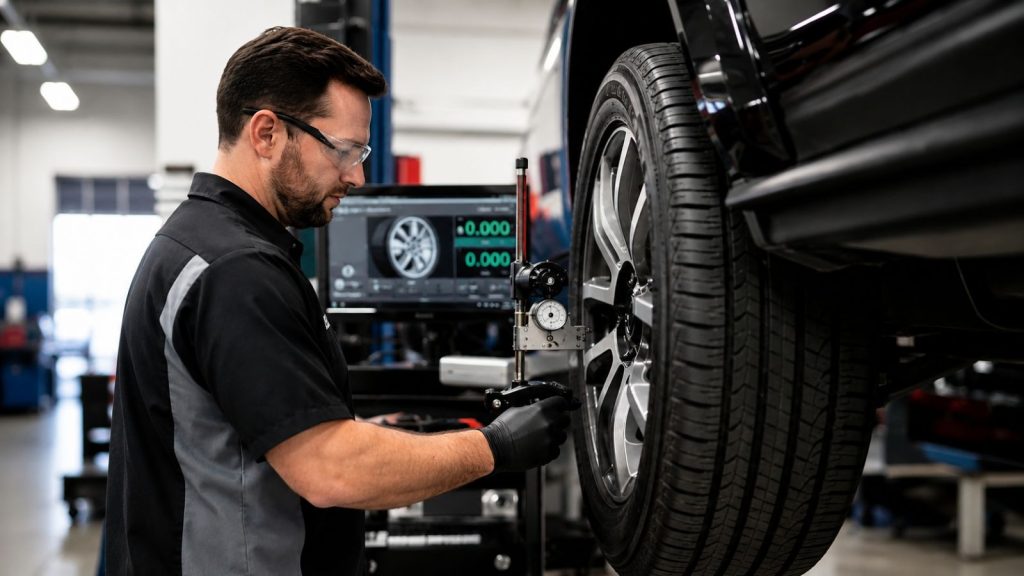
Wheel imbalance is the most common cause of highway speed vibration. New wheels balance to within 0.25 to 0.5 oz per wheel. Drivers typically feel vibration once imbalance exceeds 1.0 to 1.5 oz.
Loop 1604 cruising holds wheel rotation in a narrow frequency band. That band overlaps with the resonant frequency of strut mounts and suspension bushings. The overlap amplifies cabin vibration beyond what imbalance alone would cause.
Tire radial runout adds a second variable. OEM runout tolerance for most passenger tires falls between 0.030 and 0.050 inch. Tires measuring above 0.060 inch typically produce a noticeable, speed-sensitive vibration beginning around 55 to 65 mph, layering on top of any imbalance already present.
Drivers notice a few telltale signs of imbalance-driven vibration:
- A rhythmic shake through the steering wheel that intensifies with speed
- Vibration that fades when coasting below 50 mph
- A faint hum that grows into a buzz near 65 mph
Many drivers assume any highway vibration means bad tires. The diagnostic reality is different, since vibration frequency tied to speed separates imbalance, CV wear, and bearing wear. A road test across multiple speeds shows which pattern actually applies.
Diagnostic Verdict. Road test measurements on Loop 1604 show vibration peaking near 62 to 68 mph, consistent with imbalance and resonant overlap.
Suspension Bushing Wear From Sustained High-Speed Load
Strut bushings absorb constant load on sustained highway runs. New strut assemblies dampen wheel oscillation in 1 to 2 bounce cycles after a load input. Struts past 60,000 miles often need 3 to 4 cycles to settle.
That extra settling time changes how the cabin feels over bumps. A fresh strut soaks up an expansion joint impact in one smooth motion. A worn strut lets the body continue bouncing for a beat longer, and that residual motion reads as vibration at speed.
Loop 1604 commuters show a clear strut wear pattern. In vehicles we service from Stone Oak to La Cantera, we consistently find bushing play before 60,000 miles. Repeated expansion joint impact compresses the bushing material faster than smoother routes allow.
Diagnostic Verdict. Bounce testing on Stone Oak corridor commuters shows struts settling in 3 to 4 cycles, well ahead of the 60,000-mile baseline.
Expansion Joint Resonance Across the Loop 1604 Corridor
Expansion joints create repeated impact loading at highway speed. Each joint sends a sharp vertical pulse through the suspension. Over thousands of cycles, that pulse accelerates wear in bushings, struts, and mounts.
Technicians feel the difference during a road test. A worn mount transmits a sharp jolt straight into the cabin floor. A healthy mount absorbs most of that impact before it reaches the driver.
The frequency of joints along a given Loop 1604 stretch matters as much as the impact itself. Sections with closely spaced joints compound the load before suspension components fully recover from the last hit. That compounding effect is why some stretches feel rougher than others even on the same vehicle.
Tire condition plays a role here too. A tire with low tread depth or uneven wear transmits more of each joint impact straight into the suspension. Keeping tires in good condition reduces the total shock load the bushings and mounts absorb over time.
Diagnostic Verdict. Cabin floor impact readings drop roughly 40% after worn mount replacement, confirmed across Loop 1604 expansion joint sections.
Lane Transition Instability and CV Joint Wear
Merge zones add lateral load to the equation. Loop 1604 interchanges like the Hwy 281 connector force quick steering and weight transfer. That load reveals problems a straight highway stretch hides.
A worn CV joint produces vibration that climbs with road speed. That pattern differs from wheel imbalance, which stays constant per wheel revolution. Technicians confirm the difference with a road test across varying speeds.
The clunk often shows up first under acceleration through a turn. A healthy CV joint transmits power smoothly through its full range of motion. A worn joint introduces play at the outer extreme of that range, and the merge geometry on Loop 1604 pushes joints toward that extreme daily.
CV joint wear also follows a clear local pattern. In vehicles we service from the Hwy 281 interchange, we consistently find CV joints worn earlier than average. The repeated merge and turn motion stresses the joint angle every commute.
Diagnostic Verdict. Road tests confirm CV joint clicking under load at the Hwy 281 merge, distinct in frequency from wheel imbalance vibration.
Wheel Bearing Droning Versus Imbalance Vibration
Wheel bearings wear differently than tires or struts. OEM bearing endplay tolerance runs 0.001 to 0.005 inch. Bearings beyond 0.010 inch endplay often produce a humming or droning vibration.
Bearing related vibration shifts pitch under cornering load, unlike tire or strut vibration. The pitch change happens because cornering shifts weight onto the worn bearing race. That shift is the key diagnostic clue technicians listen for during a road test.
The sound itself offers a clue before any measurement is taken. A failing bearing produces a low, steady drone that rises with speed. It often grows louder during a gentle curve, then fades back on the straightaway, a pattern wheel imbalance never produced.
Left unaddressed, bearing wear progresses past noise into a real safety concern. Excessive endplay eventually allows the wheel to shift on its hub under load. Catching the droning early keeps the repair simple and the drive safe.
Diagnostic Verdict. Bearing endplay measurements above 0.010 inch correlate directly with the cornering sensitive droning reported by Loop 1604 commuters.
Differential diagnosis matters before any parts get replaced. The cause of highway speed vibration changes which repair actually fixes it. A full road test and inspection at a trusted San Antonio auto repair shop confirms which system needs attention.
Drivers can call or schedule a diagnostic appointment with Ruben’s Auto Repair, 7210 Polar Bear, San Antonio, TX 78238, at (210) 647-1148, before a small imbalance turns into a worn suspension component.
Frequently Asked Questions
Does wheel imbalance cause vibration at all highway speeds equally?
No, imbalance vibration intensity rises with speed and typically peaks between 60 and 70 mph.
Can a CV joint cause vibration without making any clunking noise?
Yes, early-stage CV joint wear can produce vibration before the clunk becomes audible under load.
Do San Antonio’s potholes and expansion joints wear out struts faster than normal driving?
Yes, repeated impact loading on Loop 1604 accelerates strut and bushing wear ahead of typical mileage intervals.
Is a humming sound at highway speed always a wheel bearing problem?
No, humming can also come from uneven tire wear, so a road test confirms the actual source.
Will rotating my tires fix highway speed vibration?
No, rotation addresses uneven wear patterns but does not correct imbalance, runout, or worn suspension components.