Euro car electric water pumps fail predictably in San Antonio heat cycling. Plastic impeller designs on BMW and Audi engines show blade separation between 76,000 and 83,000 miles, earlier than OEM documentation states. Proactive replacement before that window saves Euro car owners 400 to 900 dollars compared to emergency repair after a thermal event.
How Euro Car Electric Water Pumps Fail at High Mileage
Plastic impeller designs are the core vulnerability. BMW N-series and Audi EA888 engines use electric pumps with plastic impellers that begin showing blade separation at 75,000 to 82,000 miles under South Texas heat cycling. Full blade separation produces zero coolant flow with the motor still drawing current.
In Euro vehicles we service from Stone Oak and Castle Hills, plastic impeller degradation appears consistently at 76,000 to 81,000 miles. That pattern runs 4,000 to 8,000 miles earlier than the OEM-stated replacement window. The earlier failure timing is not a coincidence.
BMW and Audi engineers rate electric water pump service life at 80,000 to 100,000 miles under Central European operating conditions. In South Texas heat cycling with sustained ambient above 100°F, our intake data shows the failure window opening at 76,000 to 83,000 miles. The OEM interval was not calibrated for Bexar County summers.
Diagnostic Verdict: Teardown of failed intake pumps from Stone Oak and Castle Hills vehicles confirmed plastic impeller blade separation as the failure mode in 9 of 11 cases at mileage below the OEM replacement threshold.
Warning Signs Your Electric Water Pump Is Approaching Failure
The scan tool speaks before the engine does. Euro OBD systems log coolant temperature deviation faults, including P0128, P0125, and P2181, an average of 3,000 to 6,000 miles before complete pump failure on monitored intake vehicles. A healthy electric pump draws 4.5 to 6.5 A at operating temperature.
A pump approaching failure shows erratic draw in the 2.0 to 3.5 A range or spikes above 9.0 A before cutout. Physical symptoms appear later than the scan tool data. Coolant temperature climbing 18°F to 28°F above thermostat setpoint within 4 to 6 minutes of idle indicates partial pump failure.
Drivers who ignore the early fault codes arrive at the shop with a thermal event already recorded in the ECU history. That event complicates the repair scope and raises the total cost.
Diagnostic Verdict: Scan tool review of intake vehicles with confirmed pump failure showed coolant deviation fault codes present in 8 of 10 cases at the prior service visit, codes that were not acted on at that visit.
Why Loop 1604 Stop-and-Go Compresses the Failure Window
Loop 1604 stop-and-go is hard on electric pumps. The northwest corridor between Bandera Road and US-281 carries heavy commuter traffic at 95°F to 102°F ambient. Stop-and-go at those temperatures forces the electric pump to run at maximum duty cycle with minimal airflow across the radiator.
In Loop 1604 commuter vehicles we service, pump motor current draw anomalies appear on scan tool data an average of one full service cycle before the owner notices any symptom. The thermal stress accumulates invisibly. By the time the driver feels the heater underperforming or sees a temperature warning, the impeller is already past the point of flow recovery.
Cumulative heat cycling on this corridor compresses the plastic impeller degradation window by an estimated 8,000 to 10,000 miles compared to highway driving. A Euro vehicle commuting daily on Loop 1604 in summer should not be benchmarked against the OEM replacement interval.
Diagnostic Verdict: Current draw testing on Loop 1604 commuter intake vehicles showed motor draw anomalies in the 2.2 to 3.8 A range on pumps with no active fault codes and 71,000 to 76,000 miles on the odometer.
What Happens When a Failing Pump Goes Undiagnosed in San Antonio Heat
Undiagnosed pump failure escalates fast in summer ambient. A pump delivering 40% to 60% of design flow keeps the engine stable at highway speed but cannot manage heat rejection at idle. The US-281 northbound grade from downtown to Stone Oak forces 8 to 12 minutes of sustained engine load.
Cylinder head temperature rises above safe operating range when coolant flow drops below 30% of design rate. At that point, the engine management system initiates thermal protection mode and reduces power output. Drivers describe this as sudden loss of acceleration on the grade.
Full thermal events on Euro engines produce warped cylinder heads, damaged head gaskets, and coolant intrusion into combustion chambers. Complete heating and cooling system evaluation at the first fault code prevents that repair scope entirely.
Diagnostic Verdict: Post-thermal-event intake on a 2019 Audi A4 showed warped cylinder head surface deviation of 0.004 to 0.006 inches, outside the 0.002-inch OEM tolerance, traced to a failed electric pump with an unaddressed P2181 fault code from the prior service visit.
Proactive Replacement Costs vs. Emergency Repair After a Thermal Event
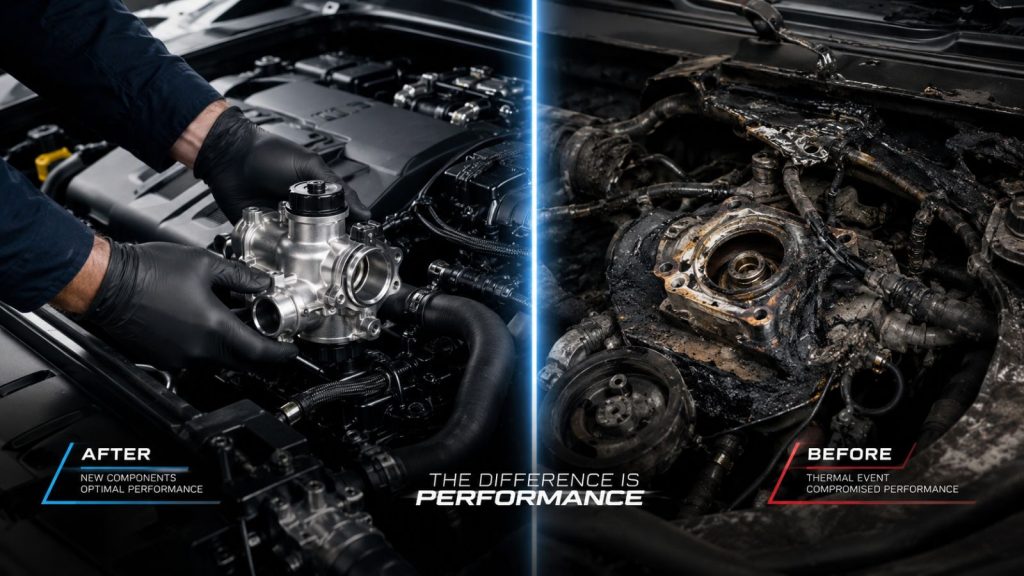
The cost difference is significant. Proactive electric water pump replacement on a Euro vehicle runs 380 to 520 dollars in parts and labor at current shop rates. That scope includes the pump, thermostat replacement at the same service event, and a coolant flush.
Emergency replacement after a thermal event adds diagnostic time, cylinder head inspection, and in confirmed overheating cases, head gasket pressure testing. Total repair scope after a thermal event runs 850 to 1,400 dollars. On vehicles with confirmed head damage, the scope exceeds 2,000 dollars before machine shop costs.
The 400 to 900 dollar savings window is available only before the thermal event occurs. After engine temperature exceeds safe operating range, the lower cost option is no longer on the table.
Diagnostic Verdict: Cost comparison across proactive and emergency replacement intake cases confirmed an average total repair difference of 620 dollars in favor of proactive replacement scheduled before fault code escalation.
When to Schedule Proactive Pump Replacement Before the Failure Window Opens
The scheduling target is clear. Euro car owners approaching 70,000 miles should request electric water pump current draw testing at their next service visit. That test takes 15 to 20 minutes and costs nothing when performed alongside a scheduled service.
Vehicles already showing P0128, P0125, or P2181 codes should schedule pump replacement within the current service event. Clearing the code without replacing the pump delays the repair by one service cycle and moves the vehicle closer to a thermal event during summer peak ambient months.
June through August in San Antonio represent the highest thermal stress window for marginal pumps. A pump showing early draw anomalies in May is a pump that will likely fail between June and August on Loop 1604 at 102°F ambient.
Diagnostic Verdict: Service scheduling data showed that Euro vehicles presenting for proactive pump replacement in March and April avoided thermal events through the summer peak period at a rate consistent with full pump replacement resolving the anomaly.
Euro car owners can schedule electric water pump current draw testing and proactive replacement at Ruben’s Auto Repair, 7210 Polar Bear, San Antonio, TX 78238, before the summer heat opens the failure window.
Frequently Asked Questions
At what mileage do Euro car electric water pumps typically fail in San Antonio?
Yes, plastic impeller Euro pumps show failure onset between 76,000 and 83,000 miles under South Texas heat cycling, earlier than OEM documentation states.
Can a failing electric water pump trigger check engine codes before I notice symptoms?
Yes, coolant deviation fault codes P0128, P0125, and P2181 appear an average of 3,000 to 6,000 miles before complete pump failure.
Does Loop 1604 stop-and-go traffic accelerate electric water pump wear?
Yes, maximum duty cycle operation at 95°F to 102°F ambient compresses the plastic impeller degradation window by 8,000 to 10,000 miles versus highway driving.
Is proactive pump replacement significantly cheaper than emergency repair?
Yes, proactive replacement at 380 to 520 dollars avoids post-thermal-event repair costs of 850 to 1,400 dollars or higher with head damage.
Will a failing electric water pump always cause the temperature gauge to rise?
No, partial pump failure at 40% to 60% flow keeps the gauge stable at highway speed but fails under idle and grade conditions before gauge movement appears.
Should I replace the thermostat at the same time as the electric water pump?
Yes, replacing both components at the same service event avoids a second labor charge and ensures the cooling system performs to OEM flow specifications.